hero media

Explore Spain’s Andalucían Mountains on horseback

Riding through the rustic charm of the Andalucían Mountains on horseback was a journey through the region’s rich history.

Traversing Andalucía’s Serranía de Ronda on horseback is definitely not on the well-worn tourist trail when it comes to Spain, yet here I am, riding a beautiful Hispano Arab named Acecho across ancient trails and hidden paths in a stunning part of the world.

Arriving at Ride Andalucía on a warm southern European winter’s morning, the horses are saddled and ready to go.

Karen, our experienced guide, has spent a lifetime working with horses.

The Andalucían Mountains region has a unique equine tradition.

The animals selected by the stables are born and bred in the mountains, and are sensible, intelligent, courageous and well trained. Acecho’s name is derived from the famous Bandolero horses and means ‘ambush’.

His lineage is a mix of the three oldest equine breeds, Arab, Andalucían and English TB. These are the most prolific bloodlines on the planet and have earned the nickname ‘Tres Sangres’ – three blood.

Much thought is given to matching horse and rider and guests are escorted by trilingual guides (English, Spanish and French) along ancient trails found for Karen by local horsemen, shepherds, gypsies, farmers and hunters.

The mountains of Andalucía have always been the perfect place for people to make themselves scarce in times of conflict. Fish merchants would also use the trails to carry goods from the coast to villages, mostly from Costa De Sol and the Straits of Gibraltar, travelling with mules in the coolness of night.

Smugglers transported silks and spices into the Andalucían hills, principally from Africa to Ronda, selling them to the Spanish nobility.

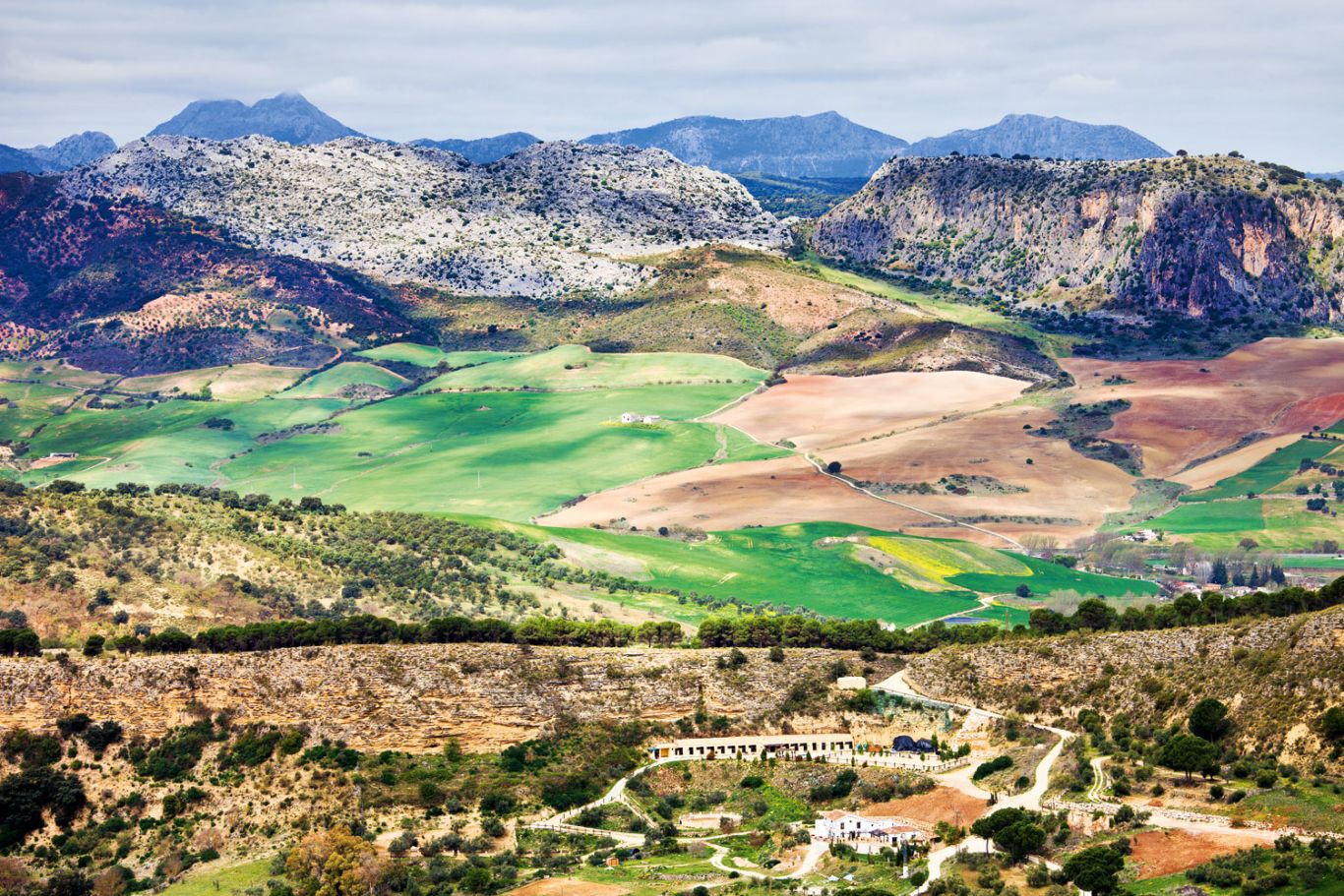
The sweeping views of the African coastline and the Mediterranean Sea are just spectacular, and the country we ride through changes constantly: from open countryside and rocky trails to steep mountain climbs and level pathways that can be cantered along.

The horses handle the trails with ease as we journey 1000 metres above sea level, along the edge of breathtaking gorges, where otters can be seen.

As our journey heads back towards the stables, we arrive at the charming village of Gaucín, with its whitewashed villas clinging to the edge of the mountainside.

Gaucín has a rich history: its cave paintings have withstood the test of time from the prehistoric era; Roman soldiers rested here after the battle between Julius Caesar and the sons of Pompey in 45BC; King Henry IV liberated it in 1457, before the Moorish population rebelled against the Catholic kings in the 16th century, killing soldiers and priests.

It was the Moors who gave Gaucín its modern name: ‘hard rock’.
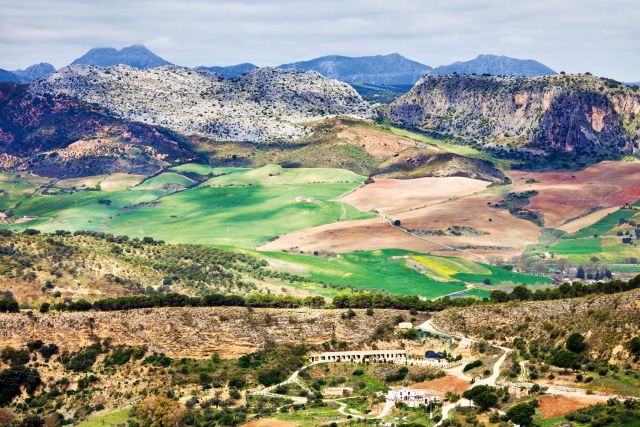
The fertile hills of Andalucía in Spain give way to mountains and their ancient trails.
The fertile hills of Andalucía give way to mountains and their ancient trails.

In 1713, nearby Gibraltar was ceded to the British and by the end of the century British Gibraltarians were making the trip to Gaucín to spend the summer months in the coolness of the mountains, as some still do today.

When the French invaded in 1808, during the Napoleonic Wars, 700 experienced mountain guerrillas tried futilely to defend the town’s castle, but the invaders slayed the citizens and destroyed the town.

This is when ‘bandolerismo’ became a career; bandoleros preyed on travellers and townsfolk, robbing and killing at liberty.

The town was captured by nationalists in 1936 during the Spanish Civil War and today the mountain retreat is an abundance of culture that refelects the rich tapestry of its past.

It is a place of tranquillity and natural beauty that has retained an authentic and charming village feel.

According to Karen, the thing she loves the most about her business is the allure of exploring and discovering the ancient trails and history of this fabulous countryside.

These rides have a real sense of adventure coupled with the unique appeal of riding locally bred horses, all while enjoying outstanding views of the Mediterranean Sea and beyond.

It’s something I will never forget, and I will definitely return here on my next journey to Spain.


Want to see more stories from International Traveller in your Google search results?

  1. Click here to set International Traveller as a preferred source.
  2. Tick the box next to "International Traveller". That's it.
hero media

What the European heatwave means for your summer travel plans

Temperatures are soaring this summer, breaking records across Europe and the UK. 

Euro summer is a feeling like no other. But when a heatwave hits? The dream trip quickly turns into a sweaty mess. Extreme heat is sweeping Europe and the UK this week, with record-high temperatures impacting travel plans across the continent.

And while Australian summers are typically hotter in absolute temperature, many European cities aren’t equipped for high temperatures, resulting in unbearable weather.

Why is it so hot in Europe?

Signs of a hot summer loomed in May, when the mercury hit unprecedented spring highs. Now, extreme high temperature warning alerts have been issued in countries such as Spain, Italy, France, England, the Netherlands and Germany.

France saw its hottest day on record on Wednesday, with an average temperature of 30°C across the day and night. This surpasses the average temperature for June, which is 15°C to 25°C. Dozens of people have died, including 40 from drowning.

In Spain, 212 deaths have been linked to the heatwave.

The UK recorded its hottest June day ever on Wednesday with temperatures soaring to 36.1°C. In an article published by the Met Office – the UK’s national meteorological service – Professor Stephen Belcher CBE, Met Office Chief Scientist, shared his concerns about June’s heat. “To see temperatures like this in the UK in June is sobering. Events like this bring home the implications of climate change, with very high temperatures and humidity bringing significant health implications from heat stress, as well as impacts to a range of sectors such as transport, energy and water supply,” he said.

Heatwaves are becoming increasingly common in Europe and the UK, neither of which is prepared for such extremes. The World Meteorological Organization reported that in 2025, at least 95% of Europe experienced above-average annual temperatures and that the continent was heating up twice as fast as the global average.

How travel is impacted

A pharmacy sign displaying 40 degrees Celcius
A pharmacy broadcasting local weather data. (Credit: Getty/Dragoncello)

During a heatwave, power grids, water systems and transport networks can be affected, resulting in disrupted itineraries for travellers. In France, power outages have left thousands without electricity and early closures have been implemented for two of Paris’s biggest attractions, the Eiffel Tower (early afternoon rather than late at night) and the Louvre (two hours early). Eurostar cancelled its London to Paris and Paris to London services from the 22nd to the 25th, and major UK rail companies have been advising travellers to avoid using trains where possible, or to travel during early hours.

If a heatwave is predicted, being flexible with your itinerary and having fully refundable/changeable tickets is key, as extreme heat can force the cancellation of outdoor activities, impact rail and flight services and change the opening hours of sites and eateries.

Why does summer in Europe often feel hotter than summer in Australia?

people swimming in the Canal Saint-Martin in Paris
People swimming in the Canal Saint-Martin in Paris to cool off. (Credit: Rachael Thompson)

With some of the highest UV levels in the world, Australians are no strangers to the heat, adapting well to intense weather. But our infrastructure is largely equipped to withstand soaring temperatures with climate-responsive passive design, refrigerated air conditioning or evaporative coolers, as well as swimming spots aplenty.

Buildings in Northern and Western Europe and the UK, however, are constructed to retain heat and handle frosty winters. The lack of universal air conditioning means it generally feels hotter even though the temperature on your app might not look it. During a heatwave, it can feel like you’re in a sauna as cities act like heat traps.

How to stay cool and prepare for another heatwave

Relief is expected across Europe and the UK later this week, but more heatwaves are still possible in the coming months. Summer heat typically peaks in July and August.

Public transport often doesn’t have air conditioning, and buses in particular can be swelteringly hot. If you’re heading outside or your accommodation has no air conditioning, it’s worth buying a spray bottle and a handheld fan from a pharmacy or tourist stand. Check ahead of time if restaurants and cafes have air conditioning and make a booking in advance. The highest temperatures typically hit between 3pm and 6pm, so aim to head outdoors outside of these hours.

Rising temperatures invite travellers to enter a more intentional era of seeing the world. Now more than ever is the time to embrace lower-impact “coolcations” and off-season getaways.

Spain's Andalucían Mountains on horseback - International Traveller