hero media

Review: Hotel SP34, Copenhagen

Cindy Bingley-Pullin is so enamoured by bolthole hotel SP34 in the Danish capital that she finds it hard to leave.

Denmark has topped the World Happiness Report three times since 2012, which may have much to do with hygge (pronounced hoo-ga); a Danish word with Norweigan roots that translates to cosiness, contentment and wellbeing. It refers to the unique way that the locals have of enjoying life’s little pleasures.

My sister and I are in Copenhagen to experience a weekend of hygge – our version of which involves wandering the streets of this appealing city, indulging in wholesome, hearty meals, and finding somewhere to sleep that defines the Scandinavian aesthetic the region is so well known for.

Research on ‘stylish Scandi stays’ leads us to Hotel SP34, and while its name may be an unimaginative abbreviation of its address, it’s far from bland.

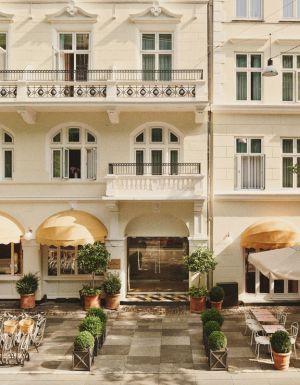
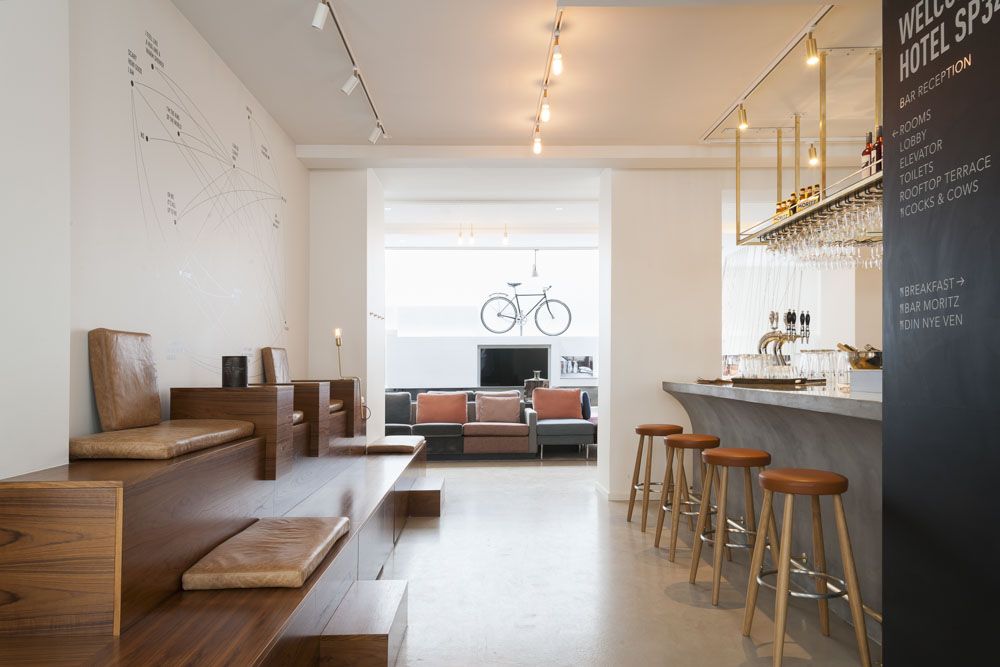
Positioned on a quiet street parallel to one of the city’s main roads, its unassuming entrance belies what’s inside. Everything about the place oozes warmth. Timber accents and minimalist lighting set off an inviting space of white walls and polished concrete floors, furnished with soft-cushioned lounges, tan chairs and tulip side tables.

Creative quirks include a bicycle displayed as art, a waif-like cactus in a terracotta pot, and a ‘Choose your own adventure’ wall of tongue-in-cheek expressions.

The hotel lobby bar doubles as reception, where flaxen-haired millennials, dressed in a funky uniform of what looks like black silk pyjamas, cheerfully hand out room key cards and scrawl directions on paper maps for guests.

Check-in is seamless; and our accommodation in a ‘Superior Comfort Room’ is relatively spacious and supremely comfortable with classic Scandinavian interiors: leather-backed wooden chairs, parquet floors, and elongated windows that let in abundant natural light.

There is plenty to smile about with this hotel. The breakfast buffet is a bountiful spread of fruits, pastries, cereals, cold cuts, cheeses and other ingredients to create our own smørrebrød (open rye sandwiches), and almost everything served is organic. Bottomless glasses of bubbly are even included in the price but for those who don’t want to splurge on brekkie, complimentary coffee and croissants are on offer at reception from 6am to 11am daily.

To kick off evenings, there is a free ‘wine hour’, where decent bottles of red and white are poured for guests to enjoy while mingling or chilling in the communal lounge area. A lovely way to get toasty before heading out for dinner!

We take advantage of the hotel’s location in the hip Latin Quarter and venture out to recommended restaurants nearby; but with 24-hour room service, three on-site dining venues, the convivial aforementioned lobby bar and an al fresco rooftop bar (open during the warmer months), there is hardly the need to eat or drink out at all. The in-house cinema – nightly movie screenings, velvety red seats and a snack buffet – offers another reason to stay in.

Hotel SP34 epitomises everything that is to love about Nordic culture. Cool yet cosy, simple yet sassy, it brims with an atmosphere of welcome – a place where life’s simple pleasures are enhanced and savoured.


Details: Hotel SP34, Copenhagen

Sankt Peders Stræde 34, 1453 Copenhagen, Denmark.

The IT Verdict: Delightfully Danish in design and spirit, Hotel SP34 is a boutique bolthole that is beautifully put together; it perfectly captures hygge.

Location: 8.5 / 10 A peaceful yet central location, it is an easy stroll, cycle or public transport ride to most of Copenhagen’s famous attractions.

Style/character: 9 / 10 Design conscious, with common spaces that encourage connecting with guests (think the daily free ‘wine hour’).

Service: 9 / 10 Efficient and unpretentious, yet effortlessly cool.

Rooms: 9 / 10 Comfy yet chic rooms that run the spectrum from snug to large, accommodating all budgets.

Food and drink: 8.5 / 10 Nordic dining, burgers, cocktails, and the nation’s largest port wine bar are all available here. Breakfast is a highlight.

Value for money: 9 / 10 For $304 per night with breakfast, you get a host of standard freebies, trendy vibes without the attitude, and definite bang for your buck.


All IT reviews are conducted anonymously and our writers pay their own way – so we experience exactly what you would.

Want to see more stories from International Traveller in your Google search results?

  1. Click here to set International Traveller as a preferred source.
  2. Tick the box next to "International Traveller". That's it.
hero media

What the European heatwave means for your summer travel plans

Temperatures are soaring this summer, breaking records across Europe and the UK. 

Euro summer is a feeling like no other. But when a heatwave hits? The dream trip quickly turns into a sweaty mess. Extreme heat is sweeping Europe and the UK this week, with record-high temperatures impacting travel plans across the continent.

And while Australian summers are typically hotter in absolute temperature, many European cities aren’t equipped for high temperatures, resulting in unbearable weather.

Why is it so hot in Europe?

Signs of a hot summer loomed in May, when the mercury hit unprecedented spring highs. Now, extreme high temperature warning alerts have been issued in countries such as Spain, Italy, France, England, the Netherlands and Germany.

France saw its hottest day on record on Wednesday, with an average temperature of 30°C across the day and night. This surpasses the average temperature for June, which is 15°C to 25°C. Dozens of people have died, including 40 from drowning.

In Spain, 212 deaths have been linked to the heatwave.

The UK recorded its hottest June day ever on Wednesday with temperatures soaring to 36.1°C. In an article published by the Met Office – the UK’s national meteorological service – Professor Stephen Belcher CBE, Met Office Chief Scientist, shared his concerns about June’s heat. “To see temperatures like this in the UK in June is sobering. Events like this bring home the implications of climate change, with very high temperatures and humidity bringing significant health implications from heat stress, as well as impacts to a range of sectors such as transport, energy and water supply,” he said.

Heatwaves are becoming increasingly common in Europe and the UK, neither of which is prepared for such extremes. The World Meteorological Organization reported that in 2025, at least 95% of Europe experienced above-average annual temperatures and that the continent was heating up twice as fast as the global average.

How travel is impacted

A pharmacy sign displaying 40 degrees Celcius
A pharmacy broadcasting local weather data. (Credit: Getty/Dragoncello)

During a heatwave, power grids, water systems and transport networks can be affected, resulting in disrupted itineraries for travellers. In France, power outages have left thousands without electricity and early closures have been implemented for two of Paris’s biggest attractions, the Eiffel Tower (early afternoon rather than late at night) and the Louvre (two hours early). Eurostar cancelled its London to Paris and Paris to London services from the 22nd to the 25th, and major UK rail companies have been advising travellers to avoid using trains where possible, or to travel during early hours.

If a heatwave is predicted, being flexible with your itinerary and having fully refundable/changeable tickets is key, as extreme heat can force the cancellation of outdoor activities, impact rail and flight services and change the opening hours of sites and eateries.

Why does summer in Europe often feel hotter than summer in Australia?

people swimming in the Canal Saint-Martin in Paris
People swimming in the Canal Saint-Martin in Paris to cool off. (Credit: Rachael Thompson)

With some of the highest UV levels in the world, Australians are no strangers to the heat, adapting well to intense weather. But our infrastructure is largely equipped to withstand soaring temperatures with climate-responsive passive design, refrigerated air conditioning or evaporative coolers, as well as swimming spots aplenty.

Buildings in Northern and Western Europe and the UK, however, are constructed to retain heat and handle frosty winters. The lack of universal air conditioning means it generally feels hotter even though the temperature on your app might not look it. During a heatwave, it can feel like you’re in a sauna as cities act like heat traps.

How to stay cool and prepare for another heatwave

Relief is expected across Europe and the UK later this week, but more heatwaves are still possible in the coming months. Summer heat typically peaks in July and August.

Public transport often doesn’t have air conditioning, and buses in particular can be swelteringly hot. If you’re heading outside or your accommodation has no air conditioning, it’s worth buying a spray bottle and a handheld fan from a pharmacy or tourist stand. Check ahead of time if restaurants and cafes have air conditioning and make a booking in advance. The highest temperatures typically hit between 3pm and 6pm, so aim to head outdoors outside of these hours.

Rising temperatures invite travellers to enter a more intentional era of seeing the world. Now more than ever is the time to embrace lower-impact “coolcations” and off-season getaways.

Review: Hotel SP34, Copenhagen | International Traveller