hero media

Is this Wes Anderson-style hotel Copenhagen’s coolest stay?

The sustainably-minded Hotel Bella Grande is officially Copenhagen’s “it" hotel.

Copenhagen epitomises effortless cool, seamlessly blending a wealth of design stores, laidback fashion, outstanding food and an eco-conscious mindset. And the accommodation that ticks all the boxes? Hotel Bella Grande. Centrally located, this design-led accommodation celebrates Scandi meets Italian grandeur with lashings of colour and pattern that make it one of the city’s most distinctive stays.

I recently checked into the boutique hotel and found myself at the whim of its Wes Anderson-style charm. Here’s everything you need to know before booking a stay.

Location
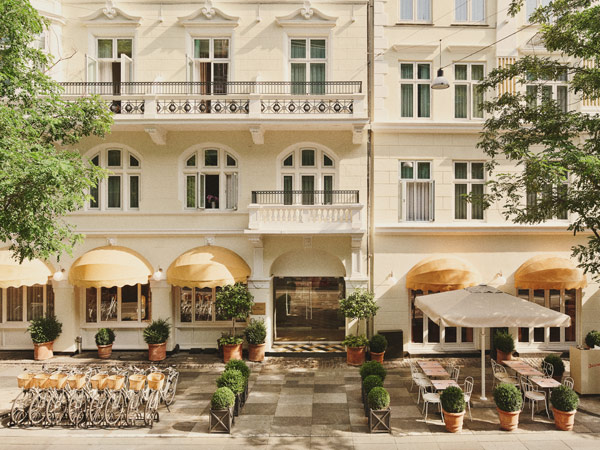
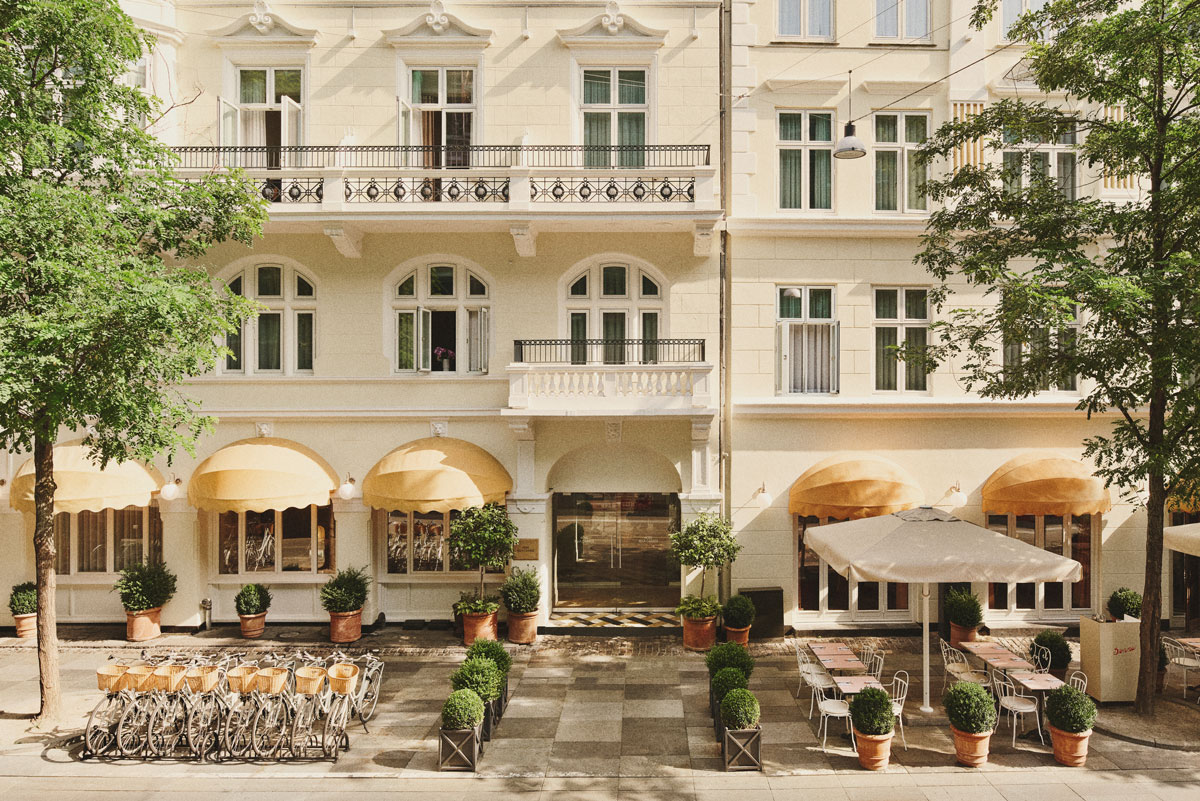
the front exterior of Hotel Bella Grande
The stylish boutique hotel puts you in the heart of Copenhagen.

Hotel Bella Grande is nestled on a quiet street in Copenhagen’s Old Town. Steps from the City Hall Square, this area is lively yet safe, walkable and full of classic Danish charm. You’re placed within walking distance of popular sites such as the colourful buildings of Nyhavn, Tivoli Gardens, Rosenborg Castle, and the Strøget shopping district.

For those not cycling or looking to explore further afield, you’ll find Copenhagen’s train system easily navigable, and Rådhuspladsen train station is also steps away.

Style and character
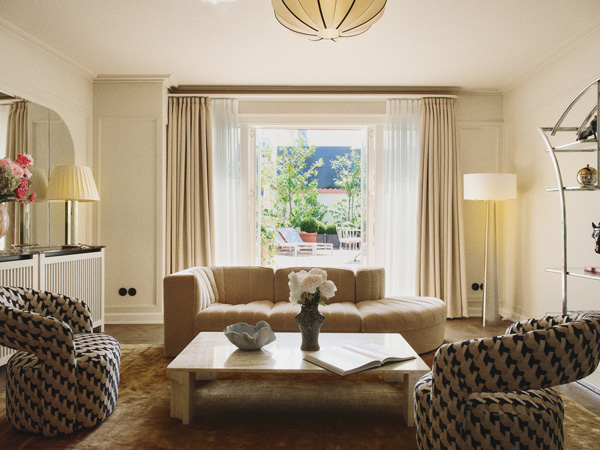
the living room interior of Hotel Bella Grande
Timeless charm meets modern elegance.

Directed by Cofoco, local interior architect and graphic design agency TONEN executed the transformation of a historic 1899 building into a charming Venetian palazzo that blends nostalgic romance with modern elegance. Guests are greeted by a pastel yellow facade elevated with curved awnings and the building’s original, delicately sculpted mouldings. Inside, the reception area echoes the concierge in Wes Anderson’s The Grand Budapest Hotel, with red-tasselled room keys displayed on the wall. The refreshed interiors hero a warm palette of pinks and creams complemented with bold geometric and floral patterns that add theatrical flair. Furniture blends mid-century Scandinavian simplicity with romantic Italian flourishes.

At the heart of the accommodation is a striking central atrium with a charming courtyard, encircled by guest rooms. This is Italian Palazzo style ramped up – climbing greenery, checkered terrazzo floors, and soft blush pink tones.
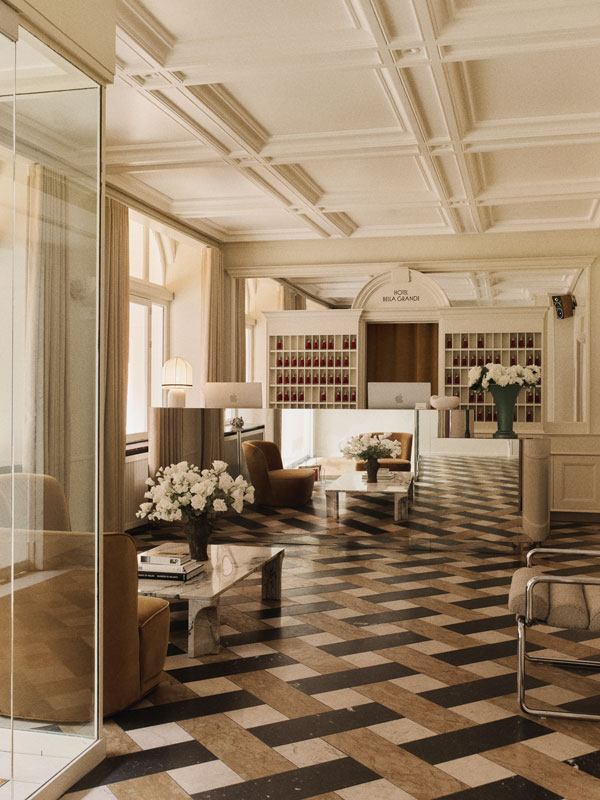
a look inside the lobby of Hotel Bella Grande
The lobby channels The Grand Budapest Hotel, with red-tasselled room keys displayed on the wall.

The designers spared no detail, even in the onsite gym, which features parquet flooring, forest green walls, and state-of-the-art equipment.

Cycling around the city is undeniably the most enjoyable way to get around and Hotel Bella Grande has bikes with baskets available to hire for 185 DKK per day.

Rooms
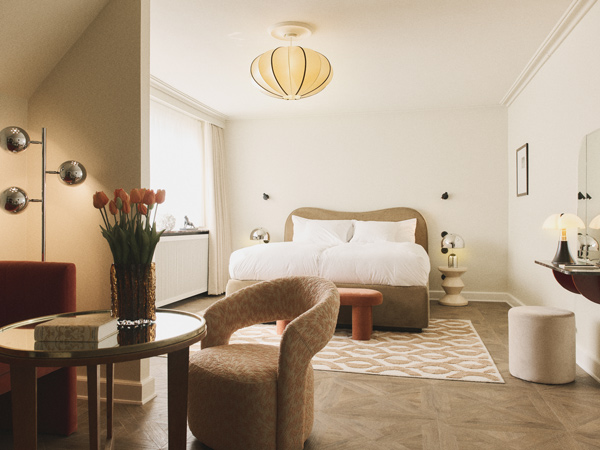
the suite interior at Hotel Bella Grande
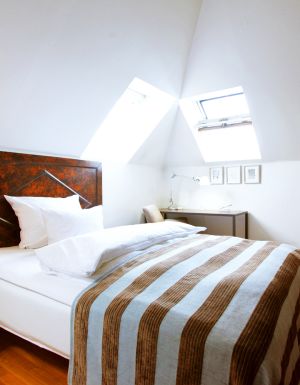
Rooms take on a more subdued palette than public spaces.

109 rooms and suites range from the cosy single – a nice option in a luxury hotel – to the lavish suite with a private rooftop terrace. I stayed in a Superior Double, which struck a perfect balance between style and comfort and featured large, street-facing windows. I particularly liked the red and white tiled bathroom and the Scandi sleep method of bedding, which gives sleepers separate duvets. A steamer was another welcome addition.

It’s worth noting that 24 of the 109 rooms face the enclosed courtyard rather than the street, which can limit access to fresh air (there is ventilation) and increased noise.

Food & Drink
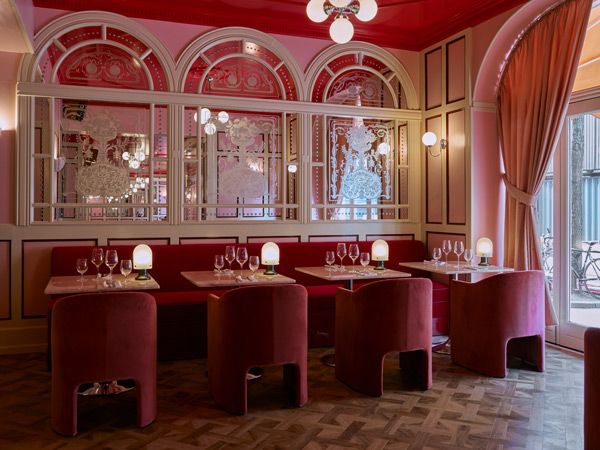
the restaurant Donna in Hotel Bella Grande
Enjoy classic Italian fare in the opulent red and pink-swathed dining space.

On-site restaurant Donna has become somewhat of a hotspot in Copenhagen, and for good reason. There are several areas to enjoy the restaurant’s classic Italian fare: the courtyard, the opulent red-and-pink swathed galley-style space, the sumptuous cocktail lounge and the alfresco space out front. Begin your feast with arancini and focaccia with whipped ricotta, followed by rigatoni alla vodka and deep-fried aubergine with tomato sauce, capers, basil and Parmesan. Finishing with tirismu is a must.

For ultimate summer vibes, I recommend sitting outside under one of the umbrellas and ordering a  Margherita with a Zola Spritz (or two).

Sustainability
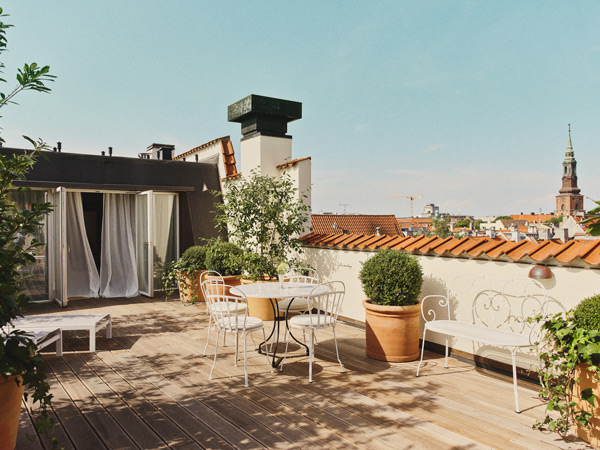
a private rooftop terrace at Hotel Bella Grande
A slice of la dolce vita tucked into Copenhagen’s Old Town.

Sustainability is central to Hotel Bella Grande’s ethos. As part of Cofoco – a leading Danish hospitality group powering its 20 venues with a dedicated six-hectare solar farm – the hotel operates on 100 per cent renewable electricity from Cofoco’s solar park.

I did note the absence of air conditioning and in-room fridge; however, understanding the hotel’s commitment to environmental responsibility, these omissions make sense, further reinforcing their sustainable approach.

Weekly travel news, experiences
insider tips, offers,
and more.

Does Hotel Bella Grande have access for guests with disabilities?

The hotel entrance and bathrooms have a step, which makes this hotel unsuitable for guests with mobility impairments.

Is Hotel Bella Grande family-friendly?

facade of Hotel Bella Grande with many windows
TONEN transformed the historic building into a charming Venetian palazzo.

Hotel Bella Grande has family rooms, which feature a double bed and bunk beds in an adjoining room.

Details

Best for: Design-savvy travellers.

Address: Vester Voldgade 23, 1552 København V, Denmark

Rate: From 1.495 DKK per night.

Want to see more stories from International Traveller in your Google search results?

  1. Click here to set International Traveller as a preferred source.
  2. Tick the box next to "International Traveller". That's it.
Rachael Thompson
Rachael Thompson is a freelance travel journalist, editor and hotel addict based in the UK. She was formerly International Traveller's Evergreen Editor and was responsible for the foundational content ahead of its website relaunch, as well as managing and growing the brand’s destination guides. With a background in design and travel media, Rachael is dedicated to creating content that is as much informational as it is beautiful. She began her career at Belle magazine, before taking up editorial roles at Homes to Love and Bed Threads. Next on her travel wish list is Malta.
View profile and articles
hero media

What the European heatwave means for your summer travel plans

Temperatures are soaring this summer, breaking records across Europe and the UK. 

Euro summer is a feeling like no other. But when a heatwave hits? The dream trip quickly turns into a sweaty mess. Extreme heat is sweeping Europe and the UK this week, with record-high temperatures impacting travel plans across the continent.

And while Australian summers are typically hotter in absolute temperature, many European cities aren’t equipped for high temperatures, resulting in unbearable weather.

Why is it so hot in Europe?

Signs of a hot summer loomed in May, when the mercury hit unprecedented spring highs. Now, extreme high temperature warning alerts have been issued in countries such as Spain, Italy, France, England, the Netherlands and Germany.

France saw its hottest day on record on Wednesday, with an average temperature of 30°C across the day and night. This surpasses the average temperature for June, which is 15°C to 25°C. Dozens of people have died, including 40 from drowning.

In Spain, 212 deaths have been linked to the heatwave.

The UK recorded its hottest June day ever on Wednesday with temperatures soaring to 36.1°C. In an article published by the Met Office – the UK’s national meteorological service – Professor Stephen Belcher CBE, Met Office Chief Scientist, shared his concerns about June’s heat. “To see temperatures like this in the UK in June is sobering. Events like this bring home the implications of climate change, with very high temperatures and humidity bringing significant health implications from heat stress, as well as impacts to a range of sectors such as transport, energy and water supply,” he said.

Heatwaves are becoming increasingly common in Europe and the UK, neither of which is prepared for such extremes. The World Meteorological Organization reported that in 2025, at least 95% of Europe experienced above-average annual temperatures and that the continent was heating up twice as fast as the global average.

How travel is impacted

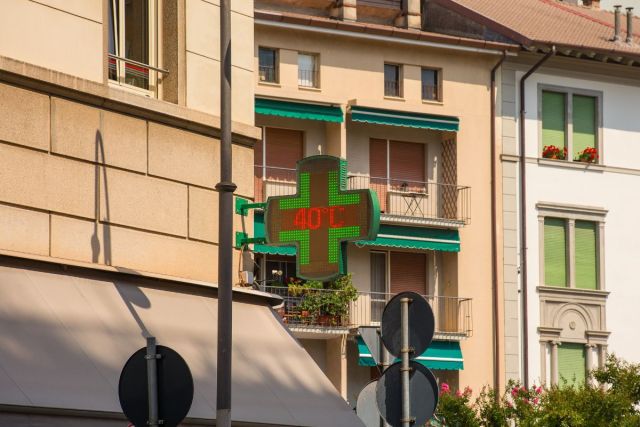
A pharmacy sign displaying 40 degrees Celcius
A pharmacy broadcasting local weather data. (Credit: Getty/Dragoncello)

During a heatwave, power grids, water systems and transport networks can be affected, resulting in disrupted itineraries for travellers. In France, power outages have left thousands without electricity and early closures have been implemented for two of Paris’s biggest attractions, the Eiffel Tower (early afternoon rather than late at night) and the Louvre (two hours early). Eurostar cancelled its London to Paris and Paris to London services from the 22nd to the 25th, and major UK rail companies have been advising travellers to avoid using trains where possible, or to travel during early hours.

If a heatwave is predicted, being flexible with your itinerary and having fully refundable/changeable tickets is key, as extreme heat can force the cancellation of outdoor activities, impact rail and flight services and change the opening hours of sites and eateries.

Why does summer in Europe often feel hotter than summer in Australia?

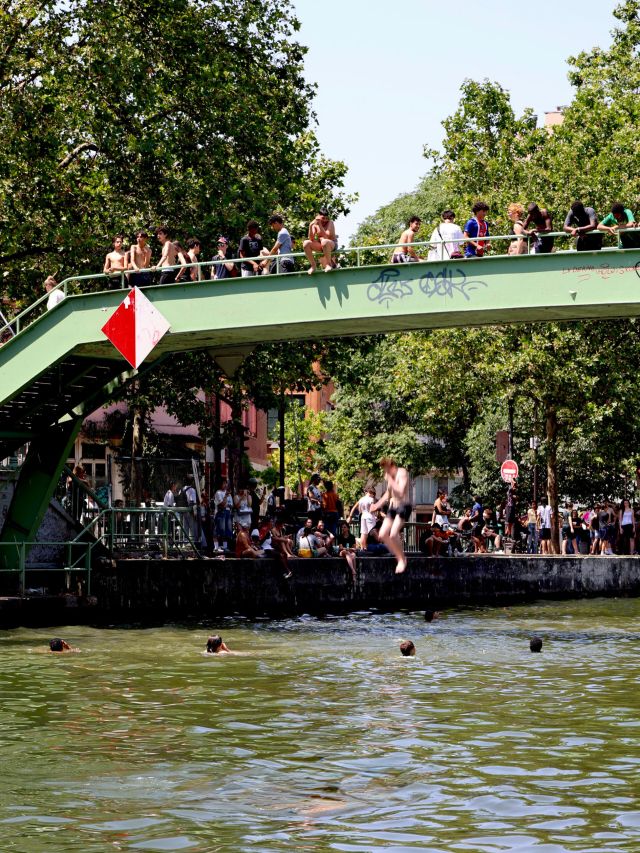
people swimming in the Canal Saint-Martin in Paris
People swimming in the Canal Saint-Martin in Paris to cool off. (Credit: Rachael Thompson)

With some of the highest UV levels in the world, Australians are no strangers to the heat, adapting well to intense weather. But our infrastructure is largely equipped to withstand soaring temperatures with climate-responsive passive design, refrigerated air conditioning or evaporative coolers, as well as swimming spots aplenty.

Buildings in Northern and Western Europe and the UK, however, are constructed to retain heat and handle frosty winters. The lack of universal air conditioning means it generally feels hotter even though the temperature on your app might not look it. During a heatwave, it can feel like you’re in a sauna as cities act like heat traps.

How to stay cool and prepare for another heatwave

Relief is expected across Europe and the UK later this week, but more heatwaves are still possible in the coming months. Summer heat typically peaks in July and August.

Public transport often doesn’t have air conditioning, and buses in particular can be swelteringly hot. If you’re heading outside or your accommodation has no air conditioning, it’s worth buying a spray bottle and a handheld fan from a pharmacy or tourist stand. Check ahead of time if restaurants and cafes have air conditioning and make a booking in advance. The highest temperatures typically hit between 3pm and 6pm, so aim to head outdoors outside of these hours.

Rising temperatures invite travellers to enter a more intentional era of seeing the world. Now more than ever is the time to embrace lower-impact “coolcations” and off-season getaways.