hero media

Jungfrau railway; the most magnificent views of the Alps

Mark Daffey discovers the Jungfrau railway takes you to the top of the Alps and the most breathtaking vistas in Switzerland; all without breaking a sweat.


An elderly man in hiking boots has just made it up the side of a mountain ahead of me. Like me, there isn’t a bead of sweat on him – not bad, considering we’ve just climbed 1400 metres in 52 minutes.

But then we didn’t hike up; we caught a train.

Both of us have the same idea – to hike from Schynige Platte to First – and we are getting to our starting point the same way too, on the country’s oldest cog (or rack) railway.

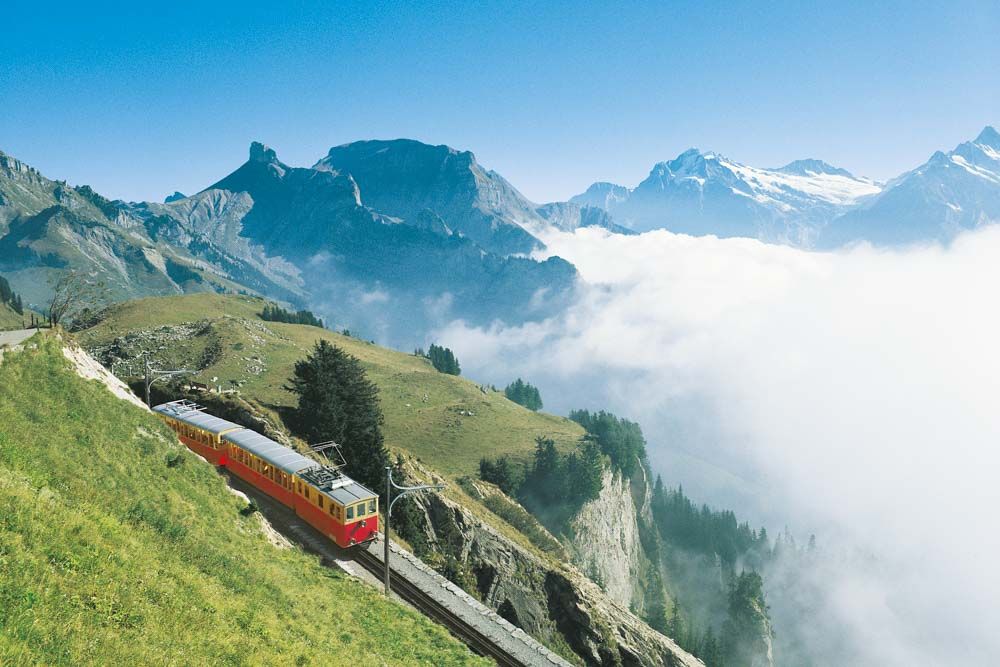
The Schynige Platte Railway has been rattling up the mountain from Wilderswil, near Interlaken, for more than 120 years. Today the railway is electrified, but when it first opened in May 1893 it used steam traction to power its way uphill.

Little has changed otherwise. Two carriages containing timber bench seats are connected to an electric rack locomotive that always operates at the lower end of the train, pushing it uphill and leading it down.
 

travel Switzerland train
The Schynige Platte Railway has been in operation for more than 120 years.


The old man was seated a few rows in front of me, which is why he made it to the top first. Not that I care; this was a novel way of getting to where I wanted to go anyway.

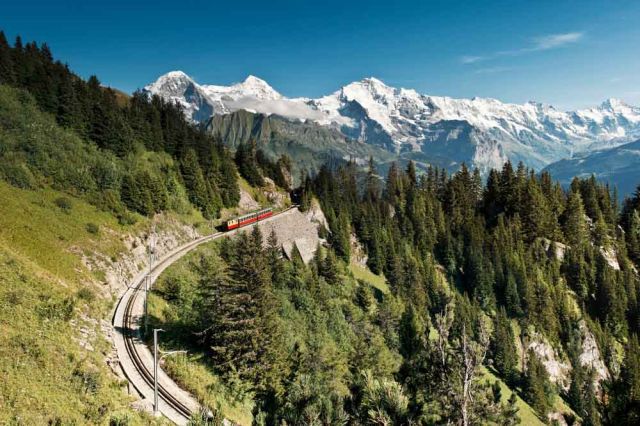
From Wilderswil, we cross the Lütschine River before our red rattler commences its climb uphill. Forests obscure the views back down the valley until the trees give way to lush alpine pastures.

By this stage, the twin lakes of Brienz and Thun are far below, cradling the tourist hub of Interlaken between them. But it’s on the final stretch where we are really wowed.

The Swiss Alps practically smack you in the face at times, they’re that close.

Here, on top of a ridgeline that forms the backbone of the Schwartzkorn Range in the Bernese Oberland, the 4000-metre peaks of the Eiger, Mönch and Jungfrau stretch towards the heavens.

Snow crowns their summits year-round, while glistening glaciers that were once mined so that Parisian socialites could cool their cocktails tumble from their peaks. Over the ridge, snaking for 23 kilometres, is Europe’s longest glacier.

Jungfrau Railways operates the Schynige Platte line, and if I squint I might be able to make out another of theirs, the railway line from Kleine Scheidegg to Jungfraujoch-Top of Europe, Europe’s highest altitude station.

Even more than the Schynige Platte line, this is one amazing feat of engineering. And persistence.

Despite numerous setbacks – both physical and financial – those responsible for constructing this line managed to burrow seven of its nine-kilometre stretch through the solid rock of the Eiger.

They also managed to incorporate two stations along the way, with windows out over the Grindelwald Valley. But that’s for another day.

It’s hiking I’ve come here to do, and for the rest of the day I walk past gushing waterfalls, through meadows filled with wildflowers and over mountain passes.

I eventually reach a gondola that ferries me back down the valley to Grindelwald and my hotel for the night.

All without breaking a sweat

Want to see more stories from International Traveller in your Google search results?

  1. Click here to set International Traveller as a preferred source.
  2. Tick the box next to "International Traveller". That's it.
hero media

What the European heatwave means for your summer travel plans

Temperatures are soaring this summer, breaking records across Europe and the UK. 

Euro summer is a feeling like no other. But when a heatwave hits? The dream trip quickly turns into a sweaty mess. Extreme heat is sweeping Europe and the UK this week, with record-high temperatures impacting travel plans across the continent.

And while Australian summers are typically hotter in absolute temperature, many European cities aren’t equipped for high temperatures, resulting in unbearable weather.

Why is it so hot in Europe?

Signs of a hot summer loomed in May, when the mercury hit unprecedented spring highs. Now, extreme high temperature warning alerts have been issued in countries such as Spain, Italy, France, England, the Netherlands and Germany.

France saw its hottest day on record on Wednesday, with an average temperature of 30°C across the day and night. This surpasses the average temperature for June, which is 15°C to 25°C. Dozens of people have died, including 40 from drowning.

In Spain, 212 deaths have been linked to the heatwave.

The UK recorded its hottest June day ever on Wednesday with temperatures soaring to 36.1°C. In an article published by the Met Office – the UK’s national meteorological service – Professor Stephen Belcher CBE, Met Office Chief Scientist, shared his concerns about June’s heat. “To see temperatures like this in the UK in June is sobering. Events like this bring home the implications of climate change, with very high temperatures and humidity bringing significant health implications from heat stress, as well as impacts to a range of sectors such as transport, energy and water supply,” he said.

Heatwaves are becoming increasingly common in Europe and the UK, neither of which is prepared for such extremes. The World Meteorological Organization reported that in 2025, at least 95% of Europe experienced above-average annual temperatures and that the continent was heating up twice as fast as the global average.

How travel is impacted

A pharmacy sign displaying 40 degrees Celcius
A pharmacy broadcasting local weather data. (Credit: Getty/Dragoncello)

During a heatwave, power grids, water systems and transport networks can be affected, resulting in disrupted itineraries for travellers. In France, power outages have left thousands without electricity and early closures have been implemented for two of Paris’s biggest attractions, the Eiffel Tower (early afternoon rather than late at night) and the Louvre (two hours early). Eurostar cancelled its London to Paris and Paris to London services from the 22nd to the 25th, and major UK rail companies have been advising travellers to avoid using trains where possible, or to travel during early hours.

If a heatwave is predicted, being flexible with your itinerary and having fully refundable/changeable tickets is key, as extreme heat can force the cancellation of outdoor activities, impact rail and flight services and change the opening hours of sites and eateries.

Why does summer in Europe often feel hotter than summer in Australia?

people swimming in the Canal Saint-Martin in Paris
People swimming in the Canal Saint-Martin in Paris to cool off. (Credit: Rachael Thompson)

With some of the highest UV levels in the world, Australians are no strangers to the heat, adapting well to intense weather. But our infrastructure is largely equipped to withstand soaring temperatures with climate-responsive passive design, refrigerated air conditioning or evaporative coolers, as well as swimming spots aplenty.

Buildings in Northern and Western Europe and the UK, however, are constructed to retain heat and handle frosty winters. The lack of universal air conditioning means it generally feels hotter even though the temperature on your app might not look it. During a heatwave, it can feel like you’re in a sauna as cities act like heat traps.

How to stay cool and prepare for another heatwave

Relief is expected across Europe and the UK later this week, but more heatwaves are still possible in the coming months. Summer heat typically peaks in July and August.

Public transport often doesn’t have air conditioning, and buses in particular can be swelteringly hot. If you’re heading outside or your accommodation has no air conditioning, it’s worth buying a spray bottle and a handheld fan from a pharmacy or tourist stand. Check ahead of time if restaurants and cafes have air conditioning and make a booking in advance. The highest temperatures typically hit between 3pm and 6pm, so aim to head outdoors outside of these hours.

Rising temperatures invite travellers to enter a more intentional era of seeing the world. Now more than ever is the time to embrace lower-impact “coolcations” and off-season getaways.