hero media

Automobile adventures, driving in Switzerland

In a country where taking the train has been elevated to glorious heights (no pun intended), Leigh-Ann Pow takes the road less travelled by driving in Switzerland.

Switzerland’s train system is legendary; indeed it is how most people get around when discovering the country. So the fact that I will be seeing most of it from behind the wheel of a car almost feels like a subversion.

But my rebelliousness is government sanctioned; the aptly named Grand Tour of Switzerland is a big focus for those charged with luring travellers to these parts, with dedicated maps of the route and fun photo-op signposts along the way.

While the Grand Tour allows you to crisscross the country this way and that, taking in lovely cities, picture-postcard towns, verdant countryside dotted with chalets and cows, and imposing mountains, I am driving a relatively direct route from Vevey in the west to Zurich in the east.

The first leg of my journey (144 kilometres) from Vevey deposits me in the delightful tourist town of Interlaken just after lunch.

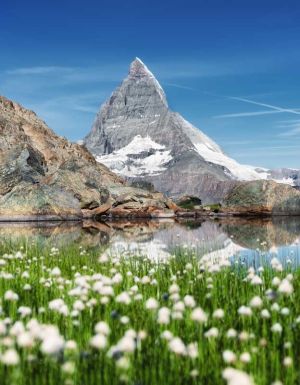
The sun is shining and the imposing trio of mountains that dominates the horizon – the Eiger, Mönch and Jungfrau – lend the location a sense of drama.

One of the best ways to take it all in is from the top of Harder Kulm, Interlaken’s local mountain some 1322 metres above sea level.

It is possible to hike it, but I opt for the 10-minute funicular railway journey instead, and end up standing at a breathtaking lookout platform that juts out from the mountain, awestruck by nature’s vast scale and beauty.

There’s time to sit in the late afternoon sunshine at the little restaurant that’s perched here, enjoying a drink and some local cold meats and cheese.

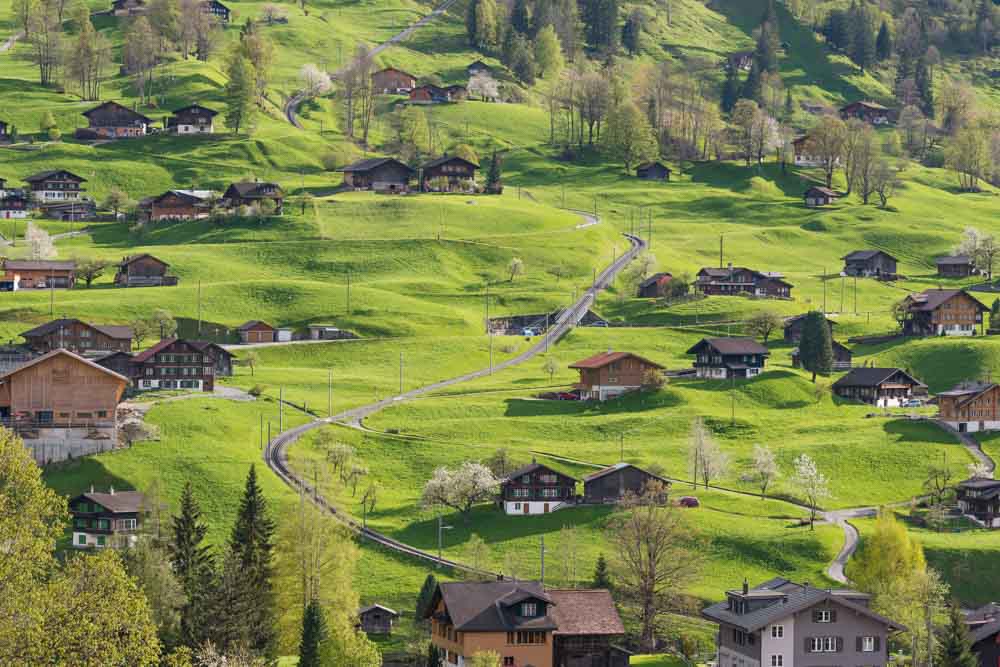
An easy 19 kilometres up the road from Interlaken is Grindelwald, a delightful little town with geranium-festooned chalet houses scattered across its green pastures and sloping mountainside, at the base of the hulking form of the Eiger.

I spend the next day atop the Grindelwald First, a much smaller summit by comparison with its neighbours but still suitably imposing.

Leaving Grindelwald behind I set off for Bern, some 75 kilometres away, along backroads carved through bucolic cow pastures dotted with traditional farmhouses and punctuated by quiet little villages.

Arriving into Bern is completely stress-free, with clear signposting and relatively light traffic (as with many European cities, bikes play a big part in keeping the number of cars on the streets at a pleasant level).

I wander the cobbled medieval streets and find a seat in a cafe amongst the locals (and their dogs, who snooze under almost every second table).

Back in the lush countryside, this time on my way to Lucerne (109 kilometres away) the road returns to the gentle pattern of cows, farmhouses and towns.

My route today passes by the Emmentaler Schaukaeserei, a show dairy where you can see cheese being made in traditional fashion, and through the UNESCO Biosphere Entlebuch, a natural nirvana spread over 400 pristine square-kilometres.

I easily find parking in Lucerne and set out to explore. Lucerne is often described as a fairytale city, but fairytales would be lucky to look this lovely. I stay for a few days to really make the most of all there is to see.

Back behind the wheel again, the road skirts the edge of Lake Lucerne, giving an idea of its impressive size. I happily cruise along on unhurried roads that I often have all to myself, before arriving into the town of Einsiedeln after about 90 minutes.

The drawcard here is the Baroque abbey with its opulently busy ceilings and library packed with thousands of historic tomes.

The last 40-kilometre leg of my Grand Tour experience is along Lake Zurich, with intermittent towns slowly morphing into the outskirts of the city.

Zurich is another wonderfully manageable city largely devoid of the kind of urban sprawl and gridlock that are the first impressions of many other cities.

This marks the end of my Grand Tour, and after days of driving I not only feel like I have seen some of the best bits of the country, but that I’ve had the flexibility and self determination to really experience them.


Get your European Roadtrip started with Peugeot Europe

Want to see more stories from International Traveller in your Google search results?

  1. Click here to set International Traveller as a preferred source.
  2. Tick the box next to "International Traveller". That's it.
hero media

What the European heatwave means for your summer travel plans

Temperatures are soaring this summer, breaking records across Europe and the UK. 

Euro summer is a feeling like no other. But when a heatwave hits? The dream trip quickly turns into a sweaty mess. Extreme heat is sweeping Europe and the UK this week, with record-high temperatures impacting travel plans across the continent.

And while Australian summers are typically hotter in absolute temperature, many European cities aren’t equipped for high temperatures, resulting in unbearable weather.

Why is it so hot in Europe?

Signs of a hot summer loomed in May, when the mercury hit unprecedented spring highs. Now, extreme high temperature warning alerts have been issued in countries such as Spain, Italy, France, England, the Netherlands and Germany.

France saw its hottest day on record on Wednesday, with an average temperature of 30°C across the day and night. This surpasses the average temperature for June, which is 15°C to 25°C. Dozens of people have died, including 40 from drowning.

In Spain, 212 deaths have been linked to the heatwave.

The UK recorded its hottest June day ever on Wednesday with temperatures soaring to 36.1°C. In an article published by the Met Office – the UK’s national meteorological service – Professor Stephen Belcher CBE, Met Office Chief Scientist, shared his concerns about June’s heat. “To see temperatures like this in the UK in June is sobering. Events like this bring home the implications of climate change, with very high temperatures and humidity bringing significant health implications from heat stress, as well as impacts to a range of sectors such as transport, energy and water supply,” he said.

Heatwaves are becoming increasingly common in Europe and the UK, neither of which is prepared for such extremes. The World Meteorological Organization reported that in 2025, at least 95% of Europe experienced above-average annual temperatures and that the continent was heating up twice as fast as the global average.

How travel is impacted

A pharmacy sign displaying 40 degrees Celcius
A pharmacy broadcasting local weather data. (Credit: Getty/Dragoncello)

During a heatwave, power grids, water systems and transport networks can be affected, resulting in disrupted itineraries for travellers. In France, power outages have left thousands without electricity and early closures have been implemented for two of Paris’s biggest attractions, the Eiffel Tower (early afternoon rather than late at night) and the Louvre (two hours early). Eurostar cancelled its London to Paris and Paris to London services from the 22nd to the 25th, and major UK rail companies have been advising travellers to avoid using trains where possible, or to travel during early hours.

If a heatwave is predicted, being flexible with your itinerary and having fully refundable/changeable tickets is key, as extreme heat can force the cancellation of outdoor activities, impact rail and flight services and change the opening hours of sites and eateries.

Why does summer in Europe often feel hotter than summer in Australia?

people swimming in the Canal Saint-Martin in Paris
People swimming in the Canal Saint-Martin in Paris to cool off. (Credit: Rachael Thompson)

With some of the highest UV levels in the world, Australians are no strangers to the heat, adapting well to intense weather. But our infrastructure is largely equipped to withstand soaring temperatures with climate-responsive passive design, refrigerated air conditioning or evaporative coolers, as well as swimming spots aplenty.

Buildings in Northern and Western Europe and the UK, however, are constructed to retain heat and handle frosty winters. The lack of universal air conditioning means it generally feels hotter even though the temperature on your app might not look it. During a heatwave, it can feel like you’re in a sauna as cities act like heat traps.

How to stay cool and prepare for another heatwave

Relief is expected across Europe and the UK later this week, but more heatwaves are still possible in the coming months. Summer heat typically peaks in July and August.

Public transport often doesn’t have air conditioning, and buses in particular can be swelteringly hot. If you’re heading outside or your accommodation has no air conditioning, it’s worth buying a spray bottle and a handheld fan from a pharmacy or tourist stand. Check ahead of time if restaurants and cafes have air conditioning and make a booking in advance. The highest temperatures typically hit between 3pm and 6pm, so aim to head outdoors outside of these hours.

Rising temperatures invite travellers to enter a more intentional era of seeing the world. Now more than ever is the time to embrace lower-impact “coolcations” and off-season getaways.

Automobile adventures, driving in Switzerland - International Traveller