
Wildfires are raging across southern Europe – here’s what travellers need to know.
Southern Europe is in the grip of one of its most destructive wildfire seasons in years. Fires driven by a punishing sequence of summer heatwaves have torn through France, Spain, Portugal, Greece, Italy and Türkiye, forcing more than 330,000 people from their homes in France and Spain alone.
What’s going on?
The fires follow a record-breaking heatwave in June that left much of the Mediterranean tinder-dry, setting the stage for rapid fire spread once blazes ignited. According to mapping compiled from the European Forest Fire Information System (EFFIS), the season is already running well above the long-term average, with France recording a national burned-area record even though the traditional peak of the fire season is still ahead.
Spain has been hit even harder. Estimates of the country’s total burned area for 2026 are at more than 150,000 hectares. A fire west of Madrid, near Ávila and Toledo, merged with other blazes into a single front of about 50,000 hectares – the worst wildfire in the Madrid region’s history – forcing more than 115,000 people to evacuate or shelter in place. Spain recorded its first death of this wave of fires in a suburb of Valencia, and firefighting reinforcements have been sent to help contain the Madrid-area blaze.
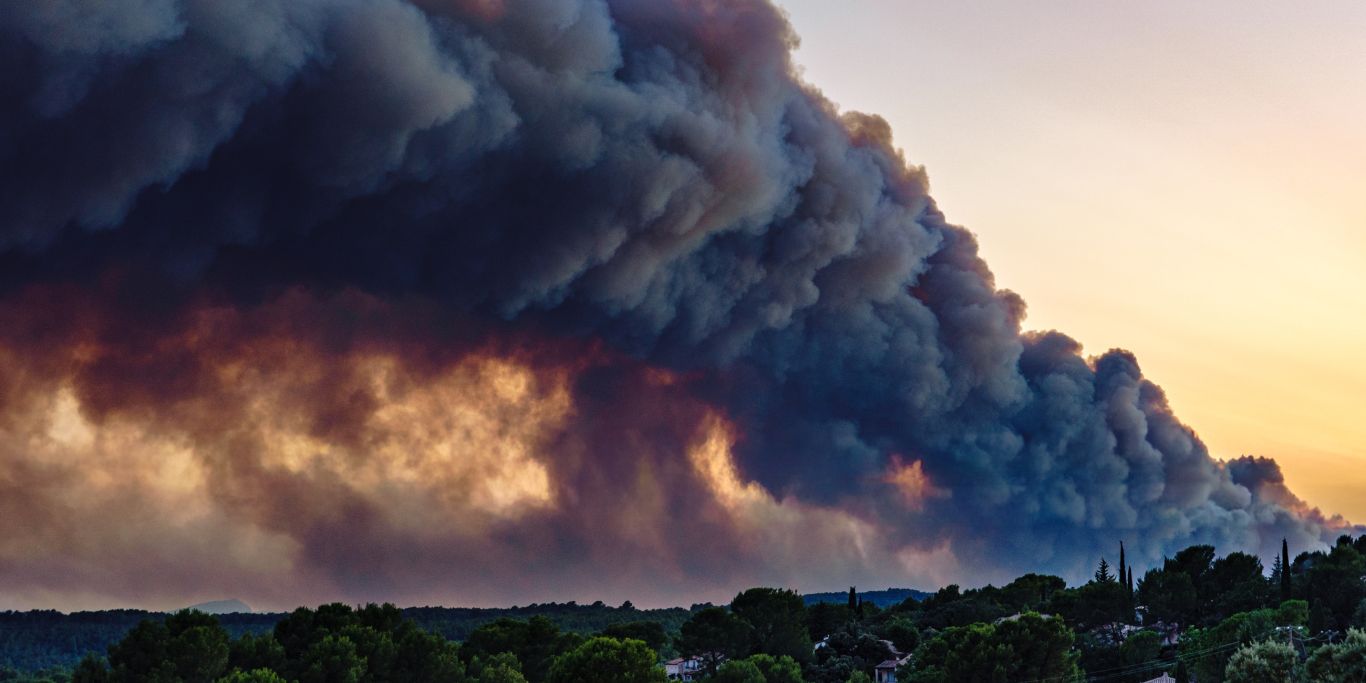
France has passed roughly 115,000 hectares burned for the year. The epicentre is the Gironde region in the southwest, where a fire north of the Arcachon Basin has forced over 220,000 people to evacuate.
The fire has, on several occasions, developed into a self-feeding firestorm generating its own lightning, sparking new flare-ups – a phenomenon called a pyrocumulonimbus.
Bordeaux itself is not currently under evacuation order, though surrounding communities, including the town of Le Porge, have been devastated. A second, smaller fire has also forced roughly 3000 evacuations in the Var region on the Mediterranean coast.
What Australian travellers should do
Governments are urging caution for anyone travelling to affected areas. Smartraveller’s latest travel advice for France notes that wildfires are impacting parts of France, with large-scale evacuations in the southwest, including tourist areas, and advises travellers to monitor media and follow the instructions of local authorities. It also flags that travellers should check current entry/exit and visa rules, as border delays are possible.
Real-time fire tracking is available through the EFFIS wildfire viewer and, for France specifically, Météo-France’s Météo des forêts tool.
Travel insurance is also front of mind for Australians with upcoming trips. A heatwave on its own is generally not enough to trigger a valid claim unless your destination becomes uninhabitable or DFAT issues a ‘Do Not Travel’ warning through Smartraveller. Wildfires are a different matter: if a heatwave leads to a natural disaster that directly disrupts a trip, cover may kick in for cancellation costs, additional expenses or unused prepaid bookings, depending on the policy. Travellers are urged to carefully read their product disclosure statement to understand what is and isn’t covered, noting that whether a claim is paid comes down to a policy’s specific terms and the individual traveller’s circumstances.
The takeaway for anyone with a booking to France or Spain: a change of mind isn’t covered, but a DFAT advisory change, an evacuation order, or a cancelled tour or transfer because of the fires generally improves your chances of a successful claim. Familiarise yourself with the common mistakes that can void your cover as well.
What happens next
European officials have warned that extreme wildfire danger could persist into August, with the traditional peak of the Mediterranean fire season still ahead. For now, the priority in both France and Spain remains containment: reinforcing firebreaks around Gironde, stabilising the Madrid-region blaze, and preparing for a fresh spike in temperatures that could complicate firefighting efforts through midweek.
Want to see more stories from International Traveller in your Google search results?
- Click here to set International Traveller as a preferred source.
- Tick the box next to "International Traveller". That's it.