hero media

The Maharajas’ Express: a luxury train journey through India

Booking a berth on a luxury train journey through the colour and bustle of India guarantees splendour and luxury discovers Tricia Welsh, with a stunning added bonus in the tail.

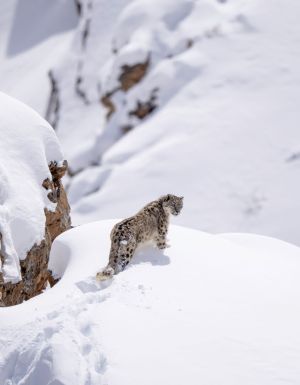
About the only thing that is not guaranteed on a leisurely week-long Indian Splendour journey on India’s most luxurious train, the Maharajas’ Express, is an elusive tiger sighting.

At our welcome briefing on arrival, our tour director even warns all 58 passengers the same. “On the Maharajas’ Express, 99 per cent of things we guarantee – except sighting tiger. Everything has to be in harmony."
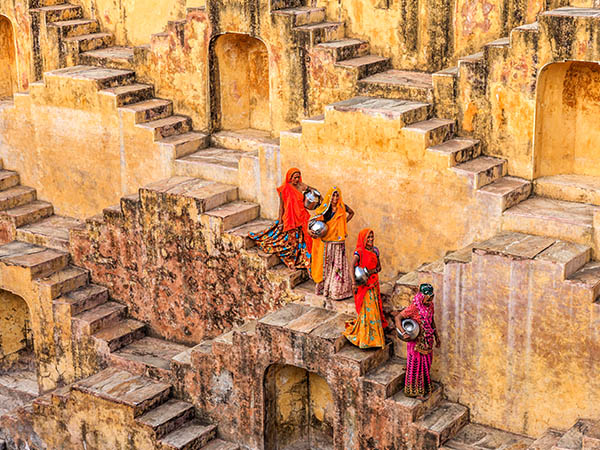
Women, Jaipur, India
Passengers onboard the Maharajas’ Express will see snapshots of Indian life in Jaipur.

The tick list they do ‘guarantee’ on this luxury train is impressive, starting on day one with the majestic Taj Mahal in Agra to discovering the gems of Rajasthan with visits to exquisite palaces, magnificent forts, colourful bazaars, remote villages and more as it snakes through Jaipur, Bikaner, Jodhpur and Udaipur, and on to Mumbai. The passage is undertaken in great style, reflecting the way maharajas might have journeyed in the heady days of the Raj.

Departing Dehli

After our red-carpet departure from Delhi, we come to expect the daily royal welcome from traditional musicians and dancers, with our liveried staff lining up to wish us well before leaving for excursions and to welcome us ‘home’ again on our return. Judging by the myriad puzzled looks, we must be the cause of great wonderment to local villagers.
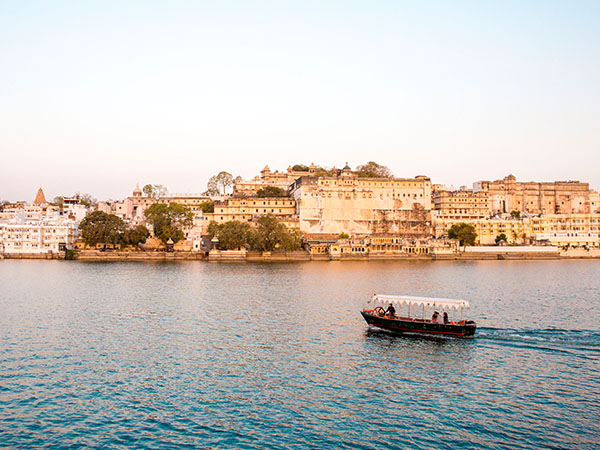
boat ride to Udaipur, India
Discover the gems of Rajasthan. (Image: Edwina Hart)

The Taj Mahal

Our first excursion to the Taj Mahal is highly anticipated. Built in the mid-1600s by a heartbroken Shah Jahan in memory of his beloved wife, Mumtaz, who died after giving birth to the couple’s 14th child, it is considered the world’s greatest monument to eternal love. Counted among the New Seven Wonders of the World, it is the epitome of Mughal architecture with its bulbous domes, Persian garden and water channels, and receives some 8 million visitors a year.
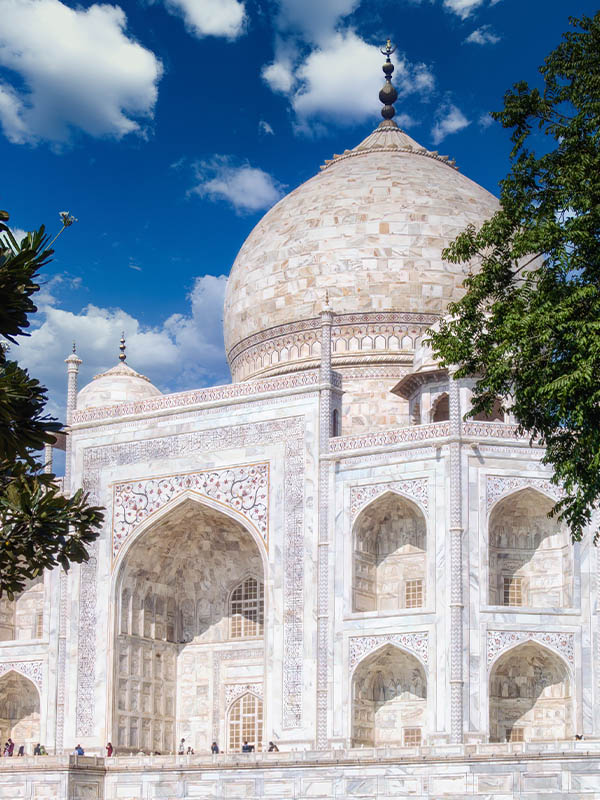
Taj Mahal, Agra, India
The Taj Mahal is a highlight of the seven-day itinerary.

Agra Fort

Nearby, Agra Fort is one of the finest Mughal forts in India. Built of red sandstone and white marble over half a century before the Taj Mahal, it might have started life as an impregnable fort, but was later transformed into a magnificent palace with courtyard upon courtyard of intricately carved and decorated pavilions and pools. Only a quarter of the complex is currently open to the public, but it is hoped the entire UNESCO World Heritage Site will be open for viewing by 2025.
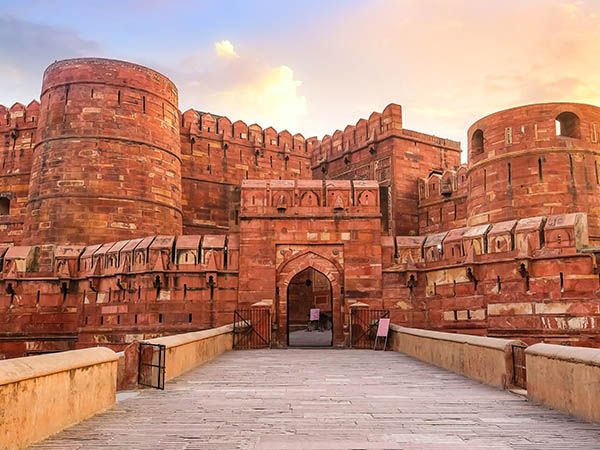
Mughal Agra Fort, India
Nearby, Agra Fort is one of the finest Mughal forts in India.

The Pink City of Jaipur

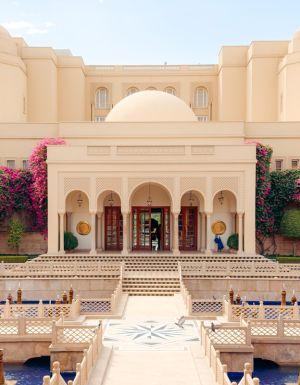
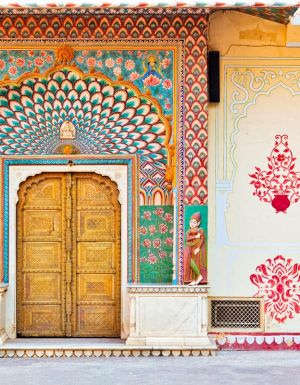
In the Pink City of Jaipur, we enjoy a jeep ride to the hill-top honey-coloured Amber Fort and later dine under the stars in the beautiful gardens of magnificent Rambagh Palace hotel, once the hunting lodge of the Maharaja of Jaipur.

Junagarh Fort

Our route then veers north-west through camel country to Bikaner, where, after marvelling at the superb interiors of Junagarh Fort, we take a plush camel-cart ride into the sand dunes for a barbecue with sunset cocktails and gypsy folk dancers.
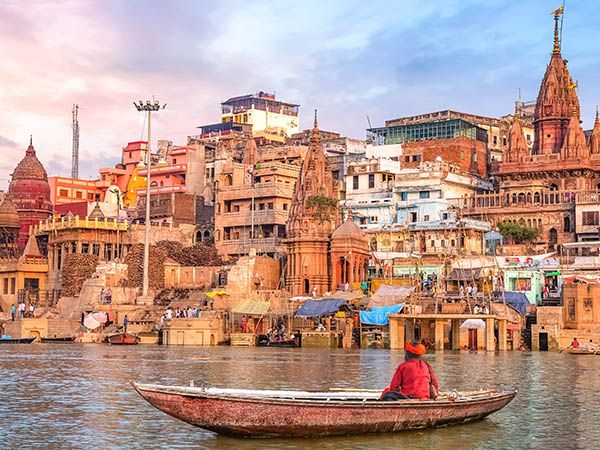
Hindu sadhu on a boat, Varanasi, India
A Hindu sadhu sitting on a boat overlooking Varanasi.

Jodhpur

In Jodhpur, we pay a visit to a remote Bishnoi village in the western Thar Desert. This little-known eco-friendly Hindu sect do not kill animals or cut down trees, hence they do not cremate their dead like other Hindus. We sit under acacia trees on hand-woven charpais (day beds) and are offered a traditional welcome drink of ground home-grown poppy seeds with water. Poured into the palm of our hands to sip, it symbolises health and prosperity. Opium is freely grown here and is an essential part of community life.

Mehrangarh Fort

From Jodhpur’s imposing Mehrangarh Fort, the view over the historic Blue City with its myriad box-like houses is spectacular. In the distance, we can see Umaid Bhawan Palace, owned by the son of the last Maharaja of Jodhpur and one of the largest private residences on the planet; today part of it is owned by Taj Hotels, making it one of the most luxurious places to stay in the world.
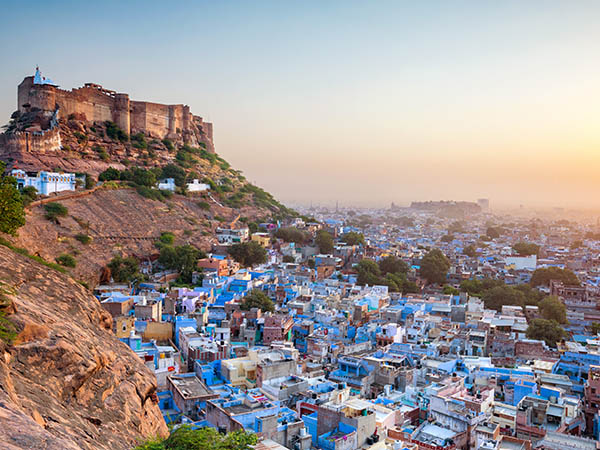
The Blue City and Mehrangarh Fort in Jodhpur. Rajasthan, India
The view over the historic Blue City with its myriad box-like houses is spectacular.

Udaipur

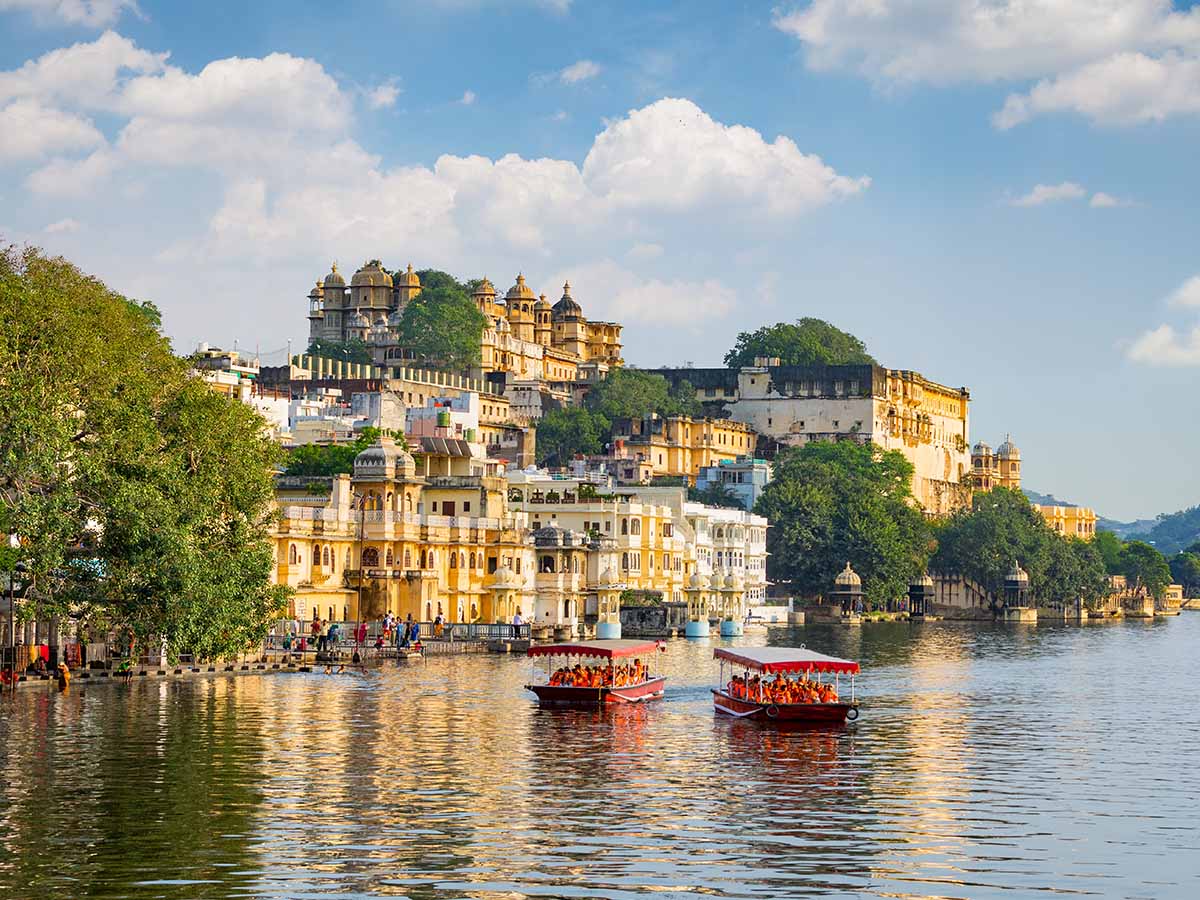
The next stop is the impossibly romantic Udaipur, situated around Pichola Lake and studded with fairy-tale palaces, the City Palace being the largest and most extravagant. There are wonderful views from its many turrets and balconies looking out to the lake, with the Taj Lake Palace hotel (built by Maharana Jagat Singh from 1743–1746 for use as his own personal pleasure palace) like an elaborate wedding cake in the middle. In the Crystal Gallery, we view an extraordinary crystal collection ordered by Maharana Sajjan Singh, and lunch in the fabulous Satkar Hall in grand style under massive crystal chandeliers.
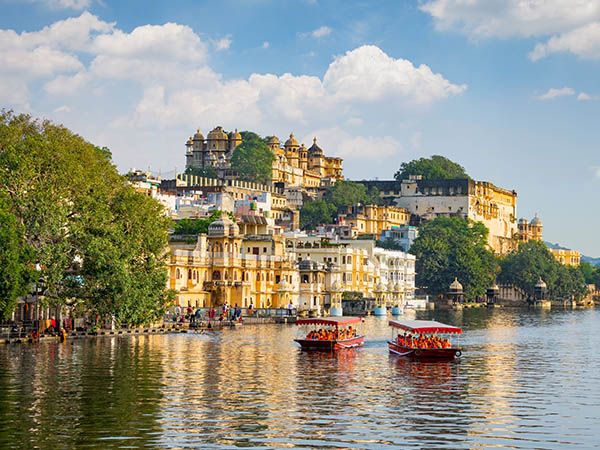
Boat ride on Lake Pichola, India
Enjoy a change of pace during a boat ride followed by a visit to Udaipur in Rajasthan.

Onboard the Maharajas’ Express

It’s easy to understand why the Maharajas’ Express has won the ‘World’s Leading Luxury Train’ award at the World Travel Awards for seven consecutive years. Debuted in 2010 to rival the handful of other luxury trains that crisscross India, it is indeed the most modern and reputedly serves the finest food. Its 23 carriages comprise 43 compartments including 20 deluxe cabins, 18 junior suites, four suites and one presidential suite that occupies an entire carriage and is the largest presidential suite on wheels in the world.
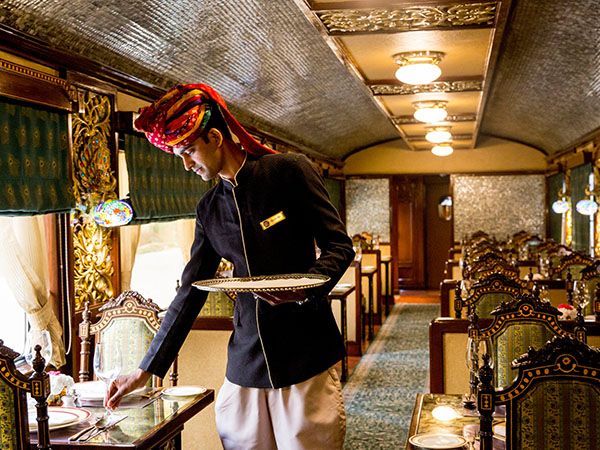
Server, Maharajas Express, India
The service is fit for royalty. (Image: Edwina Heart)

The design details

Designed by the head interior designer for the equally prestigious Taj Hotels group, and inspired by the elaborate salons built in the 1920s for the maharajas and the gracious old-fashioned English clubs of the Raj, the luxurious Maharajas’ Express wants for nothing, gliding through the vast countryside like a splendid, shiny serpent.
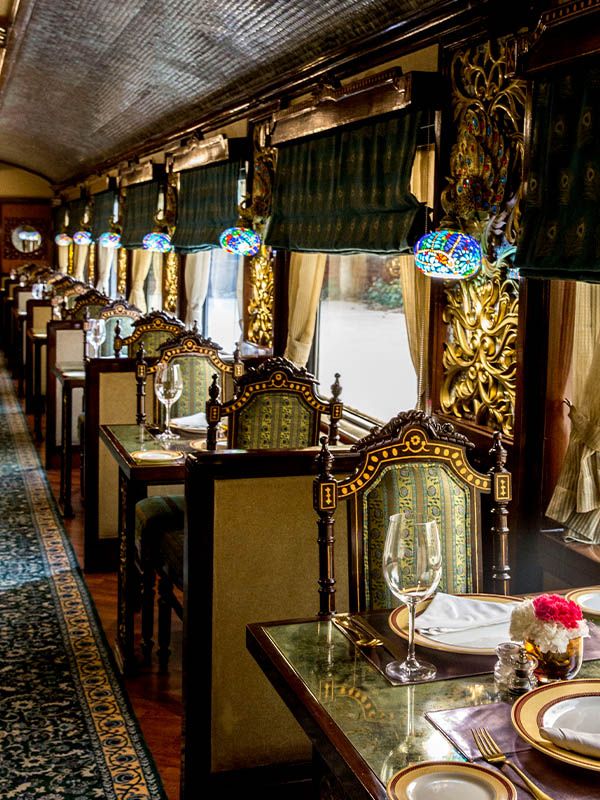
Interiors of Maharajas Express, India
The interiors were inspired by the salons built in the 1920s for the maharajas. (Image: Edwina Heart)

Weekly travel news, experiences
insider tips, offers,
and more.

The suite

Our spacious junior suite has twin beds, a small sitting area and roomy bathroom with separate glassed-in shower recess and full vanity unit. A dedicated round-the-clock valet magically appears to open doors, make up compartments, deliver early morning cups of tea and generally ensure we are all on time for excursions.

The food on the Maharajas’ Express

Food on the Maharajas’ Express is exceptional, with a good choice of traditional Indian dishes and international fare overseen by ebullient executive chef John Stone. Everything is made daily from scratch, with a pastry chef onboard to produce a fabulous selection of traditional and Indian breads as well as sweet treats. Table d’hôte menus might include popular curries, typical thali dishes with several small plates such as smoked salmon or lobster thermidor, followed by jalebi, kulfi or strawberry panna cotta. The masala dosa at breakfast is outstanding.

An unexpected tiger spotting

And while not ‘guaranteed’, we do indeed encounter a tiger while visiting Ranthambore National Park, where the number of tigers that roam free here, protected from humans who previously hunted them to near extinction, has increased from 18 in 2006 to 74 in 2020 (according to the Rajasthan Forest Department). Maybe these majestic, hulking animals know that the Maharajas’ Express is not in the habit of denying its passengers anything.
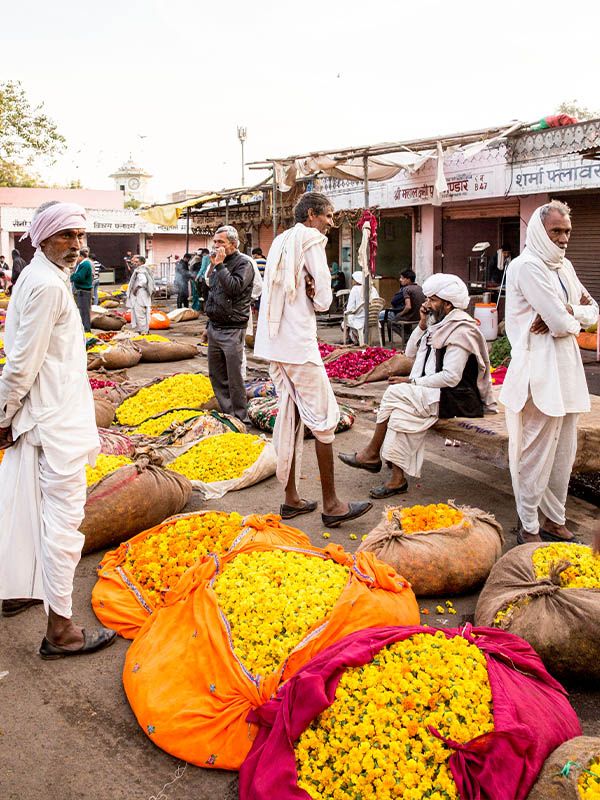
Flower Market, Rajasthan, India
Visit a flower market in Rajasthan. (Image: Edwina Hart)

A traveller’s checklist

Journeying there

The seven-day/six-night Indian Splendour journey aboard the Maharajas’ Express departs from Delhi. The 2022/23 season begins in October with monthly departures (two in October).

Getting there

Airlines including Qatar Airways, Qantas and Etihad offer flights to Delhi from Sydney and Melbourne.

Staying there

Start as you mean to go on with a stay at The Leela Palace New Delhi, a modern palace that is less than two kilometres away from Safdarjung Railway Station, where passengers embark on the Indian Splendour journey.
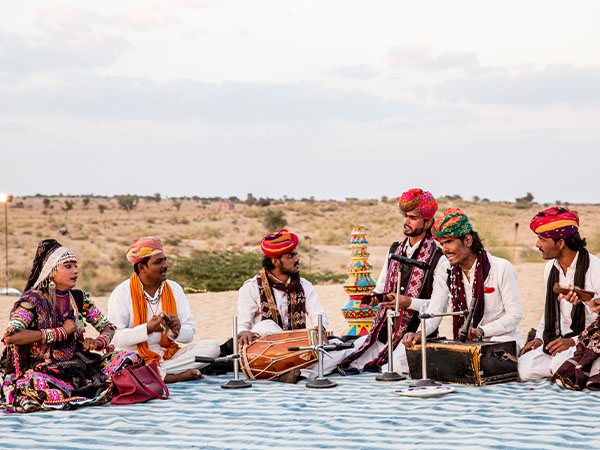
Intimate Concert, Nomadic Tribe, India
A nomadic tribe performs an intimate concert for passengers amid the rolling sand
dunes near Bikaner. (Image: Edwina Hart)

Talking there

  • Namaste – Hello
  • Vidai – Goodbye
  • Kripaya – Please
  • Dhanyavaad – Thank you
  • Ap se milkar kushi hui – Nice to meet you
  • Aap-kaa naam kyaa hai – What is your name?
  • Phir milenge – See you later!

Want to see more stories from International Traveller in your Google search results?

  1. Click here to set International Traveller as a preferred source.
  2. Tick the box next to "International Traveller". That's it.
hero media

These community homestays are changing how travellers experience Nepal

    After youth-led protests in 2025, this year Nepal elected a 35-year-old former rapper as Prime Minister. In a country where tourism is its biggest industry, what’s next for travellers? 

    In 1986, Nepal changed its clock. It had used India Standard Time since 1920 so, to differentiate, it wound its clock 15 minutes ahead of, not behind, its big-brother neighbour. Boss move. “Nepal is strongly opposed to the idea that our identity is connected to India,” says Community Homestay Network (CHN) guide Bikal Khanal.  

    Tharu dance
    Tharu dance is traditionally set to hand drums. (Credit: Kate Lewis)

    Today, Nepal is the only independent country with a 45-minute deviation to universal time; an oddity that’s become a symbol of national pride. The quirk is nearly as endearing as Kathmandu’s Tribhuvan airport where carved varnished wood and shiny red bricks rule. One sign points to a ‘Travelator’ and another to a ‘Grievance Handling Desk’ while visas are noisily stamped at customs for US dollars, cash only. When am I?  

    Nepal gray langur
    Spot the endemic Nepal gray langur. (Credit: Simon Urwin)

    The 15 or 45 minute anomaly sees me tap out completely on timezone calculations. Why bend my brain calculating if it’s quarter to or quarter past elsewhere when I’m in the honking here and now of Kathmandu where the air is high-altitude crisp, the prayer flags flutter and the street dogs howl?  

    How tourism is changing in Nepal

    Bardiya National Park
    Bardiya National Park is rich with wildlife. (Credit: Simon Urwin)

    India is not the only association many Nepalis would like to shake. With eight of the world’s 10 tallest mountains, including Mount Everest and Annapurna, Nepal has long attracted mountaineers and trekkers, and expedition numbers are continuing to rise.  

    Tourism is one of the country’s biggest sources of foreign currency, so this growth is not negative, per se. But according to Ang Tshering Lama, who co-founded Phaplu Mountain Bike Club, being reduced to a mere trekking destination is limiting.  

    “Trekking is just one layer of our identity,” says Ang. “When it becomes the dominant narrative, it limits how we’re seen and how we see ourselves.” Nepal’s recent success, however, in diverting trekkers to less-trafficked areas such as Manaslu mofuntain, where visitor numbers rose by 117 per cent last year, offers hope that tourism can diversify even more radically.   

    Local men in Bhada village
    Local men in Bhada village. (Credit: Simon Urwin)

    The founder of CHN, Shiva Dhakal, wants that change. “The whole idea of the Community Homestay Network is to promote experiences outside of trekking,” he says. “Community tourism changes lives and helps kids stay home instead of coming to the city or migrating to the Middle East.”  

    Ang grew up seeing people leave, “not because they wanted to but because there weren’t enough opportunities to stay”, he states. Yet from remote villages to living traditions; food, art, music and emerging subcultures, “there’s so much that’s not being seen.” 

    CHN is opening some of those doors. It doesn’t own, or fund, any homes. Rather, it promotes homestays to travellers on a single, slick platform, while fostering entrepreneurship in places where women, marginalised castes, Indigenous people and the youth stand to benefit the most.  

    A new generation demanding more

    Dalla Town Hall
    Dalla Town Hall, where volunteers discuss anti-poaching tactics. (Credit: Bheem Thapa)

    The future prospects of next-gen Nepalis can no longer be ignored. On a Kathmandu tour with 33-year-old guide Monica K.C, we pass buildings torched in the September 2025 ‘Gen Z protests’, including the Supreme Court and Parliament House. Seventy-two people died. “They were anti-corruption protests,” says Monica. “Politicians’ children are living a lavish life but the airports are crowded with youngsters leaving to find work.”  

    We stop in ‘little Tibet’ at the wondrous sixth-century Boudha Stupa. “The wheel of life is Buddhism in a nutshell,” says Monica. “Things such as hate, ignorance and anger keep you rotating around the wheel, so you must follow the principles of Buddhism to detach. If you can’t, there’s no nirvana for you.”  

    Boudha Stupa's prayer wheels
    Boudha Stupa’s prayer wheels are used to recite Buddhist prayers. (Credit: Kate Lewis)

    In a sun-drenched twist to the usual temple visit, we ascend the stupa’s sloping plinth and roam its whitewashed dome. Tendrils of diaphanous prayer flags stream from a steeple-like structure where the Buddha’s unblinking eyes stare out. No nirvana for you… 

    bouda stupa prayer flags
    Tibetan-style prayer flags embellish the whitewashed dome of Bouda Stupa, a Buddhist temple. (Credit: Kate Hennessy)

    The dome is delightfully free of guard rails or chiding from security. There is, however, a stern ‘No TikTok’ sign, perhaps in response to the youth’s newly flexed power. The booted-out Prime Minister, K.P. Sharma Oli, was replaced in a resounding election victory in March by 35-year-old Balendra Shah of the Rastriya Swatantra Party (RSP) – a former rapper and mayor of Kathmandu. The RSP’s manifesto indicates tourism is a priority, and that Nepal’s cultural identity in areas such as gastronomy will be strengthened.  

    Boudha Stupa vendors
    Vibrant souvenir shops and cafes around Boudha Stupa. (Credit: Kate Hennessy)

    A more confronting stop awaits at Pashupatinath Temple. Today is Bala Chaturdashi, a Hindu festival where thousands of devotees gather to honour their dead ancestors. Vendors hauling foam mattresses do a lucrative trade as people set up for a night of vigil. This includes burning the bodies of recently deceased relatives on bamboo pyres in the Bagmati River, which flows into the sacred Ganges.  

    A woman at annual Hindu festival Bala Chaturdashi
    A woman at annual Hindu festival Bala Chaturdashi, in Kathmandu. (Credit: Kate Hennessy)

    Wrapped in a shroud, the bodies are positioned with their heads facing north to the Himalayas where Lord Shiva resides. They’re covered with flowers and straw and set alight by male family members.  

    Hours later, the ashes are swept into the river where devotees will take a holy dip the next day. As much as Monica assures us it’s not voyeuristic to watch, I struggle to do so. “Here you see the reality of life because everyone ends up there,” she says, gesturing to the river.  

    Life unfiltered in the Terai region

    tharu woman
    Tharu woman and master weaver Parbati Chaudhary in Bhada Village. (Credit: Bheem Thapa)

    The reality of life needs processing time, which the western Terai region delivers in spades. The Terai is largely separated from India by the Karnali River and Bardiya National Park, where elephants, rhinos and the elusive Bengal tiger roam.  

    Once a nomadic tribe, the Indigenous Tharu people are now the largest ethnic group here. “They didn’t know their daily life was interesting for international travellers but they’re starting to understand now,” says CHN founder Shiva.  

    safari through Bardiya National Park
    Take a Jeep safari through Bardiya National Park. (Credit: Bheem Thapa)

    We fly Buddha Air to Dhangadhi airport and drive five hours to stay in Tharu homes. The journey to Bhada village is a blur of roadside fruit stalls, traffic-stopping sacred cows and fields sown with wheat, rice, mustard, spinach, cauliflower and potatoes. Nepal’s agriculture feeds only Nepal.  

    Marigolds
    Marigolds are an important part of Hindu rituals. (Credit: Simon Urwin)

    “The only thing we export is young people,” says our guide Bikal. As the light dims and we plunge evermore rural, mysterious mounds of compacted hay – some house-sized – loom like the creatures from Where The Wild Things Are. Even our trusty driver gets flummoxed by a dirt road that abruptly ends and we find ourselves hurtling across a paddock.  

    On arrival, some are ferried to mud-walled cottages greened by gourd creepers, with thatched roofs and rustic-chic mosquito nets. Myself and two others are ushered to the home of corner store owner, mechanic and mushroom farmer Man Kumar Chilaruwa and his wife Rajkumari.  

    community homestay entrance
    A warm welcome at a community homestay. (Credit: Simon Urwin)

    They escort us to a bunker-esque back building with steel doors and a folding security gate, behind which is gleaming linoleum, dolphin-printed tiles and a shower cavity that must be gingerly stepped through to reach the toilet.  

    The ceiling lights emit a rainbow of colours (the bathroom light gets stuck in, frankly, a quite frightening red). We’re nevertheless touched that our hosts invested in all this bling when the average salary is around $275 a month.  

    In the coming days, we participate in Tharu traditions such as making moonshine, dancing, weaving straw handicrafts and gold-panning. We’re fed well with staples of rice, mustard greens, lentil pancakes, daal, curried chicken and tomato chutney served on antibacterial saal leaves.  

    food at community homestay
    Dig in. (Credit: Kate Hennessy)

    Sonara community homestay president Indradevi Tharu tells us river snails are often served, and the boiled and pickled flesh of rats hunted in the rice fields. “Perhaps next time?” we say and all have a laugh.  

    The power of community homestays 

    community homestay owners in Nepal
    Barda community homestay owners Parbati Chaudhary and Ram Krishni Devi Chaudhary. (Credit: Simon Urwin)

    Immersing Western visitors in foreign cultural practices is not new. But with the Tharu, I never get that uneasy sensation that I’m being performed for. Despite being the only tourists, there’s no ‘othering’; just warm, composed and ultra-dignified welcomes. Like we’ve always been here.  

    “I love to have travellers in my village so I can see the world,” says local woman Parbati Chaudhary. “Why would I travel the world when the world comes to me?” 

    The graceful acceptance the Tharu offer, as well as the slow pace, works miracles on my frazzled nervous system. One day I even take a nap on a vacant homestay bed. 

    Sonara community room
    An authentic stay in the Sonara community. (Credit: Kate Hennessy)

    Roosters strut and goats bray as we sit on the ground in al fresco kitchens, rolling rice flour into cylinders steamed to make dhikri (dumplings). When water is needed, we fetch it using a hand-operated pump as a family of ducks strolls by, side-eying us like curious neighbours.  

    Animal lovers will delight in Tharu villages. Kind and resourceful inventions are everywhere, such as snacking stations where two posts lean together, with leafy boughs dangling on rope for baby goats to forage from.  

    CHN’s CEO, Aayusha Prasain, nods knowingly when one in our group says she cried when she left her host, Shayam Chaudhary, in Bhada. Shayam’s 17-year-old son, Prashant, had translated, which deepened the connection.  

    “Community tourism turns travel into a relationship, not a transaction,” says Aayusha. “It places decision-making power in the hands of local communities, especially women and youth.” Since 2018, CHN has hosted more than 4000 travellers from 52 countries in 408 households, and estimates women’s participation has increased by 381 per cent.  

    Elephant watch
    Elephant watch. (Credit: Simon Urwin)

    In the Bardiya community, where vexing human-animal conflict has been a balancing act for decades due to elephants raiding crops, long-time homestay operator Salik Ram Chaudhary says young people keep the older ones on their toes.  

    Gathering greens
    Gathering greens. (Credit: Bheem Thapa)

    “We can’t keep homestays stagnant,” he says. “We have to upgrade our service and redefine our product or young people won’t see it as an attractive business. If we can keep evolving with this travelling trend we’re confident the youths will stay and continue it.” 

    Back in Kathmandu, Monica explains that after the deaths of young protestors in September, a determination had spread to not let their sacrifice be in vain. “We want to keep holding the government accountable,” she says. “We don’t know what situation we’re facing, but we’re ready to face it.”  

    Interested in Nepal but prefer to experience it in total comfort? Read our guide to luxury travel in Nepal

    The Maharajas’ Express: a luxury train journey through India - International Traveller