Abu Dhabi’s Sir Bani Yas island is like no other in the world. Quentin Long explains why.
Describing Abu Dhabi’s Sir Bani Yas Island to strangers is a study in how to bewilder people. “It’s a ‘Desert Island’ that has been greened and plays ark to a bunch of endangered Asian, Arabian and African animals."
Not your standard island then.
Whether you consider Sir Bani Yas a success or failure is a lot like beauty – totally in the eye of the beholder.
For this beholder, there is an undeniable charm to the man-made environment. How can a newly born gazelle fawn, still covered in vernix, on jelly legs, desperately trying to follow mum, not be beautiful to behold? For 15 minutes I watch the fawn as mum comes back to reconnect and clean the afterbirth off her newborn. It’s wonderful.
Flying in to Sir Bani Yas presents a landscape dotted by thousands upon thousands of African acacias. During the 20-minute flight from Abu Dhabi to Sir Bani Yas, the scintillating blue Arabian Sea is occasionally smudged by the other white and barren Desert Islands. They are reminders of what Sir Bani Yas was before the late Sheikh Zayed, founder of the UAE, embarked on his environmental overhaul to make the islands more accessible to humans and a habitat for Arabia’s endangered species; every living thing on this island has been introduced.
From the window of the plane I spot a sand gazelle nibbling on the trees like a topiarist. Something is obviously not quite right about this forest of two-metre bean-pole trunks, each topped by a perfect disc of flat foliage. It’s the orderliness; each tree stands like a soldier on parade, evenly distanced from its neighbours in neat rows.
Sheik Zayed’s vision of ‘greening the desert’ was not a small project. More than a million trees of various hardy species have been planted here, each connected to what must be the most impressive irrigation system in the world.
The drawcard of the island is undoubtedly the 87.5 square-kilometre Arabian Wildlife Park that takes up more than half the island and is home to more than 10,000 animals. The park is enclosed by a large 32-kilometre fence to keep the wildlife and visitors safe from each other. In 2007 the fence was rebuilt and many sand and mountain gazelles were left outside it; adding a little natural disorderliness to the landscape today.
The Desert Islands Resort & Spa by Anantara is the only accommodation currently open on the island and while providing a full resort experience of five restaurants, spa treatments, poolside waiter service, kids’ club, it really only exists because of the wildlife.
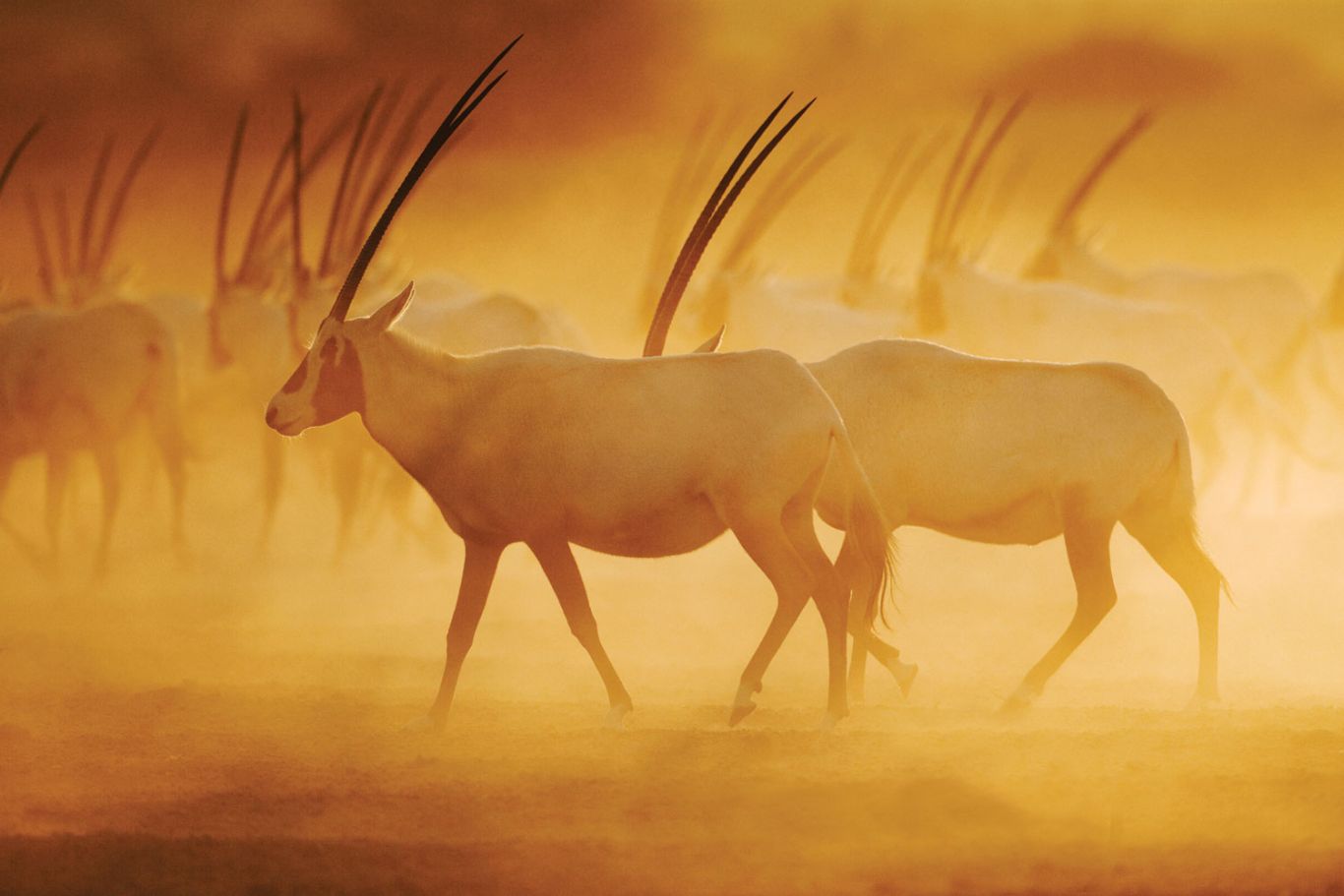
Ted, my guide and driver for the safari included in the hotel tariff, is a South African with incredible blue eyes and a passion for all things natural. The most successful conservation program on the island has been with the Arabian oryx, a medium-sized antelope.
“Before Sheikh Zayed commenced work on this island in 1971, the Arabian oryxs were extinct in the wild. Today there are 450 on this island alone and in the wild have moved from endangered to vulnerable," he tells me.
By now, oryxs have totally surrounded the 4WD. A beast with only one razor sharp, ribbed-for-no-ones-pleasure horn wanders by. “That’s our unicorn," Ted grins.
At another feeding ground in the park, Indian blackbuck with twisted horns jump out of the way of four giraffes, who pimp-roll past. Two African crowned cranes face off like bobbles on a dashboard. Sand gazelles nervously watch everything and would probably jump at their own reflection if there were one. The striped hyena are not on parade today but we do drive past the cheetah enclosure as a forlorn young male idles in the shade of a toothbrush tree.
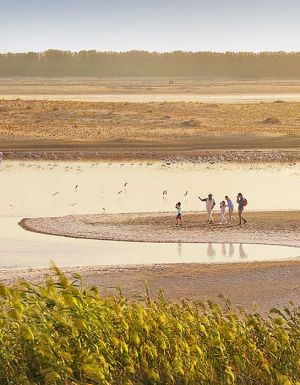
In the savannah lands, some of the 170 bird species who are now attracted to the island bounce from tall grass to tall grass as the sprinklers spray desalinated water across the flora ensuring everything survives another day.
As we leave the savannah and enter the turf grassed area a huge male ostrich strides arrogantly before us. The pink hue of his thick legs are a sure sign that he is out for a good time – it’s breeding season. A competitor appears above the horizon line on what Ted describes as the only natural part of the island – the dusty mountain. They walk off in opposite directions.
This extraordinary procession of wildlife happens in a mere three-hour drive.
It is so far from natural and yet the experience is all about nature. The paradox is inescapable. Sir Bani Yas is no ordinary island indeed.
Details
Where to stay
Currently the only accommodation on the island is the comfortable Desert Islands Resort & Spa by Anantara. It is a full service resort with kids’ club and a water sports facility for some of the best diving and fishing in the UAE. The wildlife drive in the park is complimentary for all guests. The resort’s entry-level rooms are large and start from $320 per night. desertislands.anantara.com
Anantara will be expanding the island resort before the end of the year, with new facilities opening: the Al Yamm Villas (al-yamm.anantara.com), situated on the island’s best beach (great for those looking for a beach holiday) recently opened, and Al Sahel Villas (al-sahel.anantara.com) will by the end of 2013, which will be inside the Arabian Wildlife Park itself – more of an immersive safari experience, with animals roaming free around the accommodation.
How to get there
Etihad Airways flies to Abu Dhabi 28 times per week between its three Australian hubs – Sydney, Melbourne and Brisbane. Return economy class fares from Sydney to Abu Dhabi start from $2452 (including taxes). etihad.com
From Abu Dhabi, Rotana Executive Jets fly to the island from Al Bateen Executive Airport three times a week: Tuesdays, Thursdays and Saturdays. Alternatively, you can drive to the Jebel Dhana Jetty, 250 kilometres from Abu Dhabi, and take the water taxi to the island. The taxi is complimentary for guests.
When to go
The best time is December to March when the UAE is at its coolest. The May to September period is fiercely hot with average temperatures in the 40s.
Best thing about Sir Bani Yas
It’s a living scientific experiment with real conservation success.
Worst thing about Sir Bani Yas
The uneasiness such man-made nature can have on true nature lovers.
You should know
The Desert Island Resort & Spa is located on the north-facing tip of the island, which is exposed to wind and the choppiest seas. The Al Yamm Villas, when completed, will have the pick of the beaches. Activities on the island also include walks and horse rides in the wildlife park, archery, kayaking and mountain biking.
Want to see more stories from International Traveller in your Google search results?
- Click here to set International Traveller as a preferred source.
- Tick the box next to "International Traveller". That's it.