No wonder the Brits have kept it quiet, the Isles of Scilly have the weather the Brits so sorely seek.
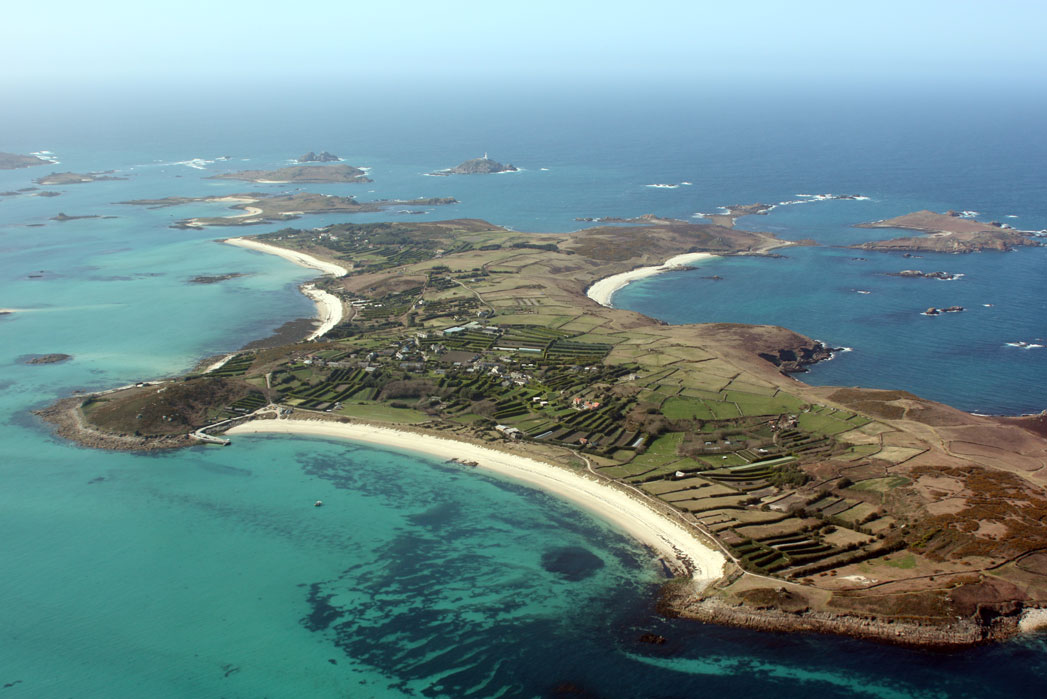
A short hop from the British mainland takes you to another world. An island archipelago where doors remain unlocked, cars are few and exotic flora thrives in the balmy climate. Although just 45 kilometres from the south-west tip of Cornwall, the isolation of the Isles of Scilly has been just enough to keep the islands remarkably unspoiled.
Most Brits know of the Isles of Scilly, the name being synonymous with a mild climate and the flower farming industry.
Despite this, surprisingly few have visited, but those making the effort return time and time again. The attraction soon becomes apparent as the Scillonian psyche is quite different to many parts of England.
The locals are easy-going, friendly and there’s an air of honesty and trust about the place. With pretty scenes at almost every turn and a sleepy atmosphere from another time, this is a great place to unwind for a few days.
Scilly’s westerly location means the isles bask in the warming winds of the Gulf Stream. Combined with the southerly latitude and the surrounding ocean, the Scillonian climate is free from extremes, with frost and snow being rare.
Consequently, all manner of plants thrive here. Some of these will be familiar to Australians, such as Cabbage Trees and Palms, but when combined with the quaint English cottages, narrow lanes and dry-stone walls, the resulting surroundings appear striking and unusual.
It is possible to take a day trip to Scilly, but a stay of several days is recommended to absorb the very different vibe of each island. Visitors arrive at the mini capital of Hugh Town on the most populated island of St Mary’s. This is the only island with any notable volume of motor vehicles; the off-islands have few cars and perhaps the odd tractor.
All five inhabited islands offer food and accommodation, but it may make sense to base yourself on St Mary’s.
Those seeking the ultimate escape may find their nirvana at one of the off-islands, especially after the day-trippers leave. However, from St Mary’s, island hopping is easy. Water taxis are available year-round, or from April to October, most visitors use the services of the St Mary’s Boatmen’s Association.
The launches are lovingly maintained, colourful and full of character, and your island of choice is reached in just 30 minutes or so. A word of warning though – the boats tend to be uncovered, so wear waterproofs if there is a swell!
Of course, the ocean dominates life here. The most popular sport is not soccer but Pilot Gig Racing – a form of rowing and a Cornish tradition. Historically the race was to get the pilot out to incoming vessels first and hence landing the job of guiding them to harbour.
Each week teams from the isles battle it out across choppy seas, and watching the race on a Wednesday or Friday evening throughout summer is quite an experience.
St Mary’s
The largest of the isles offers plenty to keep visitors entertained for several days, and packs a great deal of variety into 6.3 square-kilometres.
Expect to see farmland, flower fields, spectacular granite coast interspersed with sandy beaches, and picturesque villages. Life centres around Hugh Town, which sits on an isthmus between two pleasant bays, Town Beach and Porthcressa.
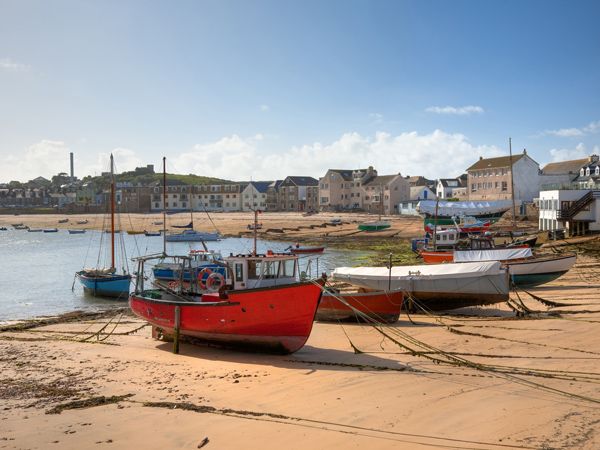
St Mary’s is rich in historical sights; amongst the most impressive is The Garrison Walls. Complete with bastions and canons, the walls are perched on a headland adjacent to the town and date back to 1588.
An equally remarkable sight is found at Penninis Head at the southern tip of St Mary’s. Here you’re faced with spectacular walls of granite plunging into the ocean, along with unusual rock formations caused by weathering. A little further along the coast is lovely Old Town, with its smattering of cottages, pub and cafés gathered around a peaceful bay.
On most islands you can see prehistoric entrance graves or burial chambers, some from Neolithic times – so we’re talking a mind-boggling 4000 or 6000 years ago.
St Mary’s has some of the finest examples, check out Bant’s Carn Burial Chamber and neighbouring Halangy Down Ancient Village, dating back to Bronze and Iron Ages. Probably the best-preserved examples though are the Innisidgen Graves at the north of the island.
Wandering the interior of St Mary’s is a delight. Locals sell their products via roadside stalls and honesty boxes.
Villages lead to lush nature trails and hedgerows support a display of flowers and succulents – a strange mix of native and exotics, escapees from gardens and cultivations, which really shouldn’t survive the English winter.
Although the isles rely on income from tourism these days, a few flower farms persevere on the isles and swathes of daffodils and amaryllis provide a magnificent splash of colour in season.
Bryher
Bryher is tiny but wildly beautiful. The west coast is one of the first significant pieces of land between England and Canada and often receives fierce swell crashing onto the coast.
The aptly named Hell Bay at the north-west side of the isle is a spectacular scene in stormy weather.
The south and east of Bryher are much more gentle with sheltered sandy beaches, notably Rushy Bay and Green Bay.
After lounging around on the sand, walk up Samson Hill or Watch Hill for some of the best views in the isles, across the lagoon towards the neighbouring isle of Tresco.
St Martin’s
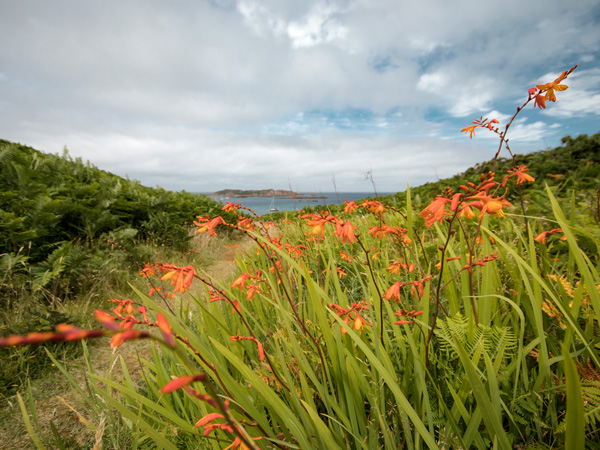
If Bryher is the untamed isle, St Martin’s is the tranquil island paradise. Sheltered by Bryher and Tresco to the west, the coast here is quite stunning and many visitors leave the isles with St Martin’s as their favourite.
In the sunshine, the white sandy beaches, aquamarine hues of the ocean and exotic plants make St Martin’s look like a subtropical idyll. Meandering along the narrow road takes you through three villages, imaginatively named Higher, Middle and Lower Town.
A short climb up Cruther’s Hill near Higher Town gives a panoramic view of the coastline.
You will also pass a small vineyard (tours available) and numerous miniature flower fields, with oversized hedges to shelter the delicate crop.
Even the wildlife is friendly here; you may be joined by wild birds that feed on your hand.
Tresco
It’s just a stone’s throw from rugged Bryher, yet the isle of Tresco exudes a very different ambience.
Parts of Tresco feel more fabricated for tourism than the other isles, with order and tidiness not seen elsewhere. However, go hiking off the beaten track and you will find a wilder side to the island.
On approach to Tresco, the first thing to grab your attention is the presence of trees, which is something lacking in other parts of the isles.
Nestled amongst these trees is Tresco Abbey Gardens– a true gem of the isles. The clever landscaping by Augustus Smith, in the early 1800s, works in harmony with the local climate to dramatic effect. Specimens from around the world mingle to form a riot of colour in this sheltered sun-trap.
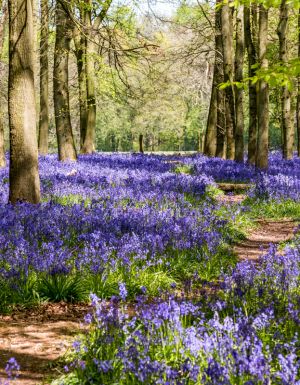
The heather at the north end turns the landscape purple in late summer. In early spring the bright yellow gorse forms a stunning colour clash against the Atlantic blues and greens.
The 17th-century Cromwell’s Castle on this colourful stretch of coast resides in a wonderful position, along with the remains of King Charles’ Castle further up the hill behind.
The beaches in the south and east of Tresco are stunning and rival those of St Martins.AppletreeBayand much of the east coast comprise white sand and turquoise ocean.
St Agnes
Far-flung St Agnes is out on a limb in the south-west of the archipelago, a picturesque isle of geological wonders, historical sights and peaceful coves.
St Agnes is very small and, in keeping with this, everything seems so dainty from the diminutive road to the distinctive 17th-century lighthouse and church. The title for Scilly’s most endearing names must also be awarded to St Agnes.
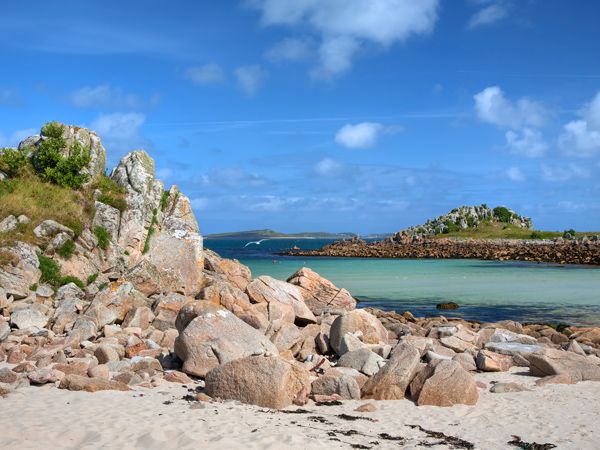
Who can resist visiting the likes of Barnaby Lane, Wingletang Down, Beady Pool and Troy Town Maze?
The latter is an unusual spiral of rock made in the late 1700s, but it’s thought this is based on an original from much earlier times.
A couple of delightful beaches are found a short walk north from Troy Town, and to the east are more bizarre granite shapes. On the east coast is the Beady Pool bay; a ship went down offshore in the 17th century with a cargo of beads – sometimes these are still washed ashore.
After some serious beachcombing, head for Cove Vean, an almost perfect fern-lined arc of crystalline water and a great spot to sit and unwind.
Uninhabited Islands
Another 140 or so uninhabited islands and named rocks make up the Scilly archipelago, some of which can be visited.
Samson is one such example where you can live out your Robinson Crusoe dreams, for a few hours at least, relaxing on the gorgeous white sand beach.
Samson was inhabited until relatively recently, but the last islanders were forced to abandon their homes in 1855 due to a lack of natural resources and eventually deprivation. Wandering amongst the abandoned house remains is quite a humbling experience. This island is a must for historians with a number of prehistoric entrance graves to explore.
The Western Rocks are some of the most notoriously dangerous waters in the British Isles. The Scilly Boatmen (safely) offer circular tours of the area.
There are seals and seabirds abound, including puffins. Bishop Rock is officially the world’s smallest island holding a building – probably the most exposed lighthouse in Britain, and the very last little piece of England.
Weekly travel news, experiences
insider tips, offers, and more.
The Details
How to get there
Emirates flies daily to London from Adelaide, Brisbane, Melbourne, Perth or Sydney via Dubai. From Gatwick connect to Newquay with Flybe which run two to three flights a day, then make the final hop to Scilly with Skybus who run up to six flights a day in high season. If you plan on visiting the mainland before departing for Scilly, the options are more numerous. The Scillonian III ferry departs Penzance daily, except Sunday. For both Skybus and Scillonian bookings, head here.
When to go
April to September ensures easy island hopping and the best weather. Early May sells out quickly, as it’s when the isles host the World Pilot Gig Championships. A visit in winter means very few tourists, but your plans may need to be flexible.
Where to Stay
COMFORTABLE
The Wheelhouse, St Mary’s is a quality bed and breakfast in an enviable location on Porthcressa Beach.
LUXURY
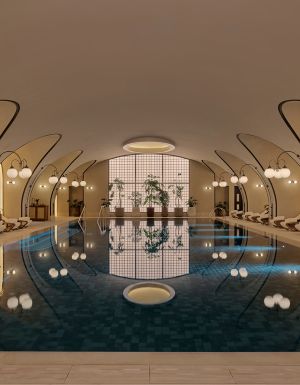
The Star Castle Hotel, St Marys offers accommodation in the 16th-century castle or a modern suite. Golf, tennis and an indoor pool are available.
Sea Garden Cottages, Tresco has contemporary chic accommodation right by the bay. Some of the facilities on offer include tennis courts, indoor pool and sailing.
Where to eat
AFFORDABLE
The Scillonian Club, Hugh Town, St Mary’s. Hearty food and real ale at an affordable price.
Adam’s Fish and Chips, Higher Town, St Martin’s. The fish is landed on St Martin’s and the potatoes are grown on the farm here too.
MID RANGE
Old Town Inn, St Mary’s. Traditional pub with real ales. Sunday roasts are always popular.
Kavorna, Hugh Town, St Mary’s. Right in the centre of town, Kavorna is a reliable choice for breakfast, lunch or dinner.
The Turks Head, St Agnes. The only pub on the island, and the most south-westerly in Britain. Sit outside to admire the vibrant shades of blue in the bay below.
HIGH END
Juliet’s Garden Restaurant is located atPorthlooBeach, a pleasant stroll from Hugh Town, and serves up wonderful food and a location to match. julietsgardenrestaurant.co.uk
You can’t leave without
Strolling on the fabulous white sand beaches – all the islands have them but St Martin’s deserves a special mention
Visiting the Tresco Abbey Gardens
Wandering amongst the impressive coast of granite at Peninnis Head, St Mary’s
The best thing about The Isles of Scilly
This is England from a bygone era, there’s nowhere else like it.
The worst thing about The Isles of Scilly
Despite one of the best sunshine records in the country, it definitely still rains, so head for the shops, galleries, museum, café or pub!
England is a land of fabulous highlands, city views, historic towns and so much more. Head here to get your England fix with our travel guide.
Want to see more stories from International Traveller in your Google search results?
- Click here to set International Traveller as a preferred source.
- Tick the box next to "International Traveller". That's it.