hero media

City guide to Sucre, Bolivia

Bolivia’s constitutional capital is an elegant city of narrow streets and colonial architecture set deep in the country’s central-south.

Sucre, Bolivia is known for

Its beauty, it being bolivia’s capital and Bolivian chocolate.

Sucre’s Eat streets

For a small city, Sucre has a diverse dining offering. For snacking, explore the three levels of Sucre’s Mercado Central – with its cafe dedicated to Bolivian cuisine at the top, and jugo ladies on the ground floor making freshly pressed juices.

Make a beeline for El Patio or Flores to try Sucre’s best salteñas; a type of Bolivian baked empanada, or savoury pastry, usually filled with meat and a sweet and spicy sauce.

For main meals choose from humble home cooking at Pension Dona Petra and fine(r) diner La Taverne.

Sucre is also good for vegetarian fare.

Try El Condor and El Germen, which serve meat-free Bolivian dishes among others, or newcomer Prem – El Arte de Vivir, which is all-out vegan

Out & about

Sucre is Bolivia’s first capital city and its symbolic heart. Although La Paz has been its administrative capital since 1899 (holding the seat of government and treasury), Sucre retains its capital status according to the constitution and in the eyes of its proud citizens.

Sucre has a moderate (for Bolivia) altitude of 2790 metres, which makes it a good stopover for those wanting to ease into high-altitude living and fend off soroche (as Bolivians call altitude sickness).

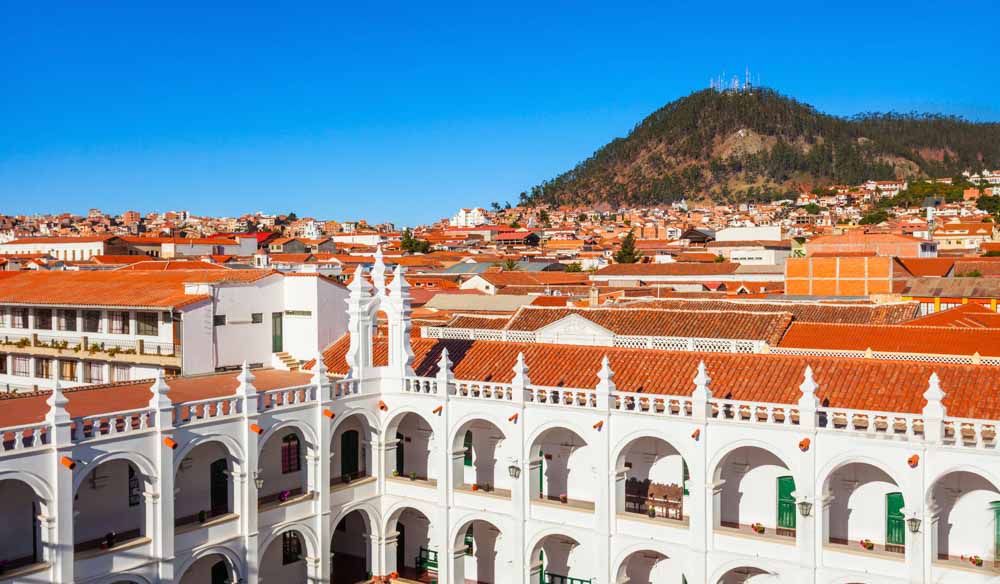
It means you can navigate Sucre’s elegant, narrow streets with ease, taking in the white-washed buildings that earned the city its nickname La Ciudad Blanca, ‘The White City’; and the wealth of religious buildings that date to the 16th century.

In 1991, the city was declared a World Heritage Site. Most stops on your itinerary will be within a five-kilometre radius of the main square, 25 de Mayo.

Insider’s secret

You’ll find tribes of digital nomads in sucre’s cafes: the wi-fi’s good for bolivia.

Retail reconnaissance

If you’re in the market for some Bolivian textiles, you’ll find a colourful and high quality selection at the Sucre store of not-for-profit organisation Inca Pallay, which seeks to improve lives of indigenous weavers in some of Bolivia’s poorest communities.

And then there’s chocolate.

With its long history of chocolate production, Sucre lays claim to yet another moniker: the ‘chocolate capital of Bolivia’.

You’ll find the best at Taboada and Para Ti, which uses local ingredients such as quinoa, coffee and chilli.

The ultimate experience

Sucre was founded by the Spanish in 1538 as Ciudad de la Plata de la Nueva Toledo (Silver Town of New Toledo), on the lands of the Yampara people.

In 1825, the region became the Republic of Bolivia and it was at the Casa de la Libertad (House of Freedom), in Sucre’s main square, that the declaration of independence was signed.

Today, the building – originally a chapel constructed in 1621 as part of the Convent of the Jesuits – exists as a museum dedicated to this period in Bolivia’s history and provides a fascinating insight.

Weekly travel news, experiences
insider tips, offers,
and more.

Caffeine hits

Sucre’s cafe scene is ever-expanding: try Abis Cafe, Metro Cafe and Cosmo Cafe on the Plaza 25 de Mayo for a decent cup of joe.

Stay & play


Affordable

Casa Verde B&B is a homey stay with clean, comfortable rooms plus a pool.

Moderate

Mi Pueblo Samary Hotel Boutique, has sleek rooms that open out to patios overlooking a lovely central courtyard.

Luxe

A five-star hotel, Parador Santa María La Real is set in an 18th-century colonial mansion just one block from 25 de Mayo square.

Want to see more stories from International Traveller in your Google search results?

  1. Click here to set International Traveller as a preferred source.
  2. Tick the box next to "International Traveller". That's it.
hero media

What the European heatwave means for your summer travel plans

Temperatures are soaring this summer, breaking records across Europe and the UK. 

Euro summer is a feeling like no other. But when a heatwave hits? The dream trip quickly turns into a sweaty mess. Extreme heat is sweeping Europe and the UK this week, with record-high temperatures impacting travel plans across the continent.

And while Australian summers are typically hotter in absolute temperature, many European cities aren’t equipped for high temperatures, resulting in unbearable weather.

Why is it so hot in Europe?

Signs of a hot summer loomed in May, when the mercury hit unprecedented spring highs. Now, extreme high temperature warning alerts have been issued in countries such as Spain, Italy, France, England, the Netherlands and Germany.

France saw its hottest day on record on Wednesday, with an average temperature of 30°C across the day and night. This surpasses the average temperature for June, which is 15°C to 25°C. Dozens of people have died, including 40 from drowning.

In Spain, 212 deaths have been linked to the heatwave.

The UK recorded its hottest June day ever on Wednesday with temperatures soaring to 36.1°C. In an article published by the Met Office – the UK’s national meteorological service – Professor Stephen Belcher CBE, Met Office Chief Scientist, shared his concerns about June’s heat. “To see temperatures like this in the UK in June is sobering. Events like this bring home the implications of climate change, with very high temperatures and humidity bringing significant health implications from heat stress, as well as impacts to a range of sectors such as transport, energy and water supply,” he said.

Heatwaves are becoming increasingly common in Europe and the UK, neither of which is prepared for such extremes. The World Meteorological Organization reported that in 2025, at least 95% of Europe experienced above-average annual temperatures and that the continent was heating up twice as fast as the global average.

How travel is impacted

A pharmacy sign displaying 40 degrees Celcius
A pharmacy broadcasting local weather data. (Credit: Getty/Dragoncello)

During a heatwave, power grids, water systems and transport networks can be affected, resulting in disrupted itineraries for travellers. In France, power outages have left thousands without electricity and early closures have been implemented for two of Paris’s biggest attractions, the Eiffel Tower (early afternoon rather than late at night) and the Louvre (two hours early). Eurostar cancelled its London to Paris and Paris to London services from the 22nd to the 25th, and major UK rail companies have been advising travellers to avoid using trains where possible, or to travel during early hours.

If a heatwave is predicted, being flexible with your itinerary and having fully refundable/changeable tickets is key, as extreme heat can force the cancellation of outdoor activities, impact rail and flight services and change the opening hours of sites and eateries.

Why does summer in Europe often feel hotter than summer in Australia?

people swimming in the Canal Saint-Martin in Paris
People swimming in the Canal Saint-Martin in Paris to cool off. (Credit: Rachael Thompson)

With some of the highest UV levels in the world, Australians are no strangers to the heat, adapting well to intense weather. But our infrastructure is largely equipped to withstand soaring temperatures with climate-responsive passive design, refrigerated air conditioning or evaporative coolers, as well as swimming spots aplenty.

Buildings in Northern and Western Europe and the UK, however, are constructed to retain heat and handle frosty winters. The lack of universal air conditioning means it generally feels hotter even though the temperature on your app might not look it. During a heatwave, it can feel like you’re in a sauna as cities act like heat traps.

How to stay cool and prepare for another heatwave

Relief is expected across Europe and the UK later this week, but more heatwaves are still possible in the coming months. Summer heat typically peaks in July and August.

Public transport often doesn’t have air conditioning, and buses in particular can be swelteringly hot. If you’re heading outside or your accommodation has no air conditioning, it’s worth buying a spray bottle and a handheld fan from a pharmacy or tourist stand. Check ahead of time if restaurants and cafes have air conditioning and make a booking in advance. The highest temperatures typically hit between 3pm and 6pm, so aim to head outdoors outside of these hours.

Rising temperatures invite travellers to enter a more intentional era of seeing the world. Now more than ever is the time to embrace lower-impact “coolcations” and off-season getaways.

City guide to Sucre, Bolivia | International Traveller