hero media

Europe’s new private-room sleeper train will visit over 100 cities

This is Europe like you’ve never done it before.

Haven’t you heard? Planes are out, trains are in. At least that’s what recent travel trends are telling us. For many, rail travel has never looked more appealing, with globetrotters increasingly swapping airport chaos for scenic, stress-free journeys.

But Berlin-based start-up Nox is redefining the experience, recently revealing its plans for an ambitious new sleeper-train network that will eventually connect over 100 cities across Europe. The best part? It’s the first service to offer fully private rooms – so you can ride in comfort, style and solitude.

What does the onboard experience look like?

Rail travel can be a holiday in itself, rather than just a mode of transport. And while there are plenty of luxurious sleeper-train experiences around the world, Nox is pushing to make it a more viable option for all travellers by rolling out a huge range of overnight services across Europe. All with private rooms – all with affordable pricetags.
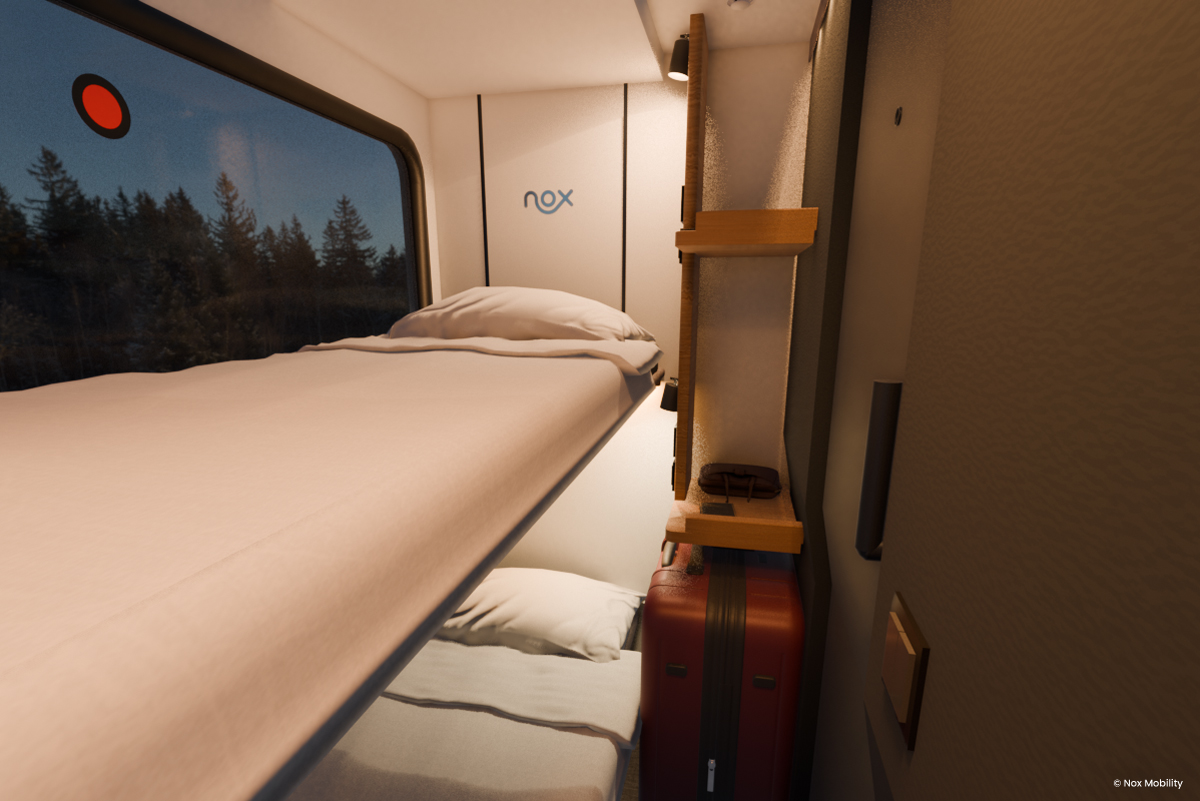
Onboard Nox's new European sleeper train
Settle into your very own private cabin onboard. (Image: Nox Mobility)

“Sleeping while a train gets you across Europe is a great concept, but today people have to share their cabins with strangers, beds are tight and it’s often more expensive than air travel," says Nox co-founder, Thibault Constant. “We want to change that and make night trains an essential part of European travel."

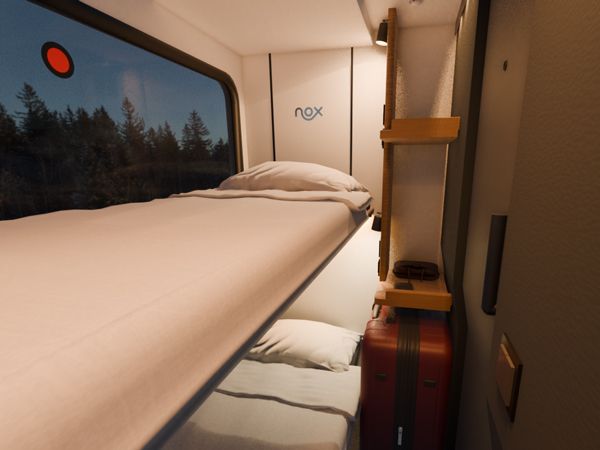
Onboard Nox's new European sleeper train
Guests can choose from single and double rooms. (Image: Nox Mobility)

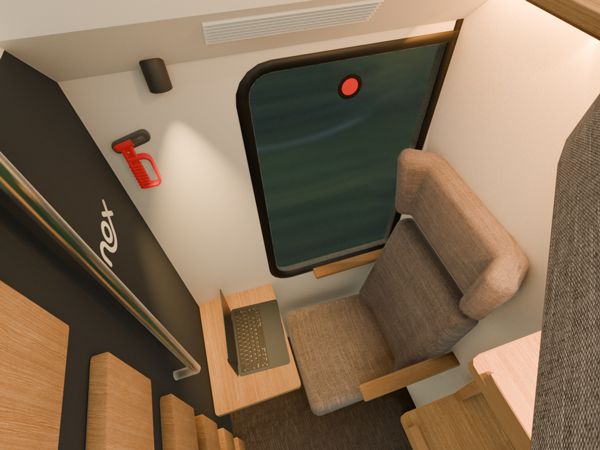
Single and double rooms will offer complete privacy for guests, while still delivering on that unique sleeper-train experience. Each sleek and spacious cabin features modern amenities and creature comforts, including two-metre-long beds, separate seats with tables and storage for luggage.

Where will the trains travel to?

Currently, most sleeper-train journeys highlight a single destination or country. Take the Rocky Mountaineer – while the eponymous brand recently expanded into the USA with the launch of Canyon Spirit, it’s primarily all about showcasing Canada’s scenic landscapes.

map of Nox's new sleeper train route
Nox plans to launch its first 35 routes in 2027. (Image: Nox Mobility)

Or Golden Eagle’s new 22-day journey along the Silk Road onboard a luxurious sleeper train. But for the Berlin start-up, it’s all about ease of access; delivering people to places at a reasonable price, without compromising on comfort.

“Our room design allows us to fit more people into our trains than traditional operators can," notes Janek Smalla, co-founder of Nox. “This, paired with a strict focus on standardisation and operational excellence, will allow us to offer affordable fares on over 35 European routes."
Onboard Nox's new European sleeper train
Space and comfort collide onboard the new sleeper trains. (Image: Nox Mobility)

The first 35 routes will launch in 2027, connecting everywhere from Paris and Milan to Geneva and Cologne. Other destinations include Cannes, Oslo, Utrecht, Zurich, Hamburg and Salzburg – just to name a few. And by 2035, Nox hopes to expand its network to more than 100 cities across the continent. Did someone say (rail)road trip?

How can I book?

While the sleeper trains aren’t expected to launch for at least another 18 months, prospective passengers can already start planning future trips with Nox. Scheduled departure routes, maps, room layouts and potential prices are all available on the company’s website.

Already sold? Join Nox’s free early bird club to stay updated, score discounted rates and gain early access to bookings.

Want to see more stories from International Traveller in your Google search results?

  1. Click here to set International Traveller as a preferred source.
  2. Tick the box next to "International Traveller". That's it.
Taylah Darnell
Taylah Darnell is International Traveller's Writer & Producer. She has been passionate about writing since she learnt to read, and this life-long love of words inspired her to study a Bachelor of Communication majoring in Creative Writing at the University of Technology Sydney, where she completed two editorial internships. After graduating, she began her full-time career in publishing at Ocean Media before scoring her dream job with Australian Traveller. Now as Writer & Producer, Taylah passionately works across both digital platforms and print titles. When she's not wielding a red pen over magazine proofs, you can find Taylah among the aisles of a second-hand bookshop, following a good nature trail or cheering on her EPL team at 3am. While she's fairly certain nothing can top witnessing the northern lights in Norway, she'd love to explore Scotland and Ireland next.
View profile and articles
hero media

What the European heatwave means for your summer travel plans

Temperatures are soaring this summer, breaking records across Europe and the UK. 

Euro summer is a feeling like no other. But when a heatwave hits? The dream trip quickly turns into a sweaty mess. Extreme heat is sweeping Europe and the UK this week, with record-high temperatures impacting travel plans across the continent.

And while Australian summers are typically hotter in absolute temperature, many European cities aren’t equipped for high temperatures, resulting in unbearable weather.

Why is it so hot in Europe?

Signs of a hot summer loomed in May, when the mercury hit unprecedented spring highs. Now, extreme high temperature warning alerts have been issued in countries such as Spain, Italy, France, England, the Netherlands and Germany.

France saw its hottest day on record on Wednesday, with an average temperature of 30°C across the day and night. This surpasses the average temperature for June, which is 15°C to 25°C. Dozens of people have died, including 40 from drowning.

In Spain, 212 deaths have been linked to the heatwave.

The UK recorded its hottest June day ever on Wednesday with temperatures soaring to 36.1°C. In an article published by the Met Office – the UK’s national meteorological service – Professor Stephen Belcher CBE, Met Office Chief Scientist, shared his concerns about June’s heat. “To see temperatures like this in the UK in June is sobering. Events like this bring home the implications of climate change, with very high temperatures and humidity bringing significant health implications from heat stress, as well as impacts to a range of sectors such as transport, energy and water supply,” he said.

Heatwaves are becoming increasingly common in Europe and the UK, neither of which is prepared for such extremes. The World Meteorological Organization reported that in 2025, at least 95% of Europe experienced above-average annual temperatures and that the continent was heating up twice as fast as the global average.

How travel is impacted

A pharmacy sign displaying 40 degrees Celcius
A pharmacy broadcasting local weather data. (Credit: Getty/Dragoncello)

During a heatwave, power grids, water systems and transport networks can be affected, resulting in disrupted itineraries for travellers. In France, power outages have left thousands without electricity and early closures have been implemented for two of Paris’s biggest attractions, the Eiffel Tower (early afternoon rather than late at night) and the Louvre (two hours early). Eurostar cancelled its London to Paris and Paris to London services from the 22nd to the 25th, and major UK rail companies have been advising travellers to avoid using trains where possible, or to travel during early hours.

If a heatwave is predicted, being flexible with your itinerary and having fully refundable/changeable tickets is key, as extreme heat can force the cancellation of outdoor activities, impact rail and flight services and change the opening hours of sites and eateries.

Why does summer in Europe often feel hotter than summer in Australia?

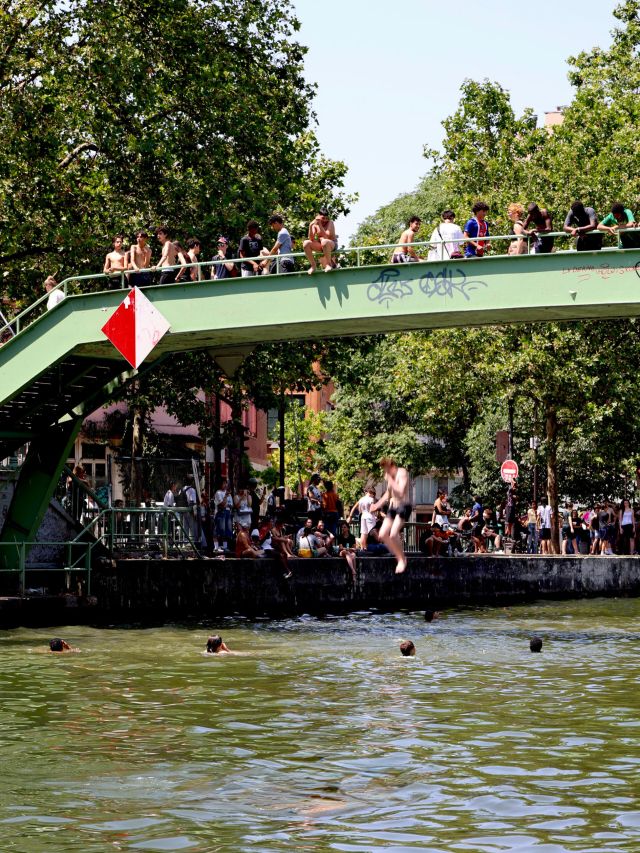
people swimming in the Canal Saint-Martin in Paris
People swimming in the Canal Saint-Martin in Paris to cool off. (Credit: Rachael Thompson)

With some of the highest UV levels in the world, Australians are no strangers to the heat, adapting well to intense weather. But our infrastructure is largely equipped to withstand soaring temperatures with climate-responsive passive design, refrigerated air conditioning or evaporative coolers, as well as swimming spots aplenty.

Buildings in Northern and Western Europe and the UK, however, are constructed to retain heat and handle frosty winters. The lack of universal air conditioning means it generally feels hotter even though the temperature on your app might not look it. During a heatwave, it can feel like you’re in a sauna as cities act like heat traps.

How to stay cool and prepare for another heatwave

Relief is expected across Europe and the UK later this week, but more heatwaves are still possible in the coming months. Summer heat typically peaks in July and August.

Public transport often doesn’t have air conditioning, and buses in particular can be swelteringly hot. If you’re heading outside or your accommodation has no air conditioning, it’s worth buying a spray bottle and a handheld fan from a pharmacy or tourist stand. Check ahead of time if restaurants and cafes have air conditioning and make a booking in advance. The highest temperatures typically hit between 3pm and 6pm, so aim to head outdoors outside of these hours.

Rising temperatures invite travellers to enter a more intentional era of seeing the world. Now more than ever is the time to embrace lower-impact “coolcations” and off-season getaways.