More hipster than hippy these days, Amsterdam’s cutting-edge architecture, environmental innovation and design have seen it evolve into one of Europe’s coolest destinations. Here, its best boutique hotels. Words by Margaret Barca.
Andaz Amsterdam Prinsengracht
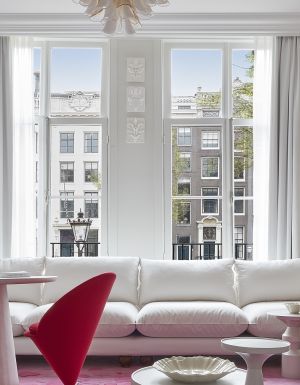
The concept: A clever conversion, turning the former Public Library (a rather ugly 1970s pile) into a knockout, five-star boutique hotel that captures Amsterdam’s artistic and innovative zeitgeist (at the top end of the market).
The Andaz may be a Hyatt hotel but there’s nothing cookie-cutter here.
The details: Local – and legendary – designer Marcel Wanders has fused Dutch tradition and new design, filling the hotel with exuberant furnishings and international art (including work from 40 international video artists).
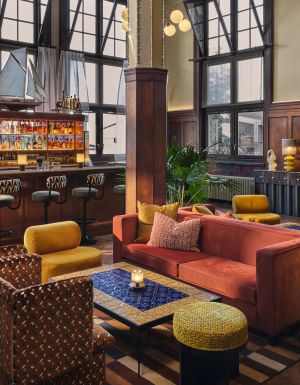
Fabulous light fittings, oversized furniture, iconic design pieces, witty references (blue-and-white Delft-inspired walls and floors, tulip-shaped chairs), extravagant use of black and Rembrandtesque richness create a powerful effect.
Guest rooms are more restrained, but still individual, with bold artworks.
What we love: Systems are seamless, as is the service, but it’s the sense of Alice in Wonderland excess that surprises and delights.
Bluespoon Restaurant matches good looks with a farm-to-table menu, and the bar – laidback but glittery and well patronised by locals – overlooks fashionable Prinsengracht Canal. And there’s a beautiful garden.
Rooms from $525 per night; amsterdam.prinsengracht.andaz.hyatt.com
Conscious Hotel Vondelpark
The concept: This hotel is not just eco-friendly – it’s eco-fastidious.
The lighting is LED and energy-saving; power comes from renewable sources; staff clothing is made from organic cotton; beds are made from all-natural materials; desks are made from recycled yoghurt pots and coffee cups (really!) and all tap fittings are water-saving.
The hotel even has a plant-covered eco-roof, for all-season insulation.
The details: The shop window-style façade references the very Amsterdam tradition of large windows without blinds and the sitting area/café is homely and comfortable, with an eye for modern design.
It’s not slick but it’s smart. Guest rooms are simple with feature walls of bold coloured prints. Ask for a premium room with a view.
What we love: It’s easy on the pocket and the planet. The vertical garden in the foyer is fun and you’re right near leafy Vondelpark.
Rooms from $129; conscioushotels.com
Canal House
The concept: A sumptuous, Vermeer-like palette, plush velvets and silks, and swathes of black imbue Canal House with a glamorous feel; but the scale is intimate and welcoming. It was also ranked No. 35 in International Traveller‘s 100 Best Hotels and Resorts
The details: With just 23 rooms in three original canal houses (late 17th- and early 18th-century), the hotel is genuinely boutique.
A narrow, marble-floored hallway lined floor-to-ceiling with Dutch paintings and prints, and a front room with severe black leather sofas, silver bar stools and multiple mirrors, are a study in contrasts.
The breakfast room features a Baroque fireplace with a spider chandelier lamp from design luminary Moooi, a bank of Marcel Wanders’ pendant lights and leafy garden views.
What we love: The mix of heritage and current Dutch design, the domestic scale of the interiors, and the secret garden. Service is low-key, friendly and thoughtful. Lovely canal-side location, too.
Rooms from $420; canalhouse.nl
College Hotel
The concept: A handsome late 19th-century schoolhouse, in the centre of the Fashion & Museum District, repurposed as a boutique hotel and a training venue for students from hotel management school.
The details: Award-winning Dutch designers FG Stijl converted the building, while retaining its fine proportions (and marvellous wide staircases), introducing furnishings handcrafted in Italy but also drawing on Dutch tradition for details.
Interiors have a warm glow with deep colours and bespoke furnishings. The restaurant, located in the former gym, serves inventive, Dutch-inspired cuisine. The service is not always perfect but usually helpful.
What we love: That you can stay in what was once the chemistry lab. If you’re lucky there’ll be cool jazz in the cosy bar, which also serves afternoon tea.
Rooms from $259; thecollegehotel.com
The Dylan
The concept: Dutch heritage meets contemporary luxe, east meets west, Zen simplicity meets intriguing colour and texture. The Dylan design, mainly by FG Stijl, manages to be original, chic and luxurious without ever being over the top.
The details: Exquisite attention to detail is one of the hotel’s hallmarks – drinks cabinets lined with silver leaf, mother-of-pearl handles, heritage plank floors, silk, Chinese trunks, Bose sound systems, iPod docks and more.
There are five distinct design styles for guest rooms (including the flamboyant colour schemes of the ‘Klassbol’ rooms and the ethereal creamy white ‘Loft’).
The Serendipity, a new room by international design maven Remy Meijers, was revealed in March.
What we love: Nothing feels ‘off-the-rack’. Michelin-starred Vinkeles restaurant is glamorous, while Brasserie OCCO, with hand-woven rugs and custom-made black Fendi sofa, is more casual (and more affordable) without any drop in the style stakes.
It’s also a brilliant location on the Keizersgracht canal.
Rooms from $484; dylanamsterdam.com
Art’otel
The concept: A traditional grand hotel, opposite the Centraal Station, is totally transformed inside with a zany, art-sharp aesthetic – this is high-end hip.
The details: The façade may be classic, however inside it’s anything but. Reception staff is stationed behind lipstick-red porcelain sculptural heads.
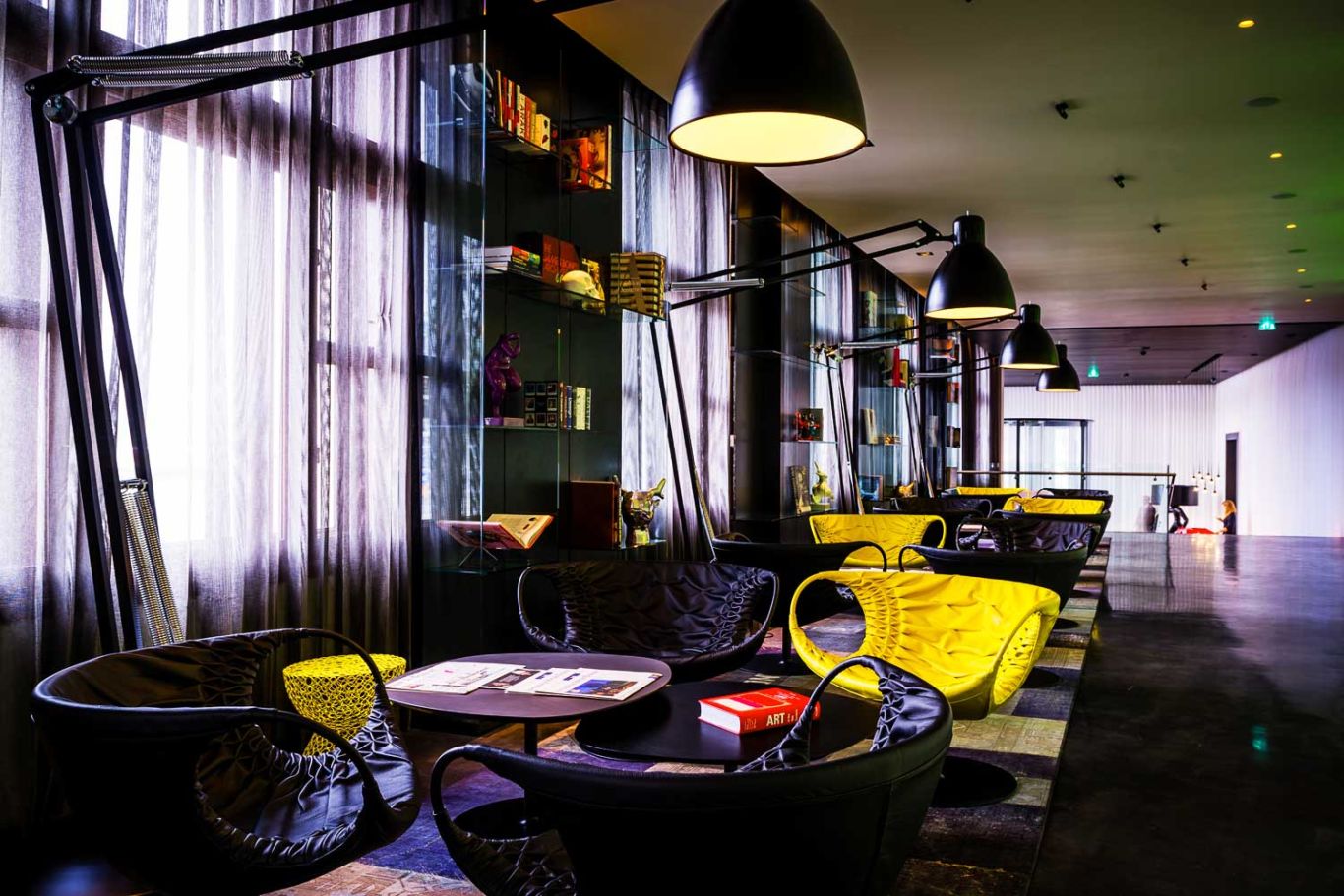
There is a mass of designer black in the bar, while the generous library and restaurant are a foil for pops of lime green and Van Gogh yellow and plenty of enormous designer floor lamps, spider chandeliers, organic seating (superbly comfortable, it has to be said) and sometimes challenging sculpture by the hotel’s signature artist, Atelier Van Lieshout.
There’s a two-storey curtain for video art, an enviable collection of art books and magazines and an art gallery. Guest rooms are spacious and understated.
What we love: The public rooms are rather night-clubby – with dark and moody lighting – but the service and tapas-style food are spot on. The ‘media centre’ in the guest rooms lets you plug in all your iThings, and the cute Illy coffee machines look like little sputniks.
Rooms from $370; artotelamsterdam.com
CitizenM Amsterdam City
The concept: This international chain for the ‘mobile (as in M) world citizen’ promotes affordable luxury, good design and innovation.
If you want your bags carried, don’t come here (you even do your own check-in, though staff help) but if you want to see the way of the future for economy travellers, this may well be it.
The details: Each of the 215 guest rooms is a standard-sized module – a box with everything in it: extra-large beds with Frette linen, if you don’t mind!, rain showers, and a ‘MoodPad’ (aka a remote) to control the blinds, flat-screen TV, room temperature and so on.
There’s no room service though you can buy breakfast, drinks and snacks 24/7 at canteenM. The lounge channels mid-century minimalism, with new Dutch design, Noguchi lamps, style books for browsing, iMacs and free wi-fi.
What we love: CitizenM addresses the essence of what the stylish, independent traveller needs in a hotel – central location, a great bed, good pillows and linen, generous showers, decent towels and wi-fi.
Rooms from $123; citizenm.com/amsterdam-city
Weekly travel news, experiences
insider tips, offers, and more.
Sir Albert Hotel
The concept: It’s quirky – even kooky.
This is supposedly the home of (the mythical) ‘modern aristocrat’ Sir Albert, who has travelled, collected and curated the hotel’s various arts and artefacts to fill the former 19th-century diamond factory.
The details: In the up-and-coming de Pijp area, the hotel has a buzzy restaurant and bar, a small reception – discreetly tucked away with artworks, curios and a mod Piet Hein Eek chandelier – and a ‘study’ in lieu of a lobby for relaxing.
The study is groovy, though rather small for a 90-room hotel. Guest rooms are white with gloss black bathrooms, pony-skin chairs, pre-loved floor rugs, designer lamps, suede bed covers, fine linens, Nespresso machines and iPod docks.
Petite rooms are ultra-petite (OK, squishy!) – the best option is a suite with a Rijksmuseum view.
What we love: There’s definitely a cool vibe. The hotel’s restaurant, IZAKAYA, is top-notch. A magnet for chic Amsterdamers, it has an Asian-inflected menu and great cocktails.
Check out Sir Albert’s little black book – an insider’s guide to Amsterdam.
Rooms from $270; siralberthotel.com
Hotel The Exchange
The concept: Suzanne Oxenaar and Otto Nan, who opened Amsterdam’s Lloyd Hotel – a showcase for Dutch design – conceived The Exchange as a place to display the talents of young designers from Amsterdam’s Fashion Institute.
The details: Right on busy Damrak Strasse (near Centraal Station), The Exchange occupies three buildings, with a skinny stairway entrance beside its friendly café, STOCK. The reception area is tiny and the lift is pretty small too.
Rooms are rated one- to five-star (that’s the hotel grading) and most are relatively compact; some are just plain small. Each of the 61 rooms is individually ‘dressed’ – there’s an ’80s room with retro sweater occupying much of the room; a Marie Antoinette room with hoop-skirt bedspread and corset detail; and the hessian and white Tailor’s Dummy with buttoned-up chairs.
STOCK café focuses on healthy, locally made food.
What we love: Fantastic concept – though some rooms are a bit whacky – perhaps best suited for the young, the brave and the seriously hip.
Rooms from $110; hoteltheexchange.com
The Conservatorium Hotel
The concept: Adapting the past to create the future – classic architecture plus 21st-century pragmatism and five-star polish.
The details: Italian designer Piero Lissoni’s vision has transformed this grand, even formidable building (it was originally a bank, later the Sweelinck Conservatory of Music), by meticulously restoring the original wing and adding a multi-level glass extension, with industrial-style beams, a vast, light-filled lobby, iconic seating (Barcelona sofas, Le Corbusier club chairs) and deftly used Dutch motifs.
Rooms, especially the split-level suites, have a Zen-like spaciousness with lofty ceilings and an urbanely Armani palette.
The lively brasserie and swish Tunes Bar shimmer.
What we love: The hotel’s ‘wellbeing centre’ is a subterranean feast of swimming pool, Hammam, water therapy and spa treatments (try the diamond anti-ageing facial).
The top-of-the-shop penthouse suites are über-luxe. We love the details of Golden Age paintings and up-market Dutch boutiques nearby for gift browsing.
Rooms from $787 per night; conservatoriumhotel.com
Want to see more stories from International Traveller in your Google search results?
- Click here to set International Traveller as a preferred source.
- Tick the box next to "International Traveller". That's it.