hero media

Inside Caffè Florian: Venice’s grandest coffee house

Leigh-Ann Pow shares her love affair with a grand old Venetian coffee house.

Grabbing a coffee has become the most pedestrian of daily tasks, something to be slotted into our routine along with the morning commute and turning on the computer.

But there are still places where having a coffee is a time-honoured ritual, and where the coffee itself plays second fiddle to the ceremony of serving it and sipping it. Such a place as Caffè Florian.

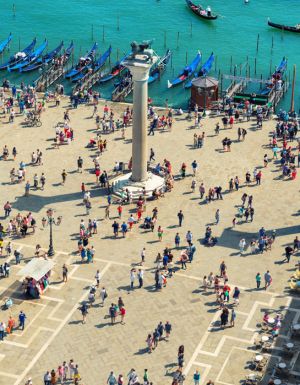
Sitting under the graciously wide arched walkways that line Venice’s St Mark’s Square on three sides, this exquisite space is the oldest coffee house in Italy having opened its doors way back in 1720.

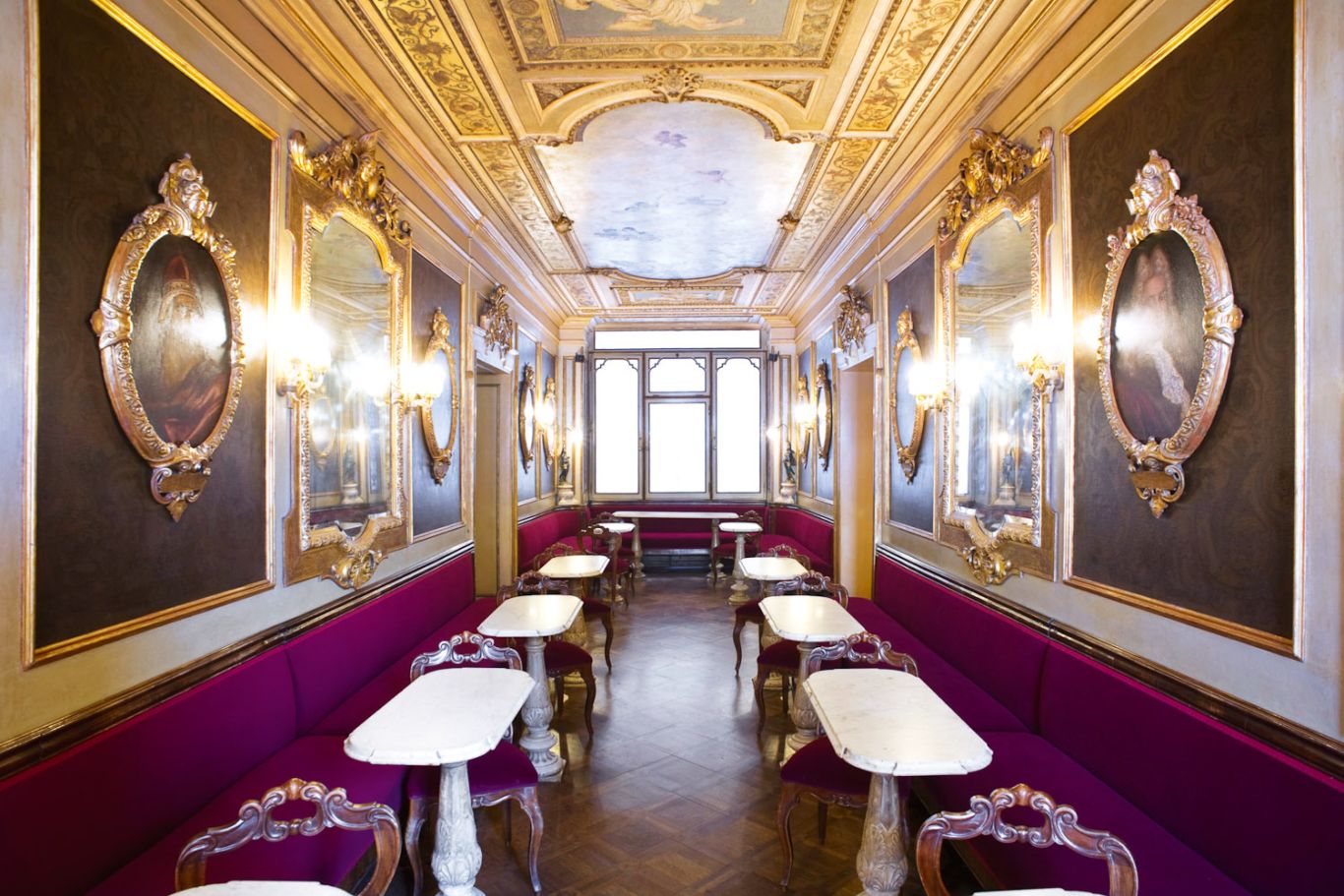
I first visited on a trip to Venice with my future husband. Giddy with the first flush of true love, we would visit every night sitting in the pretty painted salons with their velvet banquettes and little marble-topped tables sipping strong coffee and nibbling on something sweet.

Often we were the only ones there, given the late hour and the untouristy month of February. It was all wildly romantic and it became one of my absolute favourite places in the world, to be raved about and heartily recommended.

So on a recent trip to Venice with my daughter, Caffè Florian was as much a part of the itinerary as the Doge’s Palace and a gondola ride (she’s 10, it was non-negotiable).

Ducking past the three-piece ensemble performing on the square for those sitting alfresco taking in the view of San Marco and the Campanile, we take a seat inside.

The exuberantly frescoed walls and ceilings, punctuated with giant gilt-framed mirrors patinaed by age, make you feel like you’re sitting in an exquisite music box, classical music wafting in through the windows as it does.

There is a wonderful faded glory about the place; evidence of its long history rather than an affectation of it that many modern places try to replicate.

The café has made very few concessions to modernity, either in the 19th, 20th or 21st centuries.

Of course when something becomes an attraction in its own right like Caffè Florian has, the reason it existed in the first place can sometimes become incidental.

After perusing the menu, my daughter and I decide on tea accompanied by biscotti and toasted ham and cheese finger sandwiches, which come with a signature sauce.

The waiter returns with a giant tray splendidly set with dainty silver tea service (the pots have little cosies on the handles to protect our fingers from burning as we pour) and monogrammed cups, saucers and plates, and places the entire thing on our table.

My daughter makes a beeline for the biscuits; dainty shortbreads and spicy ginger cookies and almond macarons.

I am more intrigued by the delicately toasted finger sandwiches which indeed come with a generous dollop of Florian sauce; rich and unctuous and tasting of anchovies and mayonnaise; perfect for dipping.

With the tray empty of food and drink we prepare to leave. The bill is delivered to our table by our smiling white-jacket-and-bow-tie wearing waiter; the grand total comes to $65, including a $9 supplement for the hard working ensemble on the piazza.

I don’t remember it costing quite as much when I was visiting all those years ago, but then love is blind, and I do love Caffè Florian.

Details

Caffè Florian

St Mark’s Square, Venice; caffeflorian.com

Open Thursday to Tuesdays from 10am until midnight from April to October, and from 10am until 11pm from November to March.


Want to see more stories from International Traveller in your Google search results?

  1. Click here to set International Traveller as a preferred source.
  2. Tick the box next to "International Traveller". That's it.
hero media

What the European heatwave means for your summer travel plans

Temperatures are soaring this summer, breaking records across Europe and the UK. 

Euro summer is a feeling like no other. But when a heatwave hits? The dream trip quickly turns into a sweaty mess. Extreme heat is sweeping Europe and the UK this week, with record-high temperatures impacting travel plans across the continent.

And while Australian summers are typically hotter in absolute temperature, many European cities aren’t equipped for high temperatures, resulting in unbearable weather.

Why is it so hot in Europe?

Signs of a hot summer loomed in May, when the mercury hit unprecedented spring highs. Now, extreme high temperature warning alerts have been issued in countries such as Spain, Italy, France, England, the Netherlands and Germany.

France saw its hottest day on record on Wednesday, with an average temperature of 30°C across the day and night. This surpasses the average temperature for June, which is 15°C to 25°C. Dozens of people have died, including 40 from drowning.

In Spain, 212 deaths have been linked to the heatwave.

The UK recorded its hottest June day ever on Wednesday with temperatures soaring to 36.1°C. In an article published by the Met Office – the UK’s national meteorological service – Professor Stephen Belcher CBE, Met Office Chief Scientist, shared his concerns about June’s heat. “To see temperatures like this in the UK in June is sobering. Events like this bring home the implications of climate change, with very high temperatures and humidity bringing significant health implications from heat stress, as well as impacts to a range of sectors such as transport, energy and water supply,” he said.

Heatwaves are becoming increasingly common in Europe and the UK, neither of which is prepared for such extremes. The World Meteorological Organization reported that in 2025, at least 95% of Europe experienced above-average annual temperatures and that the continent was heating up twice as fast as the global average.

How travel is impacted

A pharmacy sign displaying 40 degrees Celcius
A pharmacy broadcasting local weather data. (Credit: Getty/Dragoncello)

During a heatwave, power grids, water systems and transport networks can be affected, resulting in disrupted itineraries for travellers. In France, power outages have left thousands without electricity and early closures have been implemented for two of Paris’s biggest attractions, the Eiffel Tower (early afternoon rather than late at night) and the Louvre (two hours early). Eurostar cancelled its London to Paris and Paris to London services from the 22nd to the 25th, and major UK rail companies have been advising travellers to avoid using trains where possible, or to travel during early hours.

If a heatwave is predicted, being flexible with your itinerary and having fully refundable/changeable tickets is key, as extreme heat can force the cancellation of outdoor activities, impact rail and flight services and change the opening hours of sites and eateries.

Why does summer in Europe often feel hotter than summer in Australia?

people swimming in the Canal Saint-Martin in Paris
People swimming in the Canal Saint-Martin in Paris to cool off. (Credit: Rachael Thompson)

With some of the highest UV levels in the world, Australians are no strangers to the heat, adapting well to intense weather. But our infrastructure is largely equipped to withstand soaring temperatures with climate-responsive passive design, refrigerated air conditioning or evaporative coolers, as well as swimming spots aplenty.

Buildings in Northern and Western Europe and the UK, however, are constructed to retain heat and handle frosty winters. The lack of universal air conditioning means it generally feels hotter even though the temperature on your app might not look it. During a heatwave, it can feel like you’re in a sauna as cities act like heat traps.

How to stay cool and prepare for another heatwave

Relief is expected across Europe and the UK later this week, but more heatwaves are still possible in the coming months. Summer heat typically peaks in July and August.

Public transport often doesn’t have air conditioning, and buses in particular can be swelteringly hot. If you’re heading outside or your accommodation has no air conditioning, it’s worth buying a spray bottle and a handheld fan from a pharmacy or tourist stand. Check ahead of time if restaurants and cafes have air conditioning and make a booking in advance. The highest temperatures typically hit between 3pm and 6pm, so aim to head outdoors outside of these hours.

Rising temperatures invite travellers to enter a more intentional era of seeing the world. Now more than ever is the time to embrace lower-impact “coolcations” and off-season getaways.

A love affair with Caffè Florian, Venice - International Traveller Magazine