hero media

You (or your kids) could attend Gladiator School in Rome

Susan Murphy sends her husband and son into battle to review the Eternal City’s Roman Gladiator School.


Ulfragar, Son of Wolf, greets us at the entrance to the Gladiator School of Rome dressed in a maroon tunic, cinched at the waist with a wide leather belt, and a pair of lace-up boots.


He looks as though he lifts weights to keep up his gladiatorial shape: wide shoulders, muscular legs and arms the shape of large hams. I’m impressed already, not by his physique but by his stamina; it is six degrees celsius and far too cold to be wearing a dress.


The Gladiator School of Rome is located close to the Appian Way, the great cobblestoned highway built to carry Roman armies in and out of Rome, with the ruts made by ancient carriage wheels still visible.
 

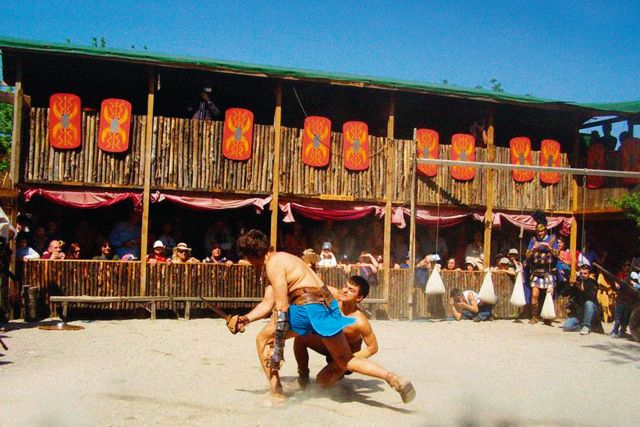
In battle at the Roman Gladiator School, Italy.


The school is set up to replicate barracks complete with a small arena and museum.


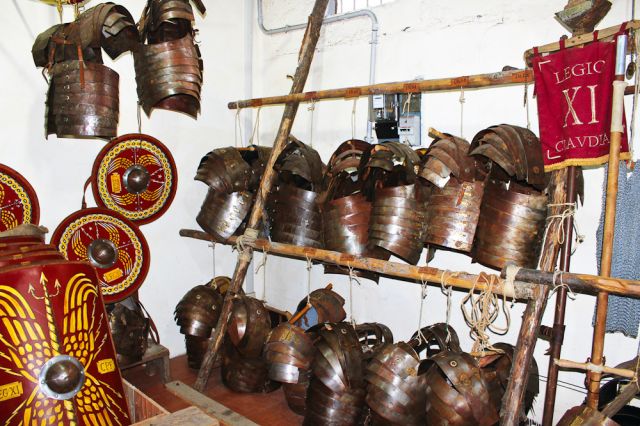
We accidently veer into what looks like a training ground, with sand bags swinging from ropes and a shed lined with racks of helmets and shields, and wonder what we’ve let ourselves in for.


A week of sightseeing has led us to hunt out some action for our teenager; a two-hour class on how to be a gladiator.


We are disappointed to find we are the only people here apart from Ulfragar; we were expecting combatants to pit ourselves against.


In a passive anti-climax, the session kicks off with a tour of the museum, which has the feel of a backyard shed junk collection but actually holds some interesting pieces.


Ulfragar, whose real name is Emanuele, walks us through the exhibits and we learn a few things that we haven’t already read in the guide books.


Gruesome weapons and tales of characters such as ‘the doctor’, who finished off half-dead gladiators with a giant hammer, fascinate us.


Our son is less impressed when he is asked to model one of the moth-eaten animal pelt head dresses on display.
Weapons and armour at the Roman Gladiator School in Rome, Italy.
Weapons and armour at the Roman Gladiator School, Italy.


Tour over, we shuffle outside hoping for a dose of adrenaline. Ulfagar is chirpy as he hands out gladiator tunics to my husband and son, but not to me.


Apparently there is graffiti written on a wall in Pompeii stating, ‘Celadus makes the girls swoon’: I’m happy to take my cue from ancient times and barrack from the side-lines.


Ulfagar gives each of the would-be gladiators a wooden sword, and soon has them swooshing and prancing with four basic sword movements and some footwork: a downward whack to the head, a side slice to the neck, a backhander to the knees with a full body twist and a quick in-out thrust to the stomach.


With the basics mastered, Ulfragar deems them ready for the real thing: huge metal swords (with blunt edges), a leather glove and a padded shield.


A bonk on the head with one of these and our travel insurance could be getting a serious work-out.


The clang of metal ringing triggers bloodlust and the pace of competition intensifies.


Gladiators were deliberately paired to highlight mismatches, to make for more interesting competition: heavy with light, fast with slow. There is a nice mismatch to this pairing: big, old and clumsy versus slim, young and agile.


The session culminates in a duel using duck-taped plastic swords where points are scored for body hits, giving father and son the opportunity to freely belt into each other, which they take to with relish. I can’t tell if they are doubled up with laughter, exhaustion or mortal blows to the stomach.


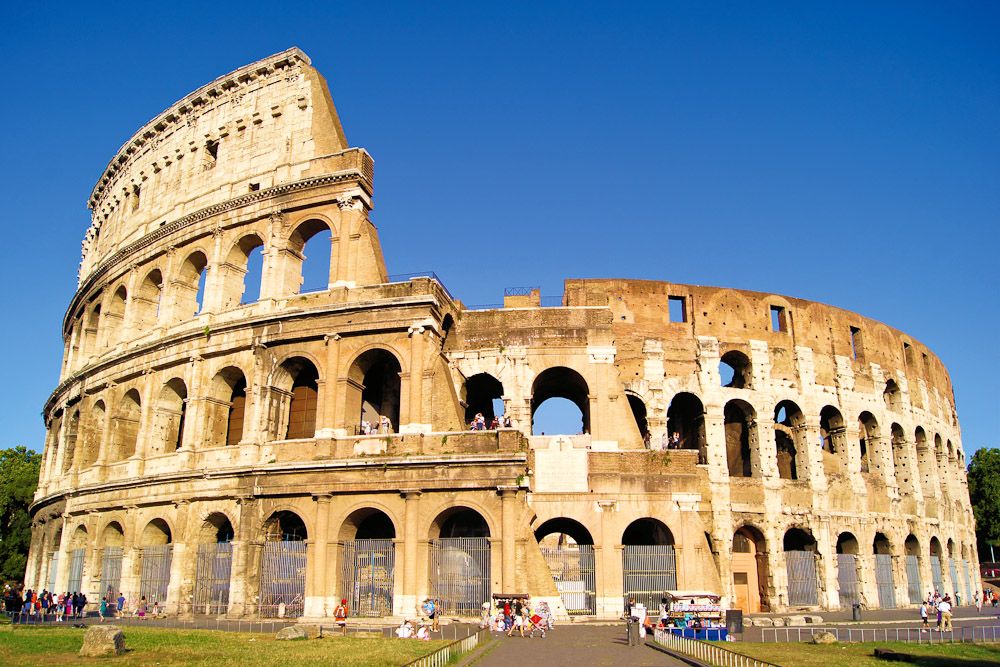
Ulfragar eventually awards both combatants a certificate complete with new gladiator names. Spartacus and Maximus rattle back into Rome over the cobblestones and past the Colosseum with a new-found appreciation for the lot of a gladiator and the satisfaction of an afternoon of energy well spent.


Details

Roman Gladiator School

18 Appia Antica, Rome
+39 33 82436678


The IT Verdict

“The gladiator lessons provide a change from passive sightseeing and a fun way to learn about gladiators, especially for children and teenagers. Longer sessions are available but two hours was enough."


Cost

$79 per person for a two-hour session, which includes a guided tour of the museum and a sword lesson.

Want to see more stories from International Traveller in your Google search results?

  1. Click here to set International Traveller as a preferred source.
  2. Tick the box next to "International Traveller". That's it.
hero media

What the European heatwave means for your summer travel plans

Temperatures are soaring this summer, breaking records across Europe and the UK. 

Euro summer is a feeling like no other. But when a heatwave hits? The dream trip quickly turns into a sweaty mess. Extreme heat is sweeping Europe and the UK this week, with record-high temperatures impacting travel plans across the continent.

And while Australian summers are typically hotter in absolute temperature, many European cities aren’t equipped for high temperatures, resulting in unbearable weather.

Why is it so hot in Europe?

Signs of a hot summer loomed in May, when the mercury hit unprecedented spring highs. Now, extreme high temperature warning alerts have been issued in countries such as Spain, Italy, France, England, the Netherlands and Germany.

France saw its hottest day on record on Wednesday, with an average temperature of 30°C across the day and night. This surpasses the average temperature for June, which is 15°C to 25°C. Dozens of people have died, including 40 from drowning.

In Spain, 212 deaths have been linked to the heatwave.

The UK recorded its hottest June day ever on Wednesday with temperatures soaring to 36.1°C. In an article published by the Met Office – the UK’s national meteorological service – Professor Stephen Belcher CBE, Met Office Chief Scientist, shared his concerns about June’s heat. “To see temperatures like this in the UK in June is sobering. Events like this bring home the implications of climate change, with very high temperatures and humidity bringing significant health implications from heat stress, as well as impacts to a range of sectors such as transport, energy and water supply,” he said.

Heatwaves are becoming increasingly common in Europe and the UK, neither of which is prepared for such extremes. The World Meteorological Organization reported that in 2025, at least 95% of Europe experienced above-average annual temperatures and that the continent was heating up twice as fast as the global average.

How travel is impacted

A pharmacy sign displaying 40 degrees Celcius
A pharmacy broadcasting local weather data. (Credit: Getty/Dragoncello)

During a heatwave, power grids, water systems and transport networks can be affected, resulting in disrupted itineraries for travellers. In France, power outages have left thousands without electricity and early closures have been implemented for two of Paris’s biggest attractions, the Eiffel Tower (early afternoon rather than late at night) and the Louvre (two hours early). Eurostar cancelled its London to Paris and Paris to London services from the 22nd to the 25th, and major UK rail companies have been advising travellers to avoid using trains where possible, or to travel during early hours.

If a heatwave is predicted, being flexible with your itinerary and having fully refundable/changeable tickets is key, as extreme heat can force the cancellation of outdoor activities, impact rail and flight services and change the opening hours of sites and eateries.

Why does summer in Europe often feel hotter than summer in Australia?

people swimming in the Canal Saint-Martin in Paris
People swimming in the Canal Saint-Martin in Paris to cool off. (Credit: Rachael Thompson)

With some of the highest UV levels in the world, Australians are no strangers to the heat, adapting well to intense weather. But our infrastructure is largely equipped to withstand soaring temperatures with climate-responsive passive design, refrigerated air conditioning or evaporative coolers, as well as swimming spots aplenty.

Buildings in Northern and Western Europe and the UK, however, are constructed to retain heat and handle frosty winters. The lack of universal air conditioning means it generally feels hotter even though the temperature on your app might not look it. During a heatwave, it can feel like you’re in a sauna as cities act like heat traps.

How to stay cool and prepare for another heatwave

Relief is expected across Europe and the UK later this week, but more heatwaves are still possible in the coming months. Summer heat typically peaks in July and August.

Public transport often doesn’t have air conditioning, and buses in particular can be swelteringly hot. If you’re heading outside or your accommodation has no air conditioning, it’s worth buying a spray bottle and a handheld fan from a pharmacy or tourist stand. Check ahead of time if restaurants and cafes have air conditioning and make a booking in advance. The highest temperatures typically hit between 3pm and 6pm, so aim to head outdoors outside of these hours.

Rising temperatures invite travellers to enter a more intentional era of seeing the world. Now more than ever is the time to embrace lower-impact “coolcations” and off-season getaways.