hero media

7 of the best unique places to stay in Ireland

Want to see a different side of the Emerald Isle?  Go in search of seven very special places to rest your head.

Ireland has always been beautiful, but today it’s a vibrant, exciting and creatively diverse place to visit. Staying in Ireland means you could find yourself sleeping in a 100-year-old lighthouse, a yurt or a castle, even in a transparent dome where the stars will lull you to sleep. Welcome to a new, unique side of Ireland.

Live in a bubble

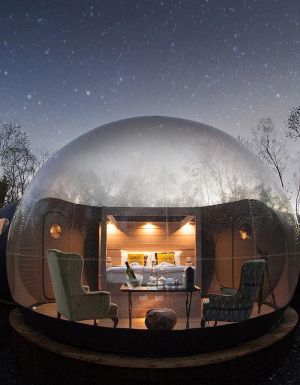
Finn Lough Bubble
Enjoy nature in the most luxurious way possible at Finn Lough Resort’s bubble-like Forest Domes; with a four-poster bed, en-suite bathroom, fluffy robes and comfy slippers. Photography credit: Sarah Fyffe


Finn Lough Resort is one of those places you hear about, but can’t imagine that such a spot actually exists; it’s that spectacular. Sure, you can stay in one of their lakeside lodges overlooking picturesque Lower Lough Erne, or in a cottage or catered suite, but the real magic happens in their bubble-like Forest Domes. With 180-degree views, you’re immersed in nature in the most luxurious way possible: with a four-poster bed, en-suite bathroom, fluffy robes and comfy slippers. There are even telescopes for night-time stargazing.

Finn Lough Bubble Aerial Shot
Photography credit: Sarah Fyffe


Finn Lough Bubble Interior Shot
Photography credit: Sarah Fyffe

Sleep within history

Titanic Hotel
Titanic Belfast is the world’s biggest Titanic visitor attraction. This majestic building stands on the very site where Titanic was built, and boasts nine galleries covering everything from Belfast’s shipbuilding heritage to the discovery of the wreck.

Belfast was once a great ship-building city, and from 1909 to 1911 Harland and Wolff constructed the most famous ship of all here, the RMS Titanic. To honour its legacy, the shipyard has been regenerated into Titanic Quarter. Here, you’ll find restaurants, the Titanic Belfast visitor attraction and the stunning and luxurious Titanic Hotel.


Built into the old Harland and Wolff headquarters (where the drawings for the Titanic were made), 119 rooms celebrate the ill-fated ship with Art Deco styling harking back to a bygone era and nautical elements throughout.

Be the king of the castle

Clomantagh Castle in County Kilkeny
Clomantagh Castle in County Kilkenny, sleeps up to 10 people over five bedrooms (one with a spectacular four-poster), so bring a crew.

Want to pretend you’re on the set of a Medieval film for a few days? Then head to Clomantagh Castle in County Kilkeny. It sleeps up to 10 people over five bedrooms (one with a spectacular four-poster), so bring a crew. The buildings in the complex date back to the 12th century, and there’s even a tower from the 1430s that is sure to fuel wild imaginations.

Hang out in a yurt

Portsalon Luxury Camping
Hang out in a yurt, surrounded by mountains and the Atlantic Ocean, boasting a deck area, fire pit and barbecue.

We know, we know – the rain in Ireland is famous, so why would you want to sleep in a tent? Well in fact, the sun shines for around 300 days of the year – and if you go in summer it has some simply stunning locations to spend time outdoors (16 hours of daylight a day, anyone?).


County Donegal is renowned for being one of the country’s most picturesque regions and it is there that you will find Portsalon Luxury Camping and their five Mongolian-style yurts. Kitted out with king-size beds, wood-burning stoves, carpets and lockable front doors, they house four to six people each, and cost as little as €65 a night. Surrounded by mountains and the Atlantic Ocean, they also boast a deck area, fire pit and barbecue. This is camping for people who don’t do camping.

Find your inner lighthouse keeper

Blackhead Cutter lighthouse
Find your inner lighthouse keeper with a stay at the Blackhead Cutter lighthouse.

Who didn’t watch Round the Twist and long to live in a lighthouse? Well now you can make that dream come true. Stay at the Blackhead Cutter overlooking Belfast Lough. Your abode is within one of the original Lightkeepers’ Houses, where lightkeepers lived and worked until 1975, witnessing Belfast’s many ships leaving port – including the Titanic.

Weekly travel news, experiences
insider tips, offers,
and more.

Hit the water

Traditional Irish narrowboat
All aboard the narrowboat!

Who needs a hotel when you can stay on a barge? Riversdale Holidays offer stays on their three beautiful barges, for trips up and down the picturesque Shannon-Erne Waterway.


Be your own captain as you glide along the water on a traditional narrowboat, complete with all the mod-cons of central heating and wood-burning stove.

En garde!

Martello Tower Sutton
You couldn’t be more secure in the Martello Tower Sutton.

Built in 1804 to defend against the growing threat of Napoleon Bonaparte’s forces, Martello Tower Sutton was the first of its kind to be built in Dublin to protect the city. Built with 2- to 4-metre-thick walls, the doorway is 3 metres above ground and was once only accessible by ladder (thankfully there is now a staircase).


Today, it has been transformed into a beautiful three-floored holiday home replete with stone-walled living room, two double bedrooms and a balcony overlooking the water. The top-floor kitchen means you can source some of the incredible local seafood and eat it up here with 360-degree views of the bay.


Want to see more stories from International Traveller in your Google search results?

  1. Click here to set International Traveller as a preferred source.
  2. Tick the box next to "International Traveller". That's it.
hero media

What the European heatwave means for your summer travel plans

Temperatures are soaring this summer, breaking records across Europe and the UK. 

Euro summer is a feeling like no other. But when a heatwave hits? The dream trip quickly turns into a sweaty mess. Extreme heat is sweeping Europe and the UK this week, with record-high temperatures impacting travel plans across the continent.

And while Australian summers are typically hotter in absolute temperature, many European cities aren’t equipped for high temperatures, resulting in unbearable weather.

Why is it so hot in Europe?

Signs of a hot summer loomed in May, when the mercury hit unprecedented spring highs. Now, extreme high temperature warning alerts have been issued in countries such as Spain, Italy, France, England, the Netherlands and Germany.

France saw its hottest day on record on Wednesday, with an average temperature of 30°C across the day and night. This surpasses the average temperature for June, which is 15°C to 25°C. Dozens of people have died, including 40 from drowning.

In Spain, 212 deaths have been linked to the heatwave.

The UK recorded its hottest June day ever on Wednesday with temperatures soaring to 36.1°C. In an article published by the Met Office – the UK’s national meteorological service – Professor Stephen Belcher CBE, Met Office Chief Scientist, shared his concerns about June’s heat. “To see temperatures like this in the UK in June is sobering. Events like this bring home the implications of climate change, with very high temperatures and humidity bringing significant health implications from heat stress, as well as impacts to a range of sectors such as transport, energy and water supply,” he said.

Heatwaves are becoming increasingly common in Europe and the UK, neither of which is prepared for such extremes. The World Meteorological Organization reported that in 2025, at least 95% of Europe experienced above-average annual temperatures and that the continent was heating up twice as fast as the global average.

How travel is impacted

A pharmacy sign displaying 40 degrees Celcius
A pharmacy broadcasting local weather data. (Credit: Getty/Dragoncello)

During a heatwave, power grids, water systems and transport networks can be affected, resulting in disrupted itineraries for travellers. In France, power outages have left thousands without electricity and early closures have been implemented for two of Paris’s biggest attractions, the Eiffel Tower (early afternoon rather than late at night) and the Louvre (two hours early). Eurostar cancelled its London to Paris and Paris to London services from the 22nd to the 25th, and major UK rail companies have been advising travellers to avoid using trains where possible, or to travel during early hours.

If a heatwave is predicted, being flexible with your itinerary and having fully refundable/changeable tickets is key, as extreme heat can force the cancellation of outdoor activities, impact rail and flight services and change the opening hours of sites and eateries.

Why does summer in Europe often feel hotter than summer in Australia?

people swimming in the Canal Saint-Martin in Paris
People swimming in the Canal Saint-Martin in Paris to cool off. (Credit: Rachael Thompson)

With some of the highest UV levels in the world, Australians are no strangers to the heat, adapting well to intense weather. But our infrastructure is largely equipped to withstand soaring temperatures with climate-responsive passive design, refrigerated air conditioning or evaporative coolers, as well as swimming spots aplenty.

Buildings in Northern and Western Europe and the UK, however, are constructed to retain heat and handle frosty winters. The lack of universal air conditioning means it generally feels hotter even though the temperature on your app might not look it. During a heatwave, it can feel like you’re in a sauna as cities act like heat traps.

How to stay cool and prepare for another heatwave

Relief is expected across Europe and the UK later this week, but more heatwaves are still possible in the coming months. Summer heat typically peaks in July and August.

Public transport often doesn’t have air conditioning, and buses in particular can be swelteringly hot. If you’re heading outside or your accommodation has no air conditioning, it’s worth buying a spray bottle and a handheld fan from a pharmacy or tourist stand. Check ahead of time if restaurants and cafes have air conditioning and make a booking in advance. The highest temperatures typically hit between 3pm and 6pm, so aim to head outdoors outside of these hours.

Rising temperatures invite travellers to enter a more intentional era of seeing the world. Now more than ever is the time to embrace lower-impact “coolcations” and off-season getaways.

7 Unique Places To Stay In Ireland