hero media

Bach, battles and bratwurst: Germany’s cultural icons

From Berlin to Leipzig, IT reader Michael Azize explores Germany’s historical depths and cultural icons.


The food

First, the ridiculous. I wasn’t surprised to find that the national food of Germany is bratwurst (sausage), but I was amazed to discover that the most popular sausage in Berlin seems to be the currywurst.

This is grilled sausage smothered in curry-flavoured tomato sauce and sprinkled with curry powder.

Talk about making a wurst thing bad! However, the non-touristy German restaurants serve up hearty, simple, tasty meals at a good price.

Now, the sublime.
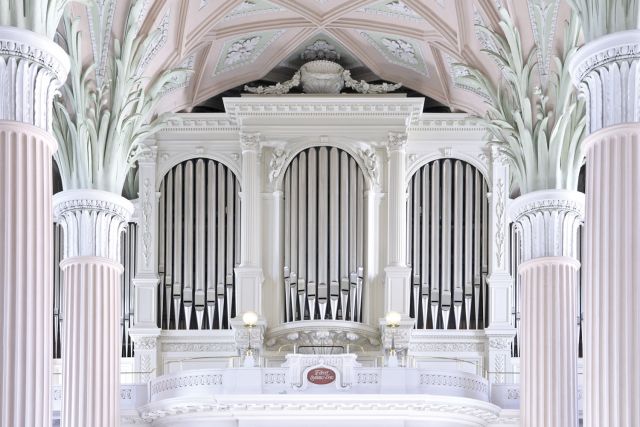
Leipzig's 18th-century St Nicholas Church.
The elaborate organ design in Leipzig’s 18th-century St Nicholas Church.

The culture

The Siegessäule (Victory Column) in Berlin marks the unification of the previously disparate and warring German-speaking people under Prussian control; you might remember it from the movie Wings of Desire.

It is simple, stunning and awe-inspiring.

The Brandenburg Gate is also magnificent and the light show that accompanies it at night quite remarkable, although the effect was ruined somewhat by a busker breaking into the Harpo song Movie Star.

Fawlty Towers told us not to mention the War, but that does not seem to be a problem for the Germans, whose museums and memorials are very frank about the nation’s conflicts.

The massive and impressively detailed German Historical Museum starts with the Celts and continues through to the Holy Roman Empire, the hegemony of the Saxons, the separation of the German states, the rise of Prussia, the two World Wars and the descent of the Iron Curtain.

Nothing seems to be left out and nothing was shied away from.

Other museums go into the Holocaust and political and social oppression under the Nazis and communists in great detail. The Checkpoint Charlie Museum is cramped and chaotic, but its message is clear, and includes amazing true stories of escape from the East.

My favourite is about a man in West Berlin who was separated from his girlfriend on the East side when the wall went up.

He got a Swiss girlfriend that looked like his East Berlin girlfriend, took her to East Berlin, stole her passport, took his East German love to the West and gave the Swiss a miss. She eventually got out and the guy spent time in gaol for the passport theft.

Just outside the capital is Potsdam, where Frederick the Great built his main palace and retreat, the gardens of which are a spectacular sight.

It almost makes you glad there were royals to do such things, provided they then disappear so we can poke unhindered around their palaces.
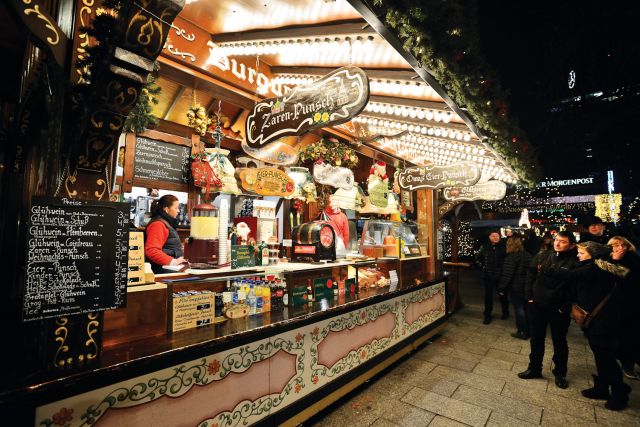
Food stall at the Christmas market in Charlottenburg, Berlin.

The bars

Before leaving the surrounds of Berlin, a note on its bars. The beer is very good but served only mildly chilled in very tall glasses with two inches of head; smoking is rampant and every German seems to know every other German.
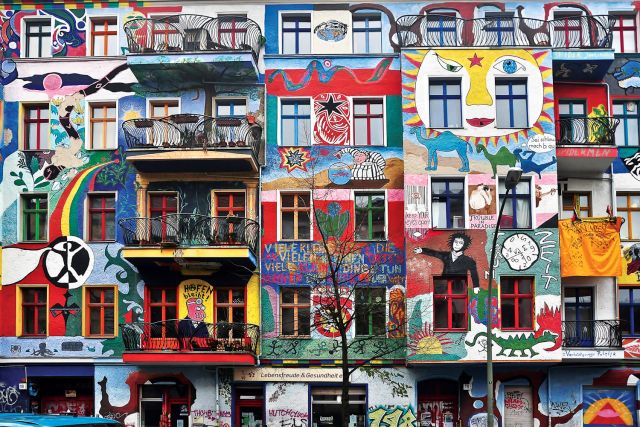
A splash of colour on houses in East Berlin.

From Berlin to Leipzig

The Google directions to my hotel were: catch a train two stations and walk for 25 minutes. Better instructions would have been: walk outside, take the No. 5 bus for 15 minutes and the hotel is around the corner.

It could be argued that Leipzig was the starting point for the downfall of communism.

Peaceful mass protests following Monday prayers at St Nicholas Church soon drew crowds of 320,000 from a population of half a million. To their credit the authorities did not turn to violence to stop them and before long the protests spread to Berlin and the rest is history.

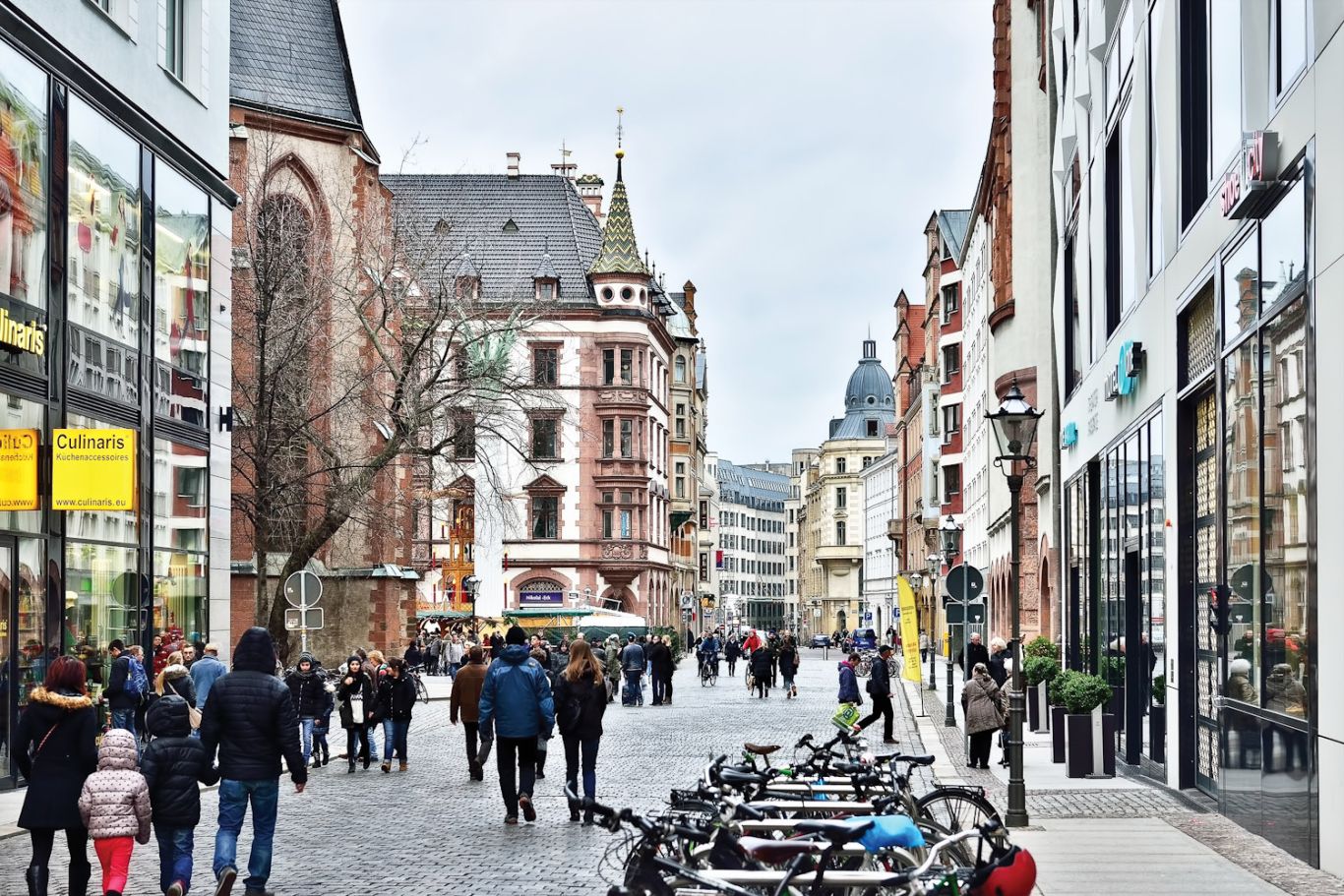
Leipzig was bombed heavily during the Second World War, but it shows few of the scars from that. The city centre has the same stores as any Western city but it is rendered quaint by the cobbled streets, old buildings and the many plazas.

When I visit it seems to be holding a festival of bad haircuts with mullets, fruitbats, mohawks and combinations of them all in abundance.

The two must-sees in Leipzig are the Bach Museum and the little-known Monument to the Battle of the Nations. The Bach Museum is an elegant and tasteful building, filled with music and light.

I do not claim to understand classical music (though I know that strictly speaking Bach is baroque, not classical); I don’t even know what I like, but this is heavenly stuff and all you really need is a willingness to open your ears.

In the Battle of the Nations, for three days Napoleon’s heavily outnumbered French force, supported by the German Confederation of the Rhine, fought a combined Russian-Prussian army. It ended in a stalemate, but coming on the heels of the disastrous Russian campaign, Napoleon lost most of central Europe and his mystique. The allies were encouraged to invade France and he was sent into exile on the island of Elba.

The monument lives up to the scale of the events it commemorates. Pictures barely do it justice, much like many things in this part of Germany, including the currywurst!

Weekly travel news, experiences
insider tips, offers,
and more.

Want to see more stories from International Traveller in your Google search results?

  1. Click here to set International Traveller as a preferred source.
  2. Tick the box next to "International Traveller". That's it.
hero media

What the European heatwave means for your summer travel plans

Temperatures are soaring this summer, breaking records across Europe and the UK. 

Euro summer is a feeling like no other. But when a heatwave hits? The dream trip quickly turns into a sweaty mess. Extreme heat is sweeping Europe and the UK this week, with record-high temperatures impacting travel plans across the continent.

And while Australian summers are typically hotter in absolute temperature, many European cities aren’t equipped for high temperatures, resulting in unbearable weather.

Why is it so hot in Europe?

Signs of a hot summer loomed in May, when the mercury hit unprecedented spring highs. Now, extreme high temperature warning alerts have been issued in countries such as Spain, Italy, France, England, the Netherlands and Germany.

France saw its hottest day on record on Wednesday, with an average temperature of 30°C across the day and night. This surpasses the average temperature for June, which is 15°C to 25°C. Dozens of people have died, including 40 from drowning.

In Spain, 212 deaths have been linked to the heatwave.

The UK recorded its hottest June day ever on Wednesday with temperatures soaring to 36.1°C. In an article published by the Met Office – the UK’s national meteorological service – Professor Stephen Belcher CBE, Met Office Chief Scientist, shared his concerns about June’s heat. “To see temperatures like this in the UK in June is sobering. Events like this bring home the implications of climate change, with very high temperatures and humidity bringing significant health implications from heat stress, as well as impacts to a range of sectors such as transport, energy and water supply,” he said.

Heatwaves are becoming increasingly common in Europe and the UK, neither of which is prepared for such extremes. The World Meteorological Organization reported that in 2025, at least 95% of Europe experienced above-average annual temperatures and that the continent was heating up twice as fast as the global average.

How travel is impacted

A pharmacy sign displaying 40 degrees Celcius
A pharmacy broadcasting local weather data. (Credit: Getty/Dragoncello)

During a heatwave, power grids, water systems and transport networks can be affected, resulting in disrupted itineraries for travellers. In France, power outages have left thousands without electricity and early closures have been implemented for two of Paris’s biggest attractions, the Eiffel Tower (early afternoon rather than late at night) and the Louvre (two hours early). Eurostar cancelled its London to Paris and Paris to London services from the 22nd to the 25th, and major UK rail companies have been advising travellers to avoid using trains where possible, or to travel during early hours.

If a heatwave is predicted, being flexible with your itinerary and having fully refundable/changeable tickets is key, as extreme heat can force the cancellation of outdoor activities, impact rail and flight services and change the opening hours of sites and eateries.

Why does summer in Europe often feel hotter than summer in Australia?

people swimming in the Canal Saint-Martin in Paris
People swimming in the Canal Saint-Martin in Paris to cool off. (Credit: Rachael Thompson)

With some of the highest UV levels in the world, Australians are no strangers to the heat, adapting well to intense weather. But our infrastructure is largely equipped to withstand soaring temperatures with climate-responsive passive design, refrigerated air conditioning or evaporative coolers, as well as swimming spots aplenty.

Buildings in Northern and Western Europe and the UK, however, are constructed to retain heat and handle frosty winters. The lack of universal air conditioning means it generally feels hotter even though the temperature on your app might not look it. During a heatwave, it can feel like you’re in a sauna as cities act like heat traps.

How to stay cool and prepare for another heatwave

Relief is expected across Europe and the UK later this week, but more heatwaves are still possible in the coming months. Summer heat typically peaks in July and August.

Public transport often doesn’t have air conditioning, and buses in particular can be swelteringly hot. If you’re heading outside or your accommodation has no air conditioning, it’s worth buying a spray bottle and a handheld fan from a pharmacy or tourist stand. Check ahead of time if restaurants and cafes have air conditioning and make a booking in advance. The highest temperatures typically hit between 3pm and 6pm, so aim to head outdoors outside of these hours.

Rising temperatures invite travellers to enter a more intentional era of seeing the world. Now more than ever is the time to embrace lower-impact “coolcations” and off-season getaways.