hero media

Sri Lanka: Beyond curries and colonialism

Lance Richardson journeys from Sri Lanka’s shaggy coastline to the top of its holy mountain by tuk-tuk and train – with colonialism and curries in between.

There’s no alcohol today, but the thousands of people on Negombo Beach are drunk on atmosphere alone.

Some swim, the women fully clothed; others buy oily short eats from carts with ‘Masha Allah’ or ‘Power of Jesus’ stencilled on their sides.

Where yesterday a snake-charmer spooked children with an uncoiling cobra, now there’s Sinhala tunes echoing across soccer games and drum circles.

Soon a stage will spotlight dancing girls in saris. The British may have left Ceylon in 1948, but the locals have been celebrating ever since, throwing huge euphoric parties each year on 4 February – Independence Day.

At the same time, history has been amended. The country is Sri Lanka again, its name in ancient epics like the Ramayana.

And school children like to tell a fanciful tale that casts the British as pea-brained teachers: they came, taught cricket, and the Sri Lankans allowed them to stay only until they could be beaten at their own game. Then they were asked to leave.

Such a story presents colonialism as a toothless anecdote, but it also reveals something about how Sri Lankans want to be seen by the world today – as shrewd, self-reliant, and equal to the larger powers.

This is a country that has endured centuries of foreign rule. More recently was the 2004 tsunami, the greatest natural disaster in living memory.

The quarter-century civil war has taken even more casualties; though it officially ended in 2009 it leaves an ethnic fissure that is yet to heal in the battered north. Sri Lanka is like a patient who has spent decades in the operating theatre, occasionally flat-lining.

But now it’s rousing back to consciousness with the vigour of a newborn.

Travellers often beeline for Colombo after landing at the airport. But a better introduction can be found slightly north, at this shaggy beach town of Negombo. It sets the scene perfectly, on Independence Day or any day at all – the laid-back lifestyle, the gaudy colour palette, the fragrant tang of cardamom and cumin drowned in coconut milk. Negombo slows the heartbeat to Sri Lankan speed, a necessary adjustment, because travelling here takes a lot of time.

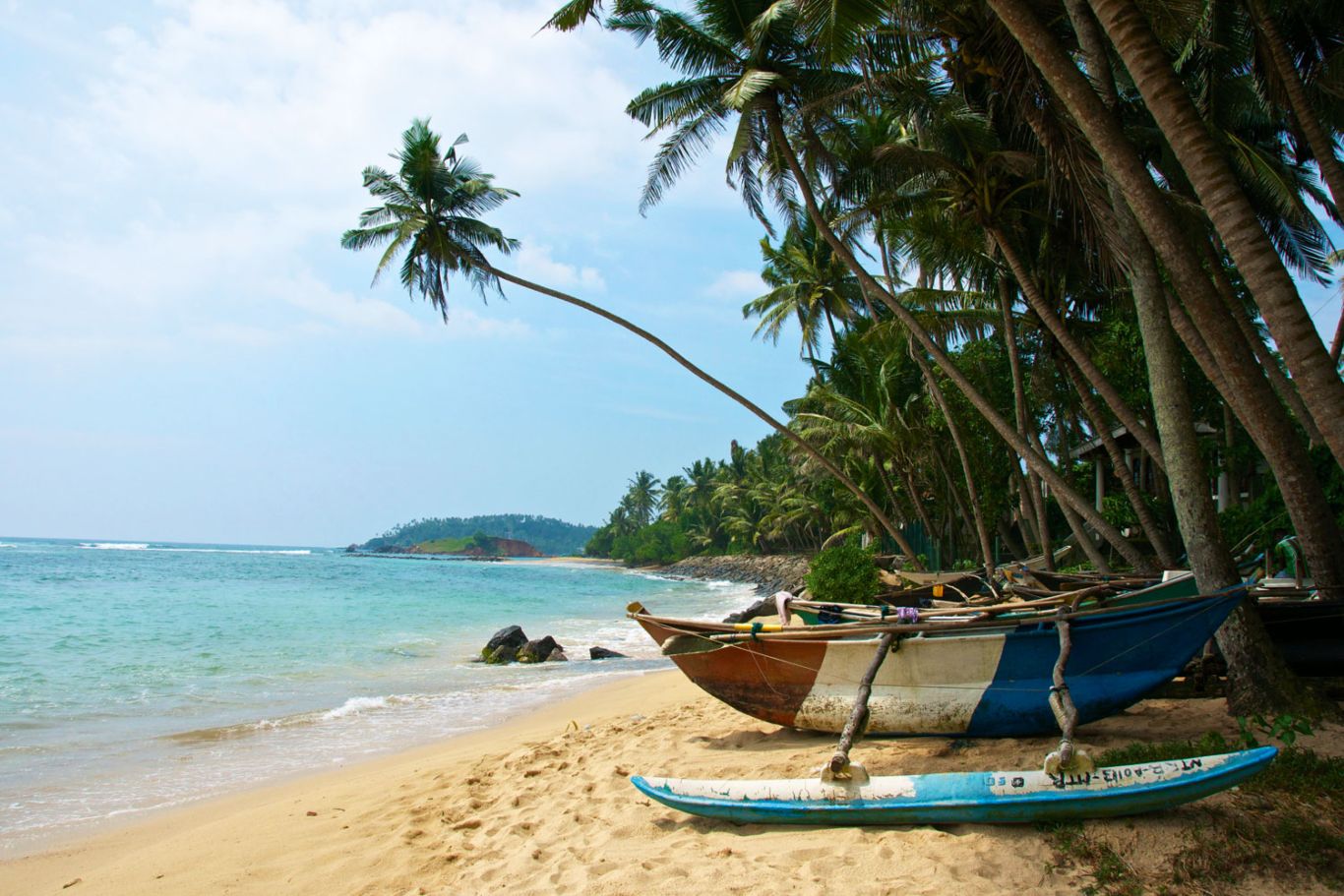
Partly this is because the beaches are so hard to leave. Travelling south past Colombo and Galle all the way to wind-swept Tangalle, this coastline is postcard Sri Lanka, with languorous palms, crab curry, and dark crows circling above white dagobas.

But the country’s fortunes are on the rise now, and there’s a great deal more to see. This trip is all about ascents – up into the mountains called the Hill Country, all the way to the very top of Sri Pada (‘Adam’s Peak’), the most sacred site of them all.

Tea and sympathy

The village of Ella has emerged as the defacto visitor’s capital of the Hill Country. To reach it from the south I board a bus in Tangalle, change at Wellawaya, and rumble up a vertigo-inducing series of switchbacks.

Ella is perched at the top, gazing down on the blue coast through a gap in the mountains that creates a natural frame. In clear weather the view is astounding, but today the town’s inclined main street is muddy, its lights on the fritz as the power supply struggles against the rain.

“Is Ella very busy?", I ask a tuk-tuk driver, his vehicle resembling a rhino beetle with its horn snapped off. People rush past with umbrellas held above their suitcases. “So busy," he says. “Everybody is looking for a room!"

This sort of comment is usually dispiriting when you haven’t booked in advance, but Sri Lanka’s sudden popularity has given rise to a class of savvy entrepreneurs.

You can trust your luck to traditional hotels, scouring the internet; or you can allow yourself to be swept along on a current of suggestions, spreading money to the people who need it most. I tell the driver I’m looking for a room too, but one away from this bustling thoroughfare – a home-stay perhaps?

The driver takes me to his friend S. M. (Namal) Priyantha, who runs the aptly named Great View Inn, a modest but comfortable addition to his family home.

Twenty minutes later I’m standing on a rose-lined terrace overlooking Ravana Falls. As Priyantha points out the hot water and mosquito net, his little girl delivers tea with barely suppressed ecstasy. She lifts the lid off the sugar and explodes into giggles. I draw a map of Australia in their guestbook.

Often the infrastructure of travel separates visitors from the local people; the tourist exists in a sort of parallel world. Sri Lanka is different: you can find the thick of everyday life with very little effort here. I hire Priyantha asking him for the insider’s guide to his Buddhist temple, the nearest tea plantation, the best rice and curry going.

This is how I end up at the Dowa temple with its 2000-year old Buddha etched into stone; and an Ayurvedic spa called Suwamedura, where a man rubs coconut oil into my head as the lights fritz again over images of Shiva. Priyantha also recommends Haplewatte Tea for a tour of the factory and a taste-test.

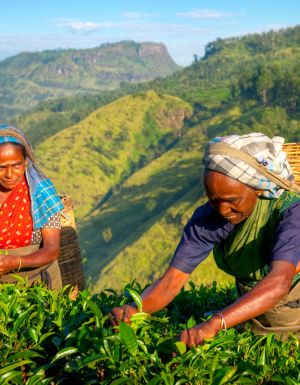
The prevalence of tea means I’m often conscious of the ghostly presence of the British, their obsession with the drink having transformed this landscape into a green carpet of almost uncanny neatness. In Nuwara Eliya (once called ‘Little England’), where I spend a night shortly after leaving Ella, ‘Edinburgh’ is lettered across a field of tea bushes.

There’s a manicured Victoria Park, with hothouses and a rose walk, and a prim golf course (“Probably the best golf course," an ambivalent sign says). Not to mention the legendary Hill Club, built in 1885 and resembling a cross between Downton Abbey and Frankenfurter’s castle from The Rocky Horror Picture Show. I’m forced to wear a musty jacket to dine beneath game trophies.

“How many ice cubes would you like?" a white-gloved waiter asks, hovering near a gin and tonic. “How many do you recommend?"

The soup is from a tin and the chocolate cake is finished with artificial cream.

It would seem grotesque were it not hilarious, like a museum lost in translation. Most everywhere else the Sri Lankans have taken the British legacy and created something new.

In Haputale, just before Nuwara Eliya, the tea factories remain the driving force of town – but it is a thoroughly Sri Lankan town, like a ramshackle bazaar with stray dogs sunbathing in the middle of the road.

When I catch the train between these places – Ella, Haputale, then Nuwara Eliya – I’m grateful for the leftover remnants of colonialism, because the train is a pleasure, floating along the hill crests like a cloud. But the things I like most are the tunnels, which Sri Lankan children treat as a game: they lean out the carriage doors and scream.

“Ghost train," one attendant offers by way of explanation. We clear the tunnel and the children howl with laughter, running down the aisle. A man walks past selling curried prawns and peanuts.

The holy mountain

The train through Hill Country was originally intended to transport tea for trade, terminating in Colombo. But the last main station in the mountains is Hatton, a dusty gateway to the sacred Sri Pada, sometimes called ‘Adam’s Peak.’

At Hatton station a bus waits to collect pilgrims; from here it’s a thrilling ride through tea fields terraced around the shores of Castlereagh Reservoir. Eventually we land up in Dalhousie, a carnival sideshow masquerading as a town. Everything else unfolds like a vivid dream.

It’s 2:00am when I wake to climb the mountain. Sri Pada looms above, a single vein of light illuminating 5200 steps.

Surrounded by old women and monks in saffron robes, it takes more than six hours because the staircase narrows dramatically, causing a bottleneck of devotees. But there are teahouses to rest in and a buoyant atmosphere.

By the time the sun rises, spilling gold, I am high above the cloud-line crouched in silence. The Buddhists believe that Buddha stepped on the top of Sri Pada, leaving his footprint; Hindus insist it was Shiva; Christians believe St Thomas; and Muslims say the print was left by Adam stepping down from Eden. Everybody makes the journey together.

In a way this feels like Sri Lanka summed up: stunning diversity crammed into a single small space. And it reminds me later of something I read in an old guidebook.

“What you get from it depends on what you bring," writes Arthur C. Clarke, the British novelist who lived in Sri Lanka until he died.

“If you never stray from your hotel bar or the dusty streets of Westernised Colombo, you could perish of fulminating boredom in a week, and it would serve you right. But if you are interested in people, history, nature and art – all the things that really matter – you may find, as I have, that a lifetime is not enough."

Places change over time, but when it comes to Sri Lanka that sentiment seems both vital and true, particularly now, as the sun rises higher and this tiny island shaped like a teardrop comes into its own again.


The Details

How to get there
Singapore Airlines flies toColombo daily with a transit inSingapore. Return economy fares fromAustralia toColombo start from $1685 (departing from the east coast) and $1538 (departing fromPerth). www.singaporeair.com

When to go
Much of Sri Lanka experiences only a wet and dry season. The best time to travel on the south coast and around the Hill Country is between December and May.

Where to stay
You don’t need a lot of money to find a comfortable room with hot water and a mosquito net. Asking around will lead to terrific home-stays that won’t be listed in guidebooks. Otherwise try these options.

Affordable: Great View Inn: modest but comfortable home-stay with a local Ella family. From $35 per night; Kithal Ella, Ella; +94 71 448 8981

Comfortable: St Andrew’s Hotel: Georgian manor recalling the halcyon days of ‘Little England,’ now run by Jetwing. Rooms from $98 per night; 10 St Andrew’s Dr, Nuwara Eliya; +94 52 222 3031; jetwinghotels.com/jetwingstandrews

Luxury: The Last House: final architectural masterpiece by Geoffrey Bawa offers a private seaside escape. Rooms from $148 (plus taxes) per night; Pubudu Mawatha, Tangalle; +94 81 720 1115; thelasthouse.com

Where to eat
The best food can be found in home-stays and nondescript local eateries. Be sure to try kothu rotti, curry, string hoppers and short eats.

Otherwise try The Hill Club – a hit-and-miss European cuisine but an entertaining time-warp with friends. 29 Grand Hotel Rd, Nuwara Eliya; +94 52 222 2653.

You can’t leave without
Egg hoppers are one of the great culinary pleasures of Sri Lanka: a cupped pancake, fried with egg and served up alongside chilli sambol. Perfect for breakfast.

Near Ella, the little-visited Dowa Temple is home to a 2000-year-old Buddha carved from stone. Water the bodhi tree and light a candle.

Slow the arduous ascent up Sri Pada (Adam’s Peak) with an early-morning rest at a teahouse.

Best thing about Sri Lanka
Sri Lanka rewards curiosity. Don’t be afraid to seek advice from locals and get off the beaten track.

Worst thing about Sri Lanka
Bus travel is incredibly convenient, but the dance music pumped through bus speakers can shred nerves without earplugs, so don’t forget to bring them for longer trips.

You should know
Australians require an Electronic Travel Authorisation to visit Sri Lanka, which can be obtained in advance. smartraveller.gov.au/zw-cgi/view/Advice/Sri_Lanka

Female travellers can be hassled here. Advances almost never go beyond catcalls, but women should exercise caution, particularly in the evenings.

The country grinds to a halt on poya (full moon) days, when alcohol is prohibited and many businesses close. Avoid climbing Sri Pada on a poya day.

Sri Lanka is currently booming as a travel destination. This means ballooning prices as local vendors push the limits of what people are willing to pay. Don’t be afraid to negotiate, but expect prices to be higher and in some cases double than those listed in guidebooks.


Weekly travel news, experiences
insider tips, offers,
and more.

Want to see more stories from International Traveller in your Google search results?

  1. Click here to set International Traveller as a preferred source.
  2. Tick the box next to "International Traveller". That's it.
hero media

These community homestays are changing how travellers experience Nepal

    After youth-led protests in 2025, this year Nepal elected a 35-year-old former rapper as Prime Minister. In a country where tourism is its biggest industry, what’s next for travellers? 

    In 1986, Nepal changed its clock. It had used India Standard Time since 1920 so, to differentiate, it wound its clock 15 minutes ahead of, not behind, its big-brother neighbour. Boss move. “Nepal is strongly opposed to the idea that our identity is connected to India,” says Community Homestay Network (CHN) guide Bikal Khanal.  

    Tharu dance
    Tharu dance is traditionally set to hand drums. (Credit: Kate Lewis)

    Today, Nepal is the only independent country with a 45-minute deviation to universal time; an oddity that’s become a symbol of national pride. The quirk is nearly as endearing as Kathmandu’s Tribhuvan airport where carved varnished wood and shiny red bricks rule. One sign points to a ‘Travelator’ and another to a ‘Grievance Handling Desk’ while visas are noisily stamped at customs for US dollars, cash only. When am I?  

    Nepal gray langur
    Spot the endemic Nepal gray langur. (Credit: Simon Urwin)

    The 15 or 45 minute anomaly sees me tap out completely on timezone calculations. Why bend my brain calculating if it’s quarter to or quarter past elsewhere when I’m in the honking here and now of Kathmandu where the air is high-altitude crisp, the prayer flags flutter and the street dogs howl?  

    How tourism is changing in Nepal

    Bardiya National Park
    Bardiya National Park is rich with wildlife. (Credit: Simon Urwin)

    India is not the only association many Nepalis would like to shake. With eight of the world’s 10 tallest mountains, including Mount Everest and Annapurna, Nepal has long attracted mountaineers and trekkers, and expedition numbers are continuing to rise.  

    Tourism is one of the country’s biggest sources of foreign currency, so this growth is not negative, per se. But according to Ang Tshering Lama, who co-founded Phaplu Mountain Bike Club, being reduced to a mere trekking destination is limiting.  

    “Trekking is just one layer of our identity,” says Ang. “When it becomes the dominant narrative, it limits how we’re seen and how we see ourselves.” Nepal’s recent success, however, in diverting trekkers to less-trafficked areas such as Manaslu mofuntain, where visitor numbers rose by 117 per cent last year, offers hope that tourism can diversify even more radically.   

    Local men in Bhada village
    Local men in Bhada village. (Credit: Simon Urwin)

    The founder of CHN, Shiva Dhakal, wants that change. “The whole idea of the Community Homestay Network is to promote experiences outside of trekking,” he says. “Community tourism changes lives and helps kids stay home instead of coming to the city or migrating to the Middle East.”  

    Ang grew up seeing people leave, “not because they wanted to but because there weren’t enough opportunities to stay”, he states. Yet from remote villages to living traditions; food, art, music and emerging subcultures, “there’s so much that’s not being seen.” 

    CHN is opening some of those doors. It doesn’t own, or fund, any homes. Rather, it promotes homestays to travellers on a single, slick platform, while fostering entrepreneurship in places where women, marginalised castes, Indigenous people and the youth stand to benefit the most.  

    A new generation demanding more

    Dalla Town Hall
    Dalla Town Hall, where volunteers discuss anti-poaching tactics. (Credit: Bheem Thapa)

    The future prospects of next-gen Nepalis can no longer be ignored. On a Kathmandu tour with 33-year-old guide Monica K.C, we pass buildings torched in the September 2025 ‘Gen Z protests’, including the Supreme Court and Parliament House. Seventy-two people died. “They were anti-corruption protests,” says Monica. “Politicians’ children are living a lavish life but the airports are crowded with youngsters leaving to find work.”  

    We stop in ‘little Tibet’ at the wondrous sixth-century Boudha Stupa. “The wheel of life is Buddhism in a nutshell,” says Monica. “Things such as hate, ignorance and anger keep you rotating around the wheel, so you must follow the principles of Buddhism to detach. If you can’t, there’s no nirvana for you.”  

    Boudha Stupa's prayer wheels
    Boudha Stupa’s prayer wheels are used to recite Buddhist prayers. (Credit: Kate Lewis)

    In a sun-drenched twist to the usual temple visit, we ascend the stupa’s sloping plinth and roam its whitewashed dome. Tendrils of diaphanous prayer flags stream from a steeple-like structure where the Buddha’s unblinking eyes stare out. No nirvana for you… 

    bouda stupa prayer flags
    Tibetan-style prayer flags embellish the whitewashed dome of Bouda Stupa, a Buddhist temple. (Credit: Kate Hennessy)

    The dome is delightfully free of guard rails or chiding from security. There is, however, a stern ‘No TikTok’ sign, perhaps in response to the youth’s newly flexed power. The booted-out Prime Minister, K.P. Sharma Oli, was replaced in a resounding election victory in March by 35-year-old Balendra Shah of the Rastriya Swatantra Party (RSP) – a former rapper and mayor of Kathmandu. The RSP’s manifesto indicates tourism is a priority, and that Nepal’s cultural identity in areas such as gastronomy will be strengthened.  

    Boudha Stupa vendors
    Vibrant souvenir shops and cafes around Boudha Stupa. (Credit: Kate Hennessy)

    A more confronting stop awaits at Pashupatinath Temple. Today is Bala Chaturdashi, a Hindu festival where thousands of devotees gather to honour their dead ancestors. Vendors hauling foam mattresses do a lucrative trade as people set up for a night of vigil. This includes burning the bodies of recently deceased relatives on bamboo pyres in the Bagmati River, which flows into the sacred Ganges.  

    A woman at annual Hindu festival Bala Chaturdashi
    A woman at annual Hindu festival Bala Chaturdashi, in Kathmandu. (Credit: Kate Hennessy)

    Wrapped in a shroud, the bodies are positioned with their heads facing north to the Himalayas where Lord Shiva resides. They’re covered with flowers and straw and set alight by male family members.  

    Hours later, the ashes are swept into the river where devotees will take a holy dip the next day. As much as Monica assures us it’s not voyeuristic to watch, I struggle to do so. “Here you see the reality of life because everyone ends up there,” she says, gesturing to the river.  

    Life unfiltered in the Terai region

    tharu woman
    Tharu woman and master weaver Parbati Chaudhary in Bhada Village. (Credit: Bheem Thapa)

    The reality of life needs processing time, which the western Terai region delivers in spades. The Terai is largely separated from India by the Karnali River and Bardiya National Park, where elephants, rhinos and the elusive Bengal tiger roam.  

    Once a nomadic tribe, the Indigenous Tharu people are now the largest ethnic group here. “They didn’t know their daily life was interesting for international travellers but they’re starting to understand now,” says CHN founder Shiva.  

    safari through Bardiya National Park
    Take a Jeep safari through Bardiya National Park. (Credit: Bheem Thapa)

    We fly Buddha Air to Dhangadhi airport and drive five hours to stay in Tharu homes. The journey to Bhada village is a blur of roadside fruit stalls, traffic-stopping sacred cows and fields sown with wheat, rice, mustard, spinach, cauliflower and potatoes. Nepal’s agriculture feeds only Nepal.  

    Marigolds
    Marigolds are an important part of Hindu rituals. (Credit: Simon Urwin)

    “The only thing we export is young people,” says our guide Bikal. As the light dims and we plunge evermore rural, mysterious mounds of compacted hay – some house-sized – loom like the creatures from Where The Wild Things Are. Even our trusty driver gets flummoxed by a dirt road that abruptly ends and we find ourselves hurtling across a paddock.  

    On arrival, some are ferried to mud-walled cottages greened by gourd creepers, with thatched roofs and rustic-chic mosquito nets. Myself and two others are ushered to the home of corner store owner, mechanic and mushroom farmer Man Kumar Chilaruwa and his wife Rajkumari.  

    community homestay entrance
    A warm welcome at a community homestay. (Credit: Simon Urwin)

    They escort us to a bunker-esque back building with steel doors and a folding security gate, behind which is gleaming linoleum, dolphin-printed tiles and a shower cavity that must be gingerly stepped through to reach the toilet.  

    The ceiling lights emit a rainbow of colours (the bathroom light gets stuck in, frankly, a quite frightening red). We’re nevertheless touched that our hosts invested in all this bling when the average salary is around $275 a month.  

    In the coming days, we participate in Tharu traditions such as making moonshine, dancing, weaving straw handicrafts and gold-panning. We’re fed well with staples of rice, mustard greens, lentil pancakes, daal, curried chicken and tomato chutney served on antibacterial saal leaves.  

    food at community homestay
    Dig in. (Credit: Kate Hennessy)

    Sonara community homestay president Indradevi Tharu tells us river snails are often served, and the boiled and pickled flesh of rats hunted in the rice fields. “Perhaps next time?” we say and all have a laugh.  

    The power of community homestays 

    community homestay owners in Nepal
    Barda community homestay owners Parbati Chaudhary and Ram Krishni Devi Chaudhary. (Credit: Simon Urwin)

    Immersing Western visitors in foreign cultural practices is not new. But with the Tharu, I never get that uneasy sensation that I’m being performed for. Despite being the only tourists, there’s no ‘othering’; just warm, composed and ultra-dignified welcomes. Like we’ve always been here.  

    “I love to have travellers in my village so I can see the world,” says local woman Parbati Chaudhary. “Why would I travel the world when the world comes to me?” 

    The graceful acceptance the Tharu offer, as well as the slow pace, works miracles on my frazzled nervous system. One day I even take a nap on a vacant homestay bed. 

    Sonara community room
    An authentic stay in the Sonara community. (Credit: Kate Hennessy)

    Roosters strut and goats bray as we sit on the ground in al fresco kitchens, rolling rice flour into cylinders steamed to make dhikri (dumplings). When water is needed, we fetch it using a hand-operated pump as a family of ducks strolls by, side-eying us like curious neighbours.  

    Animal lovers will delight in Tharu villages. Kind and resourceful inventions are everywhere, such as snacking stations where two posts lean together, with leafy boughs dangling on rope for baby goats to forage from.  

    CHN’s CEO, Aayusha Prasain, nods knowingly when one in our group says she cried when she left her host, Shayam Chaudhary, in Bhada. Shayam’s 17-year-old son, Prashant, had translated, which deepened the connection.  

    “Community tourism turns travel into a relationship, not a transaction,” says Aayusha. “It places decision-making power in the hands of local communities, especially women and youth.” Since 2018, CHN has hosted more than 4000 travellers from 52 countries in 408 households, and estimates women’s participation has increased by 381 per cent.  

    Elephant watch
    Elephant watch. (Credit: Simon Urwin)

    In the Bardiya community, where vexing human-animal conflict has been a balancing act for decades due to elephants raiding crops, long-time homestay operator Salik Ram Chaudhary says young people keep the older ones on their toes.  

    Gathering greens
    Gathering greens. (Credit: Bheem Thapa)

    “We can’t keep homestays stagnant,” he says. “We have to upgrade our service and redefine our product or young people won’t see it as an attractive business. If we can keep evolving with this travelling trend we’re confident the youths will stay and continue it.” 

    Back in Kathmandu, Monica explains that after the deaths of young protestors in September, a determination had spread to not let their sacrifice be in vain. “We want to keep holding the government accountable,” she says. “We don’t know what situation we’re facing, but we’re ready to face it.”  

    Interested in Nepal but prefer to experience it in total comfort? Read our guide to luxury travel in Nepal