hero media

City guide to Rabat, Morocco

Look past the Moroccan greats of Casablanca, Marrakesh and Fez to discover Morocco’s capital Rabat, brim full of ancient treasures.

Rabat is known for

Old medina, the beautiful Kasbah, Souq shopping

Rabat’s Eat streets

When dining in Rabat you should sample the best of both the Moroccan tradition and the French colonial influence.


A much-loved traditional restaurant can be found in the old medina. Dinarjat (+212 37 70 42 39) adds a little theatre to proceedings: you’ll be met at the medina gates by a man in traditional dress bearing a lantern who leads you through the labyrinth of old streets to the old wooden door of the restaurant.
Rabat Morocco Africa
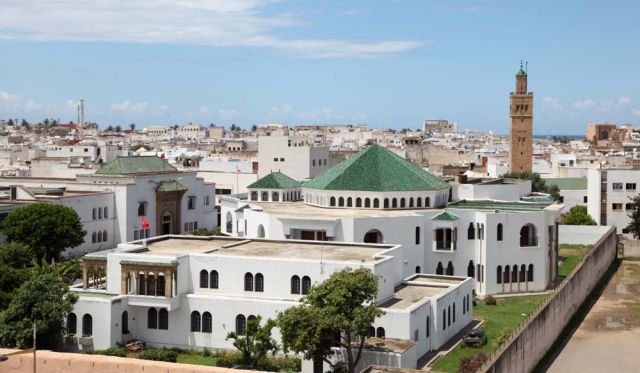
Mosque in the old town of Rabat, Morocco.

Inside a 17th-century mansion you choose from a classic menu of lamb tagine, couscous and salads under vaulted ceilings.


For a taste of France, head to Le Grand Comptoir. Housed in a restored 1930s Art Deco building, it has that Casablanca romance; a place of martinis, jazz and rare steak.

Out and about in Rabat

If you only have a day or two in Rabat head straight for the 17th-century walled Medina, a rabbit warren of streets that carry that old North African sense of romance and adventure.


Dip in and out of the souqs and cafes and you could get lost, but not for long as you’ll eventually hit one of the ancient fortress walls.


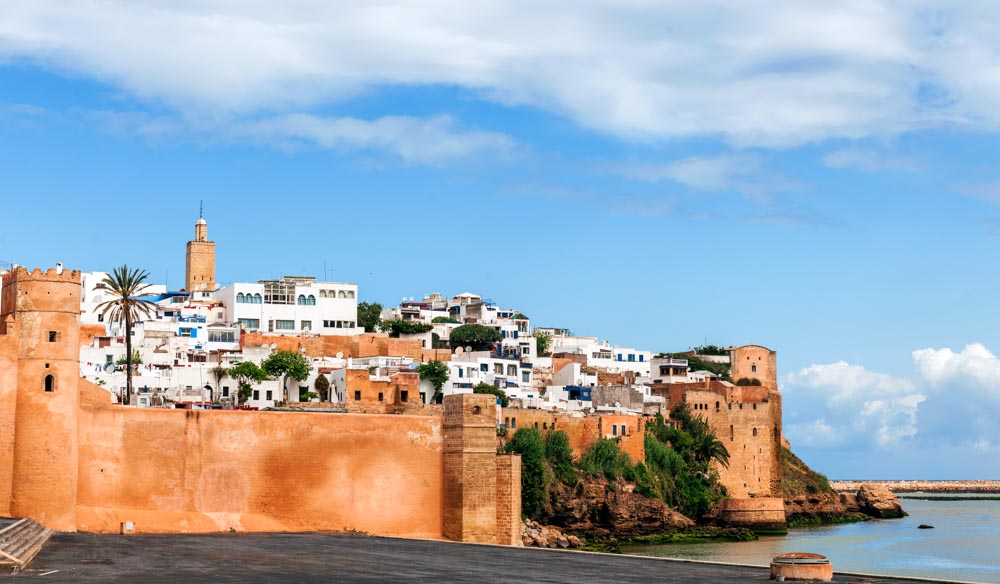
Head north up the Rue des Consuls past grand old courtyards before leaving the Medina and entering another of Rabat’s treasures, the beautiful Kasbah les Oudaias, through the spectacular Bab Oudaia gate.


Relax in the Andalusian Gardens here and wander the narrow streets and blue-and-white walls of this 12th-century citadel that overlooks the Atlantic.

Insider’s secret

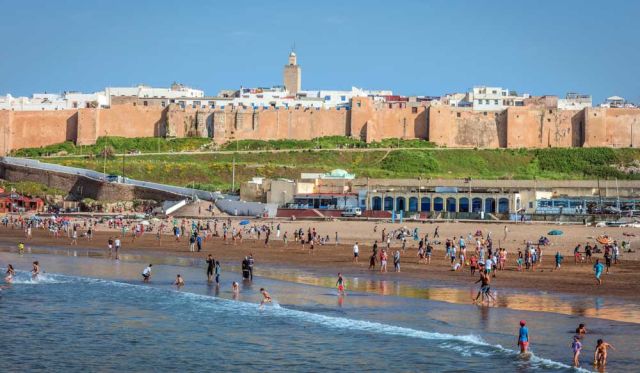
Summer heat getting too much? There’s a lovely clean swimming beach right in the city.

Retail reconnaissance

Make your way to the 14th-century Grande Mosquée de Rabat Medina, which marks the start of Rue Souika, a thoroughfare of shops with the reed-covered Souq as-Sebbat at its eastern end.


Practise your bartering for Moroccan lamps, embroidered babouche slippers, jewellery and fabrics among baskets filled with bright spices and Turkish delight.


Don’t miss the bustling souqs in the neighbouring city of Salé, a short taxi hop over the bridge that crosses the Bou Regreg river.


Salé is known for its carpenters, who produce fine chairs, tables and trays.
Rabat Morocco Africa
Moroccan women and children having fun on a sunny day at the Kasbah des Oudaias beach in the city of Rabat, Africa.

Stop by one of the woodworking factories to pick up a gift.

The ultimate experience

Looking like some alien obelisk, the Hassan Tower forms a striking edifice on the banks of the Bou Regreg river.


The 44-metre high minaret, a slab of ornately carved red sandstone, is all that remains of Sultan Yacub al-Mansour’s effort to build the biggest mosque in the world, an attempt that was destroyed by earthquake in 1755.


Take a walk in the surrounding gardens and then catch a five-minute taxi to Rabat’s other must-see sight, the Chellah.


This medieval muslim necropolis was built on top of a Roman Fort. You’ll find the remains of a spectacular mosque here and the ancient ruins now play host to an annual jazz festival in September.

Weekly travel news, experiences
insider tips, offers,
and more.

Caffeine hits

Avenue Mohammed V is a tree-lined boulevard with plenty of shady spots to sit and have a coffee.


Try La Comédie, which bakes its own pastries every day, and watch the world go by.

Stay & play

Affordable: The Repose has traditionally styled suites in a lovely old riad in Salé’s Medina.


Moderate: Riad Sidi Fatah is set in a traditional mansion in Rabat Medina.


Luxe: With its own hammam, wellness centre and pool, the Relais & Châteaux property Villa Diyafa is the ultimate way to indulge after a day in the hot, crowded souqs.

Want to see more stories from International Traveller in your Google search results?

  1. Click here to set International Traveller as a preferred source.
  2. Tick the box next to "International Traveller". That's it.
hero media

At the foot of the pyramids, Egypt finally tells its own story

    Ancient Egyptian history has been scattered across the globe for decades, admired, preserved, and studied, but it’s rarely seen where it actually belongs. The newly opened Grand Egyptian Museum (GEM) brings it home.

    From a viewing platform inside the Grand Egyptian Museum, the Great Pyramids of Giza rise from the desert, and for a moment, it feels like modern Egypt and ancient Egypt are shaking hands. The museum, grand in name and reality, has been a long time coming—since 1992, to be exact. Towering pharaohs, relics, and entire chapters of civilisation are on display here, all in full view of the pyramids. And because the GEM is the largest archaeological museum in the world dedicated to a single civilisation, it gets to tell Egypt’s story through its own voice, something many overseas institutions, understandably, haven’t quite managed.

    Reshaping Giza

    GEM entrance and gardens
    The GEM holds its own commanding position. (Image: Natasha Bazika)

    You might expect any building beside the Great Pyramids of Giza to fade into the background, but the GEM doesn’t bow to its famous neighbours. Perfectly aligned on the same axis and vast enough to span 70 football fields, the museum is less of an addition to Giza and more of a marker of the shift from a gateway to a cultural district.

    Inside, hieroglyphs carved from alabaster sweep across the walls and triangles appear everywhere, yet it’s a 3,200-year-old, 11-metre-tall, statue of Ramesses II who commands the room. His scale dictated the soaring atrium ceilings, which pour in natural light, unusual in museums but safe for the stone artefacts displayed.

    Hieroglyphs line the walls of the main entrance of the GEM
    Hieroglyphs line the walls of the main entrance. (Image: Natasha Bazika)

    Unlike many museums, the GEM has really considered how visitors move through it. The six-storey grand staircase leads you chronologically through Egypt’s history, from the Predynastic era to the Coptic period, flanked by statues that grow in scale and complexity as you climb. Elevators and lifts run alongside, keeping the journey accessible to everyone.

    At the top, a viewing wall frames the pyramids before you enter the main gallery to see artefacts rarely seen outside tombs, including the complete contents of Tutankhamun’s tomb, a highlight for many visitors.

    Pharaohs, artefacts and everything in between

    The GEM's showpiece Ramesses II
    The GEM’s showpiece Ramesses II. (Image: Natasha Bazika)

    The GEM holds around 100,000 artefacts across seven millennia, but the experience is entirely modern. Digital panels, QR navigation and clear bilingual signage make self-guided wandering easy, while short, glare-free labels in English, Arabic and braille are colour-coded to move you from broad themes to object-level detail.

    That said, a guide adds context you don’t get from a panel. I was lucky to have Essam Al Ebd Aziz, an Egyptologist, on board a 12-day Uniworld Nile cruise, walk me through some of the museum’s standout pieces.

    Top of the list is, of course, the Tutankhamun exhibit. Almost everything from his tomb, much of it never shown outside the Valley of the Kings, is here, from his golden funerary mask to delicate jewellery and ceremonial objects. But the GEM isn’t just about one boy king.

    GEM entrance is guarded by an 11-metre-tall Ramesses II statue.
    An 11-metre-tall Ramesses II statue guards the entrance. (Image: Natasha Bazika)

    Essam points out the canopic chest of Hetepheres, mother of Khufu, where her organs were stored in alabaster. I loved the forty little marching soldier figurines from the tomb of Mesehti, all lined up and hanging on a wall. And then there’s the statue of Metri, a scribe, with piercing blue eyes carved from lapis lazuli. All these pieces, and thousands more, now sit under one roof. And for the first time, people can see Egypt’s history in one place, told in its own voice, without leaving the shadow of the pyramids. That alone changes everything.