hero media

English hotel that couldn’t be more ‘Cambridge’ if it tried

Clayton Hotel charms with its playful mix-and-match of patterns, textures and historic references, but what exactly makes it so quintessentially Cambridge, asks Leigh-Ann Pow.


The Clayton Hotel,  the luxury hotel that opened its doors in Cambridge in March 2017 (previously named Tamburlaine after a Persian emperor in one of dramatist and Cambridge alumnus Christopher Marlowe’s 16th-century plays) is enough to give it a sense of place in the university city.


The Clayton Hotel originally opened the doors in 2017 under the name Tamburlaine, a reference to the Persian emperor in one of dramatist and Cambridge alumnus Christopher Marlowe’s 16th-century plays, and while the name may have changed the charm remains the same.


Their rooms remain distinguished by academic terms – Fresher, Scholar and Dean – instead of size, a well-stocked library and a pastel-and-floral-drenched Garden Room, and it couldn’t be more Cambridge if it tried. The layered references play out throughout the hotel, according to designer Bryan O’Sullivan.


“The aim was to create an interior scheme that sits well in the historic surroundings of Cambridge. Persian influences were taken from the play Tamburlaine, and the five public spaces in the hotel each reflect a different feeling through the use of colour and texture.


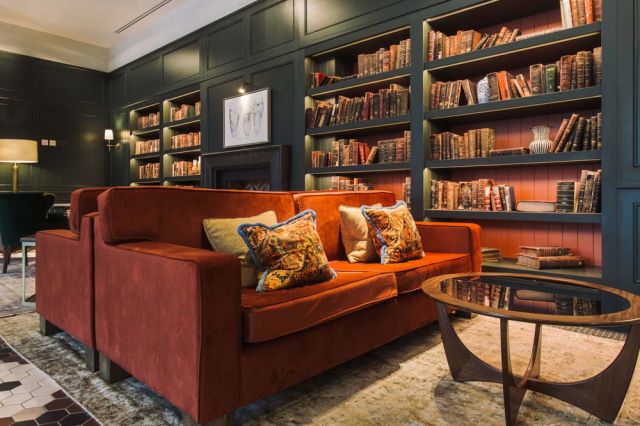
For example, in the Garden Room the inspiration was a Persian botanical oasis, whilst the library is more rooted in traditional Cambridge, with its dark timber panelling."
Tamburlaine luxury hotel Cambridge history english
Book-stacked shelves in the lobby, The Clayton Hotel, Cambridge.


The old-meets-new grandeur is instantly apparent upon entering the lobby, with its double-height ceilings, imposing chandelier, spiral staircase and a mélange of bespoke furniture running the gamut from leather club chairs to overstuffed sofas to pieces heavily influenced by mid-20th century lines, and bookshelves inset into walls groaning under the weight of vintage leather-bound tomes. Even the staff adhere to the themes, decked out as they are in a uniform of velvet, plaid and collegiate stripes.


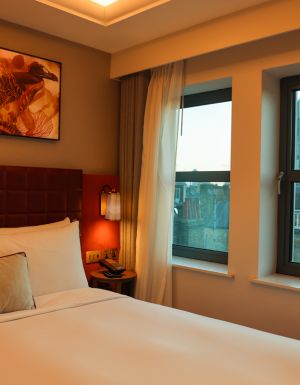
Upstairs, the 155 guest rooms are crammed with personality, with floor-to-ceiling windows (some with city views, others with views out to the surrounding countryside), wood-panelled walls and polished concrete floors.


Layered on top of this is more bespoke furniture and cleverly curated retro pieces, as well as generous bursts of colour (Cambridge blue is a recurring theme throughout), texture (brass, velvets, plaids) and whimsy; a cute little chinoiserie teapot and cups and saucers are included for enjoying a real English brew.
Bathroom luxury hotel Cambridge history english
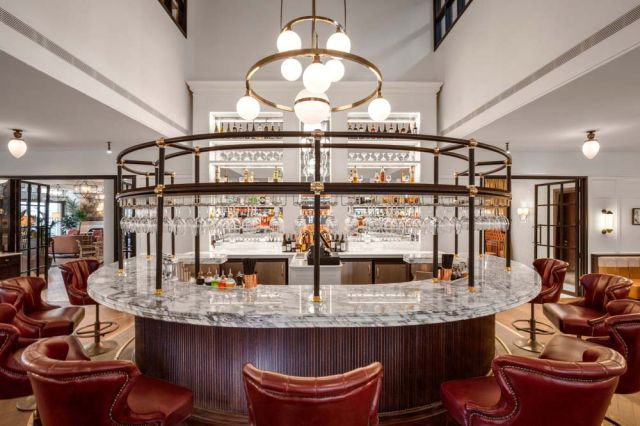
Pull up a chair at The Clayton Hotel’s marble bar.

But it is the shared spaces throughout the hotel that are proving a hit with guests and locals alike. The buzzing bar, dominated by a mammoth, curved marble bar and comfy leather chairs, has become a bit of a weekend hot spot, while the brasserie-style restaurant, finished in leather, brass and salvaged timber, serves up breakfast, lunch and dinner menus of honest, seasonal food made from locally sourced ingredients. And the library, with its antique books, a generous velvet Chesterfield to plonk down on and an open fire, is the perfect place to retreat to for a few hours.


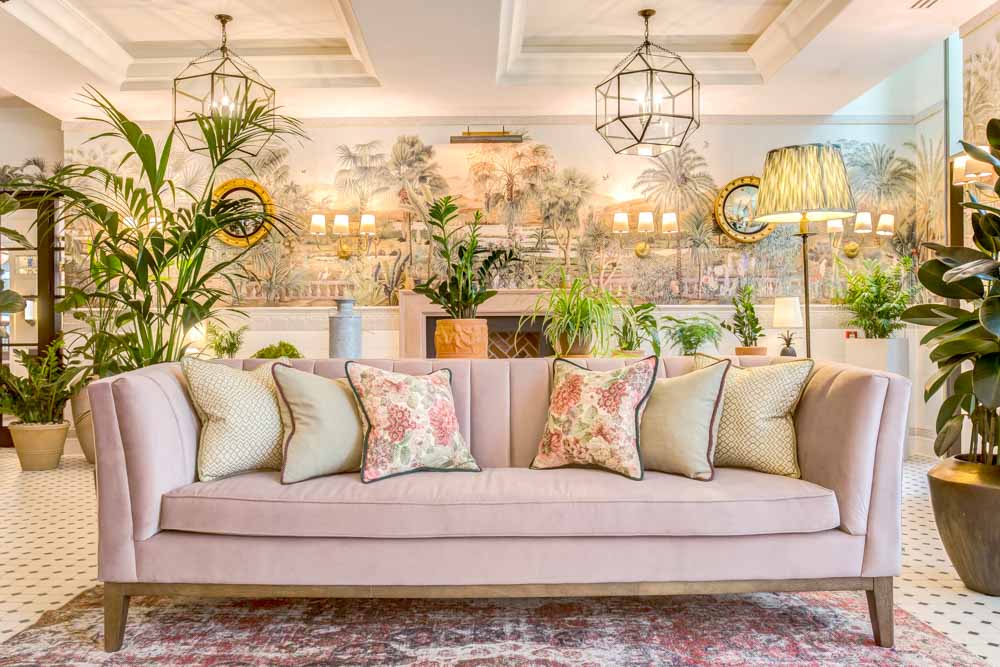
And then there’s the Garden Room, a real treat for the eyes with its painted Victorian wall panels, pretty pastel velvet, silk and white wicker seating arrangements and lush potted plants generously scattered throughout.


“[The Garden Room] is overflowing with exotic Middle Eastern imagery and femininity," says Bryan of his inspired design. “The tiled walls and floors echo the orangeries in the great British stately homes, and the ornate panoramic wallpaper depicts a faraway landscape, typical of the late Renaissance. The entire space is packed with exotic plants and soft furnishings that are colourful yet delicate."


An instant hit with visitors, who slavishly upload endless images of its dainty details to Instagram, sitting in its genteel surrounds enjoying afternoon tea has quickly become an essential Cambridge experience (one that you definitely need to book ahead for).
Tamburlaine Bathroom luxury hotel Cambridge history English
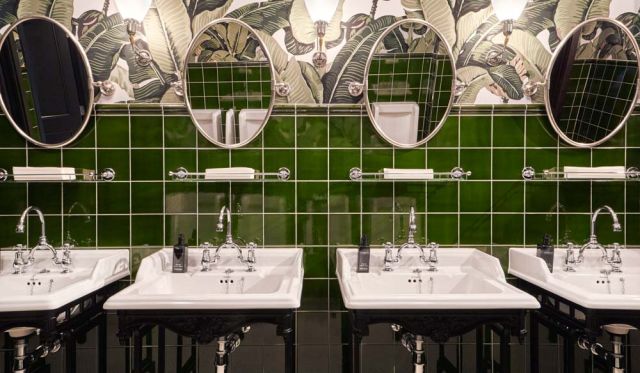
A typically pleasing mash-up of pattern, texture and colour.

“The delicious Afternoon Tea menu is ever changing according to seasonal produce," explains the hotel’s general manager, Simon Drake. “Guests can enjoy homemade scones, Devonshire clotted cream, strawberry preserve, and a selection of delectable fresh seasonal cakes and finger sandwiches, accompanied by a choice of Rare Tea Company’s loose leaf teas."


You can’t get more Cambridge than that!


Cambridge quintessential highlights: from the The Clayton Hotel designer

1. Pop into the bar at The Clayton to try one of our quirky cocktails from our head mixologist.

2. Go punting on the River Cam.

3. Do a walking tour of the university buildings.

4. Visit the Botanical Garden.

5. Stop by the Fitzwilliam Museum, which has one of the greatest collections of Egyptian and Roman artefacts.

Want to see more stories from International Traveller in your Google search results?

  1. Click here to set International Traveller as a preferred source.
  2. Tick the box next to "International Traveller". That's it.
hero media

What the European heatwave means for your summer travel plans

Temperatures are soaring this summer, breaking records across Europe and the UK. 

Euro summer is a feeling like no other. But when a heatwave hits? The dream trip quickly turns into a sweaty mess. Extreme heat is sweeping Europe and the UK this week, with record-high temperatures impacting travel plans across the continent.

And while Australian summers are typically hotter in absolute temperature, many European cities aren’t equipped for high temperatures, resulting in unbearable weather.

Why is it so hot in Europe?

Signs of a hot summer loomed in May, when the mercury hit unprecedented spring highs. Now, extreme high temperature warning alerts have been issued in countries such as Spain, Italy, France, England, the Netherlands and Germany.

France saw its hottest day on record on Wednesday, with an average temperature of 30°C across the day and night. This surpasses the average temperature for June, which is 15°C to 25°C. Dozens of people have died, including 40 from drowning.

In Spain, 212 deaths have been linked to the heatwave.

The UK recorded its hottest June day ever on Wednesday with temperatures soaring to 36.1°C. In an article published by the Met Office – the UK’s national meteorological service – Professor Stephen Belcher CBE, Met Office Chief Scientist, shared his concerns about June’s heat. “To see temperatures like this in the UK in June is sobering. Events like this bring home the implications of climate change, with very high temperatures and humidity bringing significant health implications from heat stress, as well as impacts to a range of sectors such as transport, energy and water supply,” he said.

Heatwaves are becoming increasingly common in Europe and the UK, neither of which is prepared for such extremes. The World Meteorological Organization reported that in 2025, at least 95% of Europe experienced above-average annual temperatures and that the continent was heating up twice as fast as the global average.

How travel is impacted

A pharmacy sign displaying 40 degrees Celcius
A pharmacy broadcasting local weather data. (Credit: Getty/Dragoncello)

During a heatwave, power grids, water systems and transport networks can be affected, resulting in disrupted itineraries for travellers. In France, power outages have left thousands without electricity and early closures have been implemented for two of Paris’s biggest attractions, the Eiffel Tower (early afternoon rather than late at night) and the Louvre (two hours early). Eurostar cancelled its London to Paris and Paris to London services from the 22nd to the 25th, and major UK rail companies have been advising travellers to avoid using trains where possible, or to travel during early hours.

If a heatwave is predicted, being flexible with your itinerary and having fully refundable/changeable tickets is key, as extreme heat can force the cancellation of outdoor activities, impact rail and flight services and change the opening hours of sites and eateries.

Why does summer in Europe often feel hotter than summer in Australia?

people swimming in the Canal Saint-Martin in Paris
People swimming in the Canal Saint-Martin in Paris to cool off. (Credit: Rachael Thompson)

With some of the highest UV levels in the world, Australians are no strangers to the heat, adapting well to intense weather. But our infrastructure is largely equipped to withstand soaring temperatures with climate-responsive passive design, refrigerated air conditioning or evaporative coolers, as well as swimming spots aplenty.

Buildings in Northern and Western Europe and the UK, however, are constructed to retain heat and handle frosty winters. The lack of universal air conditioning means it generally feels hotter even though the temperature on your app might not look it. During a heatwave, it can feel like you’re in a sauna as cities act like heat traps.

How to stay cool and prepare for another heatwave

Relief is expected across Europe and the UK later this week, but more heatwaves are still possible in the coming months. Summer heat typically peaks in July and August.

Public transport often doesn’t have air conditioning, and buses in particular can be swelteringly hot. If you’re heading outside or your accommodation has no air conditioning, it’s worth buying a spray bottle and a handheld fan from a pharmacy or tourist stand. Check ahead of time if restaurants and cafes have air conditioning and make a booking in advance. The highest temperatures typically hit between 3pm and 6pm, so aim to head outdoors outside of these hours.

Rising temperatures invite travellers to enter a more intentional era of seeing the world. Now more than ever is the time to embrace lower-impact “coolcations” and off-season getaways.