hero media

Review: The London Edition

Is Ian Schrager’s latest opening all you’d expect from the visionary hotelier? Quentin Long seems to think so. 

In my next life I want to be Ian Schrager.

The guy is a genius.

Everything he touches is so ahead of its time, yet so now and incredibly successful. From the moment he ‘created’ the boutique hotel as a concept in 1985 with the Sanderson in London, he has had the hoteliers’ equivalent of the Midas touch.

And his latest move is no different. A joint venture with Marriott hotels, the EDITION Hotels (Istanbul and London are already open, with Miami Beach, New York and Sanya set to come in the next 12 months) marry the concept of international brand expectations (“I want to know what I am getting") with the best of immersive travel (“I want to hang with the locals").

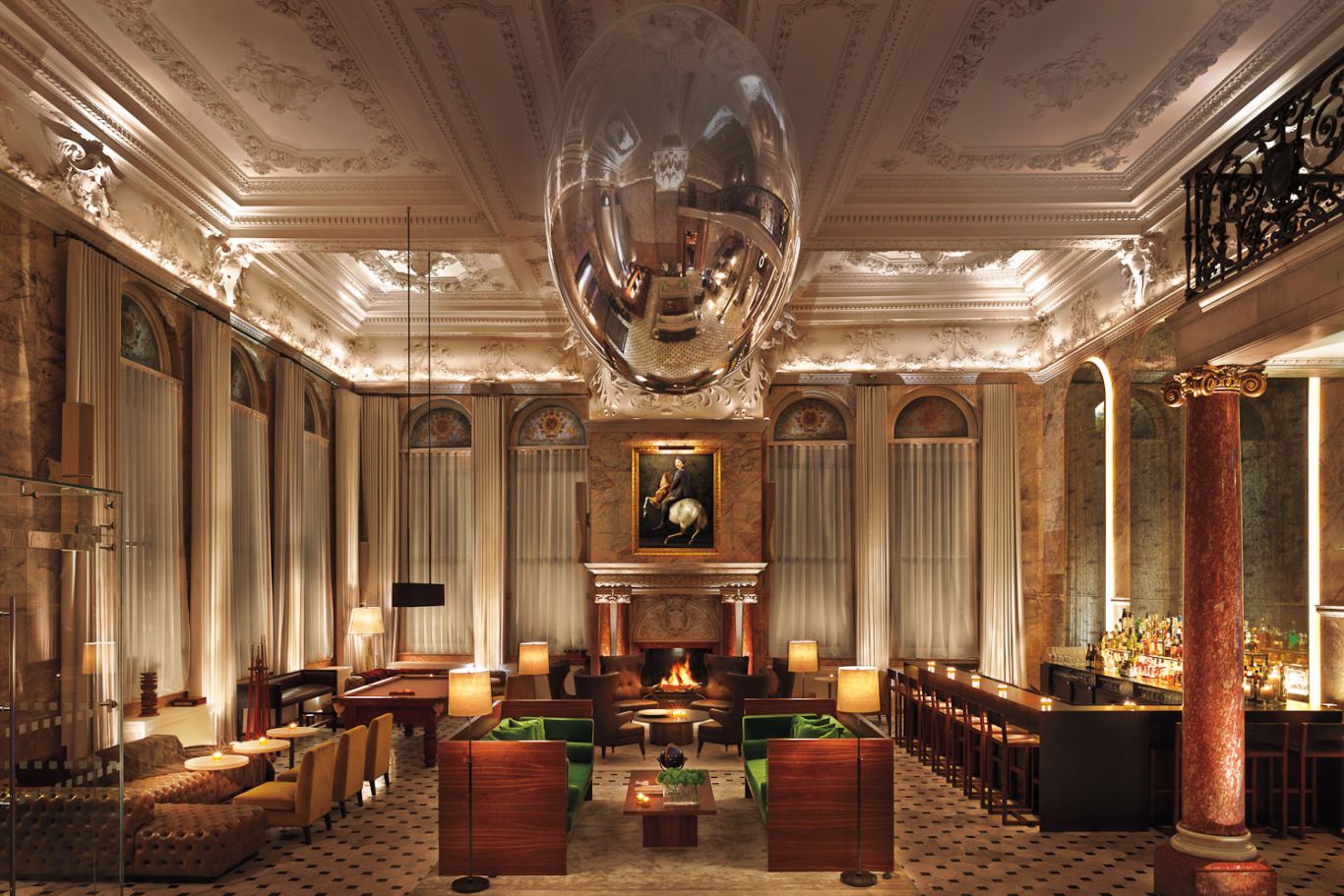
Just metres from Oxford Street, I step into what looks like a Belle Epoque Fitzrovia mansion from the street but turns out to be a buzzing hotel lobby. There are people everywhere. It’s chatty and energetic and I immediately sense that I have stumbled into the place that everyone wants to be.

A two-metre chrome egg hangs over me accentuating the high ceilings. A combination of marble columns and incredible green lounges gives way to a discreet reception area that’s tucked away behind the lobby bar.

Schrager has created an experience well before you actually see any part of the inner workings of the hotel itself.

Berners Tavern, the hotel’s restaurant, is accessed via a large doorway from the lobby. The Belle Epoque milieu continues here, with endless gilt-framed landscape paintings juxtaposed with moody portrait photographs covering all available space on the walls. It is an incredibly busy but very effective environment that adds to the overwhelming energy of the hotel on the ground floor.

Getting to my room is probably the only little disappointment: the hallways are boring. For a property that is just so stunning everywhere else, it’s a bit of a letdown.

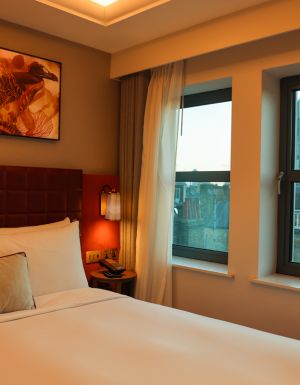
My room follows the same theme of ornate, detailed spaces contrasted by minimalist features that I loved so much downstairs. The dark-wood panelled walls are paired with blonde timber floors, creating an earthy feel in the bedroom.

The bathroom, by contrast, is completely tiled with stark white sunglasses-at-the-ready mosaics.

The bed, as you would expect, is huge and soft, with a draped brown fur throw adding another sensory element to the décor. Big drop lights create atmosphere and work perfectly with the chocolate brown tones throughout.

There’s the requisite walk-in wardrobe, a minibar of artisan chocolates, beautiful handcrafted popcorn, and even a London EDITION notebook, if you want jot down your inner most thoughts (or write a hotel review).

In its entirety the room works brilliantly, and the attention to detail is fantastic. The only slightly jarring element is the television which hangs from the wall at an awkward angle to the bed; moving it into the prime laze-on-the-bed position makes it look like it’s about to fall off at any moment.

If it all gets too precarious, there’s a big cosy reading chair in the corner with its own pouf and lighting as an alternative.

Back downstairs I find that the quality of the food served in Berners Tavern matches the impact of the space itself. Michelin-starred chef Jason Atherton offers up a contemporary menu of great English food.

The other noteworthy feature of the food and beverage roster is the Punch Room, a cosy retreat for a tête-à-tête that serves up the latest in fashionable cocktails.

Overall, this is a fantastic new addition (bad pun intended) to the London hotel scene.

Its location is ideal, its service is outstanding and the experience is sublime.

Gold standard, in fact.

Details

The London Edition

10 Berners Street London, +44 20 7781 0000, edition-hotels.marriott.com/london

The IT Verdict

Fantastic buzzy hotel, perfect for young-at-heart London-bound travellers looking to connect with ‘what’s happening’ in the city.

  • Location: 9/10
    Oxford Street and the nightlife of Soho are on your doorstep.
  • Style/character: 9.5/10
    Straight from the zeitgeist, this is cool you have never seen before.
  • Service: 8/10
    Slightly too cool for school but incredibly professional.
  • Rooms 8/10
    Clever use of space, precariously hung TV aside.
  •  Food and drink: 9.5/10
    Great British dining that holds its own without the hotel.
  • Value for money: 9.5/10
    Even though it was a big wedge of cash at $578 for the night, it was worth it.

Want to see more stories from International Traveller in your Google search results?

  1. Click here to set International Traveller as a preferred source.
  2. Tick the box next to "International Traveller". That's it.
hero media

What the European heatwave means for your summer travel plans

Temperatures are soaring this summer, breaking records across Europe and the UK. 

Euro summer is a feeling like no other. But when a heatwave hits? The dream trip quickly turns into a sweaty mess. Extreme heat is sweeping Europe and the UK this week, with record-high temperatures impacting travel plans across the continent.

And while Australian summers are typically hotter in absolute temperature, many European cities aren’t equipped for high temperatures, resulting in unbearable weather.

Why is it so hot in Europe?

Signs of a hot summer loomed in May, when the mercury hit unprecedented spring highs. Now, extreme high temperature warning alerts have been issued in countries such as Spain, Italy, France, England, the Netherlands and Germany.

France saw its hottest day on record on Wednesday, with an average temperature of 30°C across the day and night. This surpasses the average temperature for June, which is 15°C to 25°C. Dozens of people have died, including 40 from drowning.

In Spain, 212 deaths have been linked to the heatwave.

The UK recorded its hottest June day ever on Wednesday with temperatures soaring to 36.1°C. In an article published by the Met Office – the UK’s national meteorological service – Professor Stephen Belcher CBE, Met Office Chief Scientist, shared his concerns about June’s heat. “To see temperatures like this in the UK in June is sobering. Events like this bring home the implications of climate change, with very high temperatures and humidity bringing significant health implications from heat stress, as well as impacts to a range of sectors such as transport, energy and water supply,” he said.

Heatwaves are becoming increasingly common in Europe and the UK, neither of which is prepared for such extremes. The World Meteorological Organization reported that in 2025, at least 95% of Europe experienced above-average annual temperatures and that the continent was heating up twice as fast as the global average.

How travel is impacted

A pharmacy sign displaying 40 degrees Celcius
A pharmacy broadcasting local weather data. (Credit: Getty/Dragoncello)

During a heatwave, power grids, water systems and transport networks can be affected, resulting in disrupted itineraries for travellers. In France, power outages have left thousands without electricity and early closures have been implemented for two of Paris’s biggest attractions, the Eiffel Tower (early afternoon rather than late at night) and the Louvre (two hours early). Eurostar cancelled its London to Paris and Paris to London services from the 22nd to the 25th, and major UK rail companies have been advising travellers to avoid using trains where possible, or to travel during early hours.

If a heatwave is predicted, being flexible with your itinerary and having fully refundable/changeable tickets is key, as extreme heat can force the cancellation of outdoor activities, impact rail and flight services and change the opening hours of sites and eateries.

Why does summer in Europe often feel hotter than summer in Australia?

people swimming in the Canal Saint-Martin in Paris
People swimming in the Canal Saint-Martin in Paris to cool off. (Credit: Rachael Thompson)

With some of the highest UV levels in the world, Australians are no strangers to the heat, adapting well to intense weather. But our infrastructure is largely equipped to withstand soaring temperatures with climate-responsive passive design, refrigerated air conditioning or evaporative coolers, as well as swimming spots aplenty.

Buildings in Northern and Western Europe and the UK, however, are constructed to retain heat and handle frosty winters. The lack of universal air conditioning means it generally feels hotter even though the temperature on your app might not look it. During a heatwave, it can feel like you’re in a sauna as cities act like heat traps.

How to stay cool and prepare for another heatwave

Relief is expected across Europe and the UK later this week, but more heatwaves are still possible in the coming months. Summer heat typically peaks in July and August.

Public transport often doesn’t have air conditioning, and buses in particular can be swelteringly hot. If you’re heading outside or your accommodation has no air conditioning, it’s worth buying a spray bottle and a handheld fan from a pharmacy or tourist stand. Check ahead of time if restaurants and cafes have air conditioning and make a booking in advance. The highest temperatures typically hit between 3pm and 6pm, so aim to head outdoors outside of these hours.

Rising temperatures invite travellers to enter a more intentional era of seeing the world. Now more than ever is the time to embrace lower-impact “coolcations” and off-season getaways.