hero media

Review: Hotel National Moscow

Immerse yourself in Moscow’s fascinating history…

During a harsh Russian winter, Amy McPherson checks in to one of Moscow’s most historic hotels to find warmth in old-fashioned glamour and borscht.


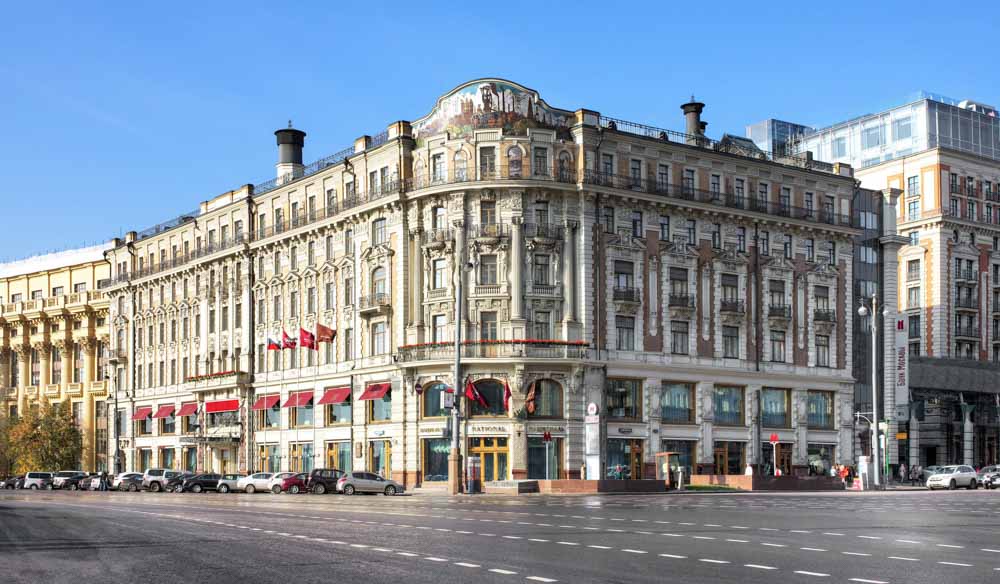
This year marks the centenary of the Russian Revolution, and for more than 100 years Hotel National Moscow has witnessed the country’s political transformation, from imperial reign through to communist rule and the fall of the Soviet Union.

Arriving in Moscow, it seems only fitting to stay in a hotel that can match the city’s fascinating history.

The doorman, dressed in a long trench coat and polished leather shoes tips his top hat as I approach.

“Welcome ma’am," he says holding the door open with a gloved hand.

In the reception, chandeliers hang from high ceilings; large picture windows that look out towards Red Square are framed with thick, luxurious red curtains trimmed with gold tassels; and on the opposite wall a heavily decorated mirror complements the Art Nouveau furnishings.

My Junior Suite is spacious and has the same regal ambience as the reception.

Everything about the room is impressive, except for the view: opening the windows I’m greeted by the sight of the roof of the bar below.

Never mind; I set out to explore the hotel.

I descend via the grand staircase and follow its intricate railings, stained glass windows and royal red carpet to the second floor in search of room 107, where a plaque informs me that Lenin lived and worked here in March 1918.

Intrigued, I continue further down the corridor to find a gallery of all the guests of political and social importance who have stayed here.

I am surprised to find a picture of a pre-presidential Barack Obama hung not far from the portrait of Stalin.

How times have changed!

Hungry but not yet brave enough to take on Russia’s savage winter, I dine at the bar I can see from my window, Bar Alexandrovsky.

At 6pm it is already busy with guests enjoying pre-dinner drinks – perhaps why the service is inconsistent.

It takes a while for me to get someone’s attention long enough to ask for a menu, and another while to flag down a waiter to place my order.

I order a beer (the Siberian beer is excellent), borscht (beetroot soup) and the ‘House Special’ beef stroganoff.

As I wait, a woman, dressed to the nines, conspicuously loiters around the bar.

Ten minutes later, a lone man approaches, pays for her drink, before the two leave together.

I suspect that the hotel, as one of the oldest in Moscow, must have some tolerance for the world’s oldest profession.

My food arrives and the borscht instantly warms me inside and out, while the beef stroganoff is the best I’ve had by far.

The following morning there’s an excellent choice on offer at the buffet breakfast, and the dining room on the first floor has big windows with a perfect view of Red Square and the Kremlin.

There is no better way to wake up to Moscow, and I dine on blinis with fresh fruit thinking of the ghosts of revolutions past.


Details

Hotel National Moscow; 15/1 Mokhovaya Str. Bld. 1, Moscow, Russia.


The IT Verdict

This historic hotel has the feel of an imperial estate. Perfect for those interested in Russian history.

  • Location: 10 / 10
    Situated just across from the Kremlin and Red Square, and a block from the Bolshoi Theatre.
  • Style / character: 8 / 10
    The hotel wears its history on its sleeve and has a romantic, old-school glamour.
  • Service: 7 / 10
    Staff have varying degrees of experience and are mostly friendly.
  • Rooms: 8 / 10
    The Junior Suite is impressive but could do with a better view.
  • Food and drink: 9 / 10
    The menu has something for every taste and the bar is well stocked.
  • Value for money: 9 / 10
    I paid $517 per night; great value for a 5-star hotel of such standing.


All IT reviews are conducted anonymously and our writers pay their own way – so we experience exactly what you would. 

Want to see more stories from International Traveller in your Google search results?

  1. Click here to set International Traveller as a preferred source.
  2. Tick the box next to "International Traveller". That's it.
hero media

What the European heatwave means for your summer travel plans

Temperatures are soaring this summer, breaking records across Europe and the UK. 

Euro summer is a feeling like no other. But when a heatwave hits? The dream trip quickly turns into a sweaty mess. Extreme heat is sweeping Europe and the UK this week, with record-high temperatures impacting travel plans across the continent.

And while Australian summers are typically hotter in absolute temperature, many European cities aren’t equipped for high temperatures, resulting in unbearable weather.

Why is it so hot in Europe?

Signs of a hot summer loomed in May, when the mercury hit unprecedented spring highs. Now, extreme high temperature warning alerts have been issued in countries such as Spain, Italy, France, England, the Netherlands and Germany.

France saw its hottest day on record on Wednesday, with an average temperature of 30°C across the day and night. This surpasses the average temperature for June, which is 15°C to 25°C. Dozens of people have died, including 40 from drowning.

In Spain, 212 deaths have been linked to the heatwave.

The UK recorded its hottest June day ever on Wednesday with temperatures soaring to 36.1°C. In an article published by the Met Office – the UK’s national meteorological service – Professor Stephen Belcher CBE, Met Office Chief Scientist, shared his concerns about June’s heat. “To see temperatures like this in the UK in June is sobering. Events like this bring home the implications of climate change, with very high temperatures and humidity bringing significant health implications from heat stress, as well as impacts to a range of sectors such as transport, energy and water supply,” he said.

Heatwaves are becoming increasingly common in Europe and the UK, neither of which is prepared for such extremes. The World Meteorological Organization reported that in 2025, at least 95% of Europe experienced above-average annual temperatures and that the continent was heating up twice as fast as the global average.

How travel is impacted

A pharmacy sign displaying 40 degrees Celcius
A pharmacy broadcasting local weather data. (Credit: Getty/Dragoncello)

During a heatwave, power grids, water systems and transport networks can be affected, resulting in disrupted itineraries for travellers. In France, power outages have left thousands without electricity and early closures have been implemented for two of Paris’s biggest attractions, the Eiffel Tower (early afternoon rather than late at night) and the Louvre (two hours early). Eurostar cancelled its London to Paris and Paris to London services from the 22nd to the 25th, and major UK rail companies have been advising travellers to avoid using trains where possible, or to travel during early hours.

If a heatwave is predicted, being flexible with your itinerary and having fully refundable/changeable tickets is key, as extreme heat can force the cancellation of outdoor activities, impact rail and flight services and change the opening hours of sites and eateries.

Why does summer in Europe often feel hotter than summer in Australia?

people swimming in the Canal Saint-Martin in Paris
People swimming in the Canal Saint-Martin in Paris to cool off. (Credit: Rachael Thompson)

With some of the highest UV levels in the world, Australians are no strangers to the heat, adapting well to intense weather. But our infrastructure is largely equipped to withstand soaring temperatures with climate-responsive passive design, refrigerated air conditioning or evaporative coolers, as well as swimming spots aplenty.

Buildings in Northern and Western Europe and the UK, however, are constructed to retain heat and handle frosty winters. The lack of universal air conditioning means it generally feels hotter even though the temperature on your app might not look it. During a heatwave, it can feel like you’re in a sauna as cities act like heat traps.

How to stay cool and prepare for another heatwave

Relief is expected across Europe and the UK later this week, but more heatwaves are still possible in the coming months. Summer heat typically peaks in July and August.

Public transport often doesn’t have air conditioning, and buses in particular can be swelteringly hot. If you’re heading outside or your accommodation has no air conditioning, it’s worth buying a spray bottle and a handheld fan from a pharmacy or tourist stand. Check ahead of time if restaurants and cafes have air conditioning and make a booking in advance. The highest temperatures typically hit between 3pm and 6pm, so aim to head outdoors outside of these hours.

Rising temperatures invite travellers to enter a more intentional era of seeing the world. Now more than ever is the time to embrace lower-impact “coolcations” and off-season getaways.





