hero media

Game of Thrones, Star Wars: Ireland’s famous film locations

Ireland’s dramatic scenery, with spectacular coastlines and drop-dead gorgeous landscapes, has proven the perfect backdrop for myriad movies over the decades. Writes Tricia Welsh.

On my first visit to Ireland nearly 40 years ago, I remember being held up for several hours while driving around the Dingle Peninsula in the island’s south-west as huge boulders were being pushed over a cliff, their thundering sound being recorded as part of the filming of the 1970 film, Ryan’s Daughter.

Today, you’re more likely to follow a three-eyed raven and be swept up in the phenomenal hype that is Game of Thrones, since much of it is filmed in Northern Ireland, or see where Harry Potter and Star Wars played out their fanciful tales, or Braveheart and the Vikings battled for glory.

Tim Castle, County Heath
Mel Gibson’s Braveheart stronghold can be visited today at Trim Castle in County Meath.

Game of Thrones

Film-lovers can experience the real Westeros and tour the centuries-old castles, mystical mountains, ancient forests and dramatic coastlines used as key filming locations for the Seven Kingdoms.

There are 25 epic locations used throughout the fantasy series including Tollymore Forest Park in County Down, transformed into the Haunted Forest where the White Walkers dwell; Dark Hedges, that otherworldly avenue of serpentine beech trees near Armoy in County Antrim that represents the Kingsroad; and Pollnagollum Cave in County Fermanagh, portrayed as Beric Dondarrion’s hideout. There is also Ballintoy Harbour in County Antrim as the Port of Pyke in the Iron Islands, and Downhill Strand in County Londonderry as Dragonstone.

You can explore Game of Thrones territory by self-drive or go with a guide, enjoying authentic medieval feasts, meeting direwolves, shooting arrows where Robb Stark taught Bran archery or glamping overnight in Winterfell at Castle Ward in County Down. There’s also the clever Door of Thrones treasure hunt trail, where you can check out 10 intricately carved doors, each telling the story of a GOT episode in Season 6, which were handcrafted from two trees blown down when a storm hit the Dark Hedges in 2016. They now grace pubs close to the series’ filming locations including The Cuan in Strangford, Fiddler’s Green in Portaferry and Percy French in Newcastle, all in County Down, as well as Blakes of the Hollow in Enniskillen, County Fermanagh, and Frank Owens’ Bar in Limavady, County Londonderry.

And be sure to see the 77-metre Bayeux-style tapestry, made from Irish linen, which immortalises the first six Game of Thrones series and is on display in the Ulster Museum in Belfast. For fans of the series, there’s no doubt Northern Ireland is Mecca.

Star Wars

Fans of this sci-fi classic can feel the force at both rugged Malin Head, the most northerly point of Ireland on the Inishowen Peninsula, and on the windswept island of Skellig Michael, located some 11 kilometres off the Iveragh Peninsula in County Kerry, where Rey memorably met Luke Skywalker for the first time at the end of Star Wars: The Force Awakens. You can take a boat tour to the UNESCO World Heritage Listed Skellig Michael, depending on the weather, to see its awe-inspiring sixth-century monastery ruins.

Other location spots include Loop Head in County Clare, Dingle in County Kerry with its resident dolphin, and Brow Head near Crookhaven in County Cork.

It is said the Star Wars production team loved this rugged stretch of coastline so much, they kept their cameras rolling along the Wild Atlantic Way from Cork, Kerry and Clare all the way to Donegal. Also check out some of the filming locations for the upcoming Star Wars Episode VIII The Last Jedi set to be released this December.

Vikings and more

Lough Tay Ireland
Lough Tay on the Guinness Estate in County Wicklow proved the perfect backdrop for scenes shot on board the Norsemen’s longboats in the hit series Vikings.

Although the series is set in medieval Scandinavia, the Luggala Mountains around Lough Tay on the Guinness Estate in County Wicklow proved the perfect backdrop for scenes shot on board the Norsemen’s longboats in the hit series Vikings. Similar scenes were also filmed on Lough Dan and Blessington Lakes, the River Boyne outside Drogheda, and the Poulaphouca Reservoir in the heart of the Wicklow Mountains just out of Dublin.

Wicklow Mountains National Park, with its glacial lakes, woodlands and beautiful coastline, is only about an hour by car from Dublin, making it an ideal day trip for a guided or self-guided film location tour.

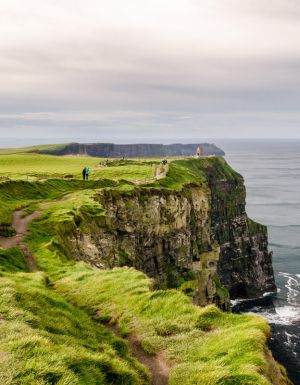
Other stand-out movies filmed in Ireland include Harry Potter, whose Horcrux cave was at the base of the famous Cliffs of Moher; Brooklyn and Saving Private Ryan, both of which featured the golden sands of Curracloe Beach in County Wexford; and Braveheart where Mel Gibson’s stronghold can be visited at Trim Castle in County Meath. You’ll find more details about exploring these locations here.

Cliffs of Moher
Harry Potter’s Horcrux cave was at the base of the famous Cliffs of Moher.

For more information: Tourism Ireland

Want to see more stories from International Traveller in your Google search results?

  1. Click here to set International Traveller as a preferred source.
  2. Tick the box next to "International Traveller". That's it.
hero media

What the European heatwave means for your summer travel plans

Temperatures are soaring this summer, breaking records across Europe and the UK. 

Euro summer is a feeling like no other. But when a heatwave hits? The dream trip quickly turns into a sweaty mess. Extreme heat is sweeping Europe and the UK this week, with record-high temperatures impacting travel plans across the continent.

And while Australian summers are typically hotter in absolute temperature, many European cities aren’t equipped for high temperatures, resulting in unbearable weather.

Why is it so hot in Europe?

Signs of a hot summer loomed in May, when the mercury hit unprecedented spring highs. Now, extreme high temperature warning alerts have been issued in countries such as Spain, Italy, France, England, the Netherlands and Germany.

France saw its hottest day on record on Wednesday, with an average temperature of 30°C across the day and night. This surpasses the average temperature for June, which is 15°C to 25°C. Dozens of people have died, including 40 from drowning.

In Spain, 212 deaths have been linked to the heatwave.

The UK recorded its hottest June day ever on Wednesday with temperatures soaring to 36.1°C. In an article published by the Met Office – the UK’s national meteorological service – Professor Stephen Belcher CBE, Met Office Chief Scientist, shared his concerns about June’s heat. “To see temperatures like this in the UK in June is sobering. Events like this bring home the implications of climate change, with very high temperatures and humidity bringing significant health implications from heat stress, as well as impacts to a range of sectors such as transport, energy and water supply,” he said.

Heatwaves are becoming increasingly common in Europe and the UK, neither of which is prepared for such extremes. The World Meteorological Organization reported that in 2025, at least 95% of Europe experienced above-average annual temperatures and that the continent was heating up twice as fast as the global average.

How travel is impacted

A pharmacy sign displaying 40 degrees Celcius
A pharmacy broadcasting local weather data. (Credit: Getty/Dragoncello)

During a heatwave, power grids, water systems and transport networks can be affected, resulting in disrupted itineraries for travellers. In France, power outages have left thousands without electricity and early closures have been implemented for two of Paris’s biggest attractions, the Eiffel Tower (early afternoon rather than late at night) and the Louvre (two hours early). Eurostar cancelled its London to Paris and Paris to London services from the 22nd to the 25th, and major UK rail companies have been advising travellers to avoid using trains where possible, or to travel during early hours.

If a heatwave is predicted, being flexible with your itinerary and having fully refundable/changeable tickets is key, as extreme heat can force the cancellation of outdoor activities, impact rail and flight services and change the opening hours of sites and eateries.

Why does summer in Europe often feel hotter than summer in Australia?

people swimming in the Canal Saint-Martin in Paris
People swimming in the Canal Saint-Martin in Paris to cool off. (Credit: Rachael Thompson)

With some of the highest UV levels in the world, Australians are no strangers to the heat, adapting well to intense weather. But our infrastructure is largely equipped to withstand soaring temperatures with climate-responsive passive design, refrigerated air conditioning or evaporative coolers, as well as swimming spots aplenty.

Buildings in Northern and Western Europe and the UK, however, are constructed to retain heat and handle frosty winters. The lack of universal air conditioning means it generally feels hotter even though the temperature on your app might not look it. During a heatwave, it can feel like you’re in a sauna as cities act like heat traps.

How to stay cool and prepare for another heatwave

Relief is expected across Europe and the UK later this week, but more heatwaves are still possible in the coming months. Summer heat typically peaks in July and August.

Public transport often doesn’t have air conditioning, and buses in particular can be swelteringly hot. If you’re heading outside or your accommodation has no air conditioning, it’s worth buying a spray bottle and a handheld fan from a pharmacy or tourist stand. Check ahead of time if restaurants and cafes have air conditioning and make a booking in advance. The highest temperatures typically hit between 3pm and 6pm, so aim to head outdoors outside of these hours.

Rising temperatures invite travellers to enter a more intentional era of seeing the world. Now more than ever is the time to embrace lower-impact “coolcations” and off-season getaways.