hero media

Virgin Voyages’ Resilient Lady cabins reviewed

Quentin Long has written a review of Virgin Voyages’ Resilient Lady, which is coming to Australia in December 2023. Here’s a detailed analysis of all the cabins on board.

Before embarking, a knowledgeable cruiser suggested the interior design of the Virgin Voyage’s cabins was a bit ‘Ikea-ish’; overly simple and ordinary. But I found the design to be fresh and cleverly minimalist.

The designers have done away with some of the heavier furniture like floor-to-ceiling cupboards, instead installing enclosed hanging spaces to create a far lighter interior and feeling of space.
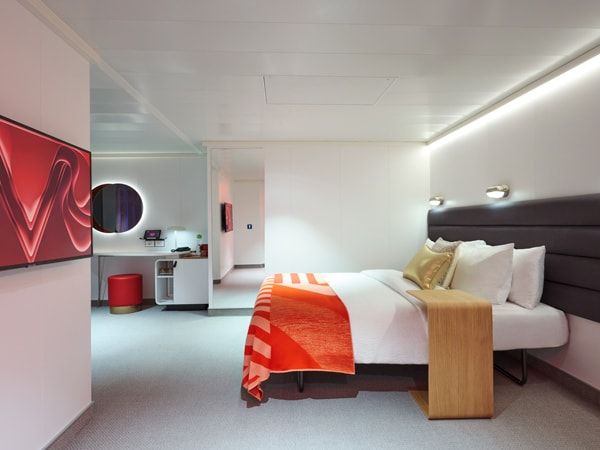
the bedroom interior inside a cabin at Virgin Voyages’ Resilient Lady
Virgin Voyages’ Resilient Lady cabins will keep you cosy for the night.

Much of the cabin is controlled by the in-room tablet, which allows you to open and close the curtains and operate the TV. The lighting is also controlled by the tablet, with three phases plus individual settings like ‘cinema setting’ (perfect when watching the 43" 4K TV).

The cabins are also fitted with sensors to know when you’ve left the room, allowing it to then go into power-saving mode. Cleverly, the lighting is also set to automatically adjust to the time of day.
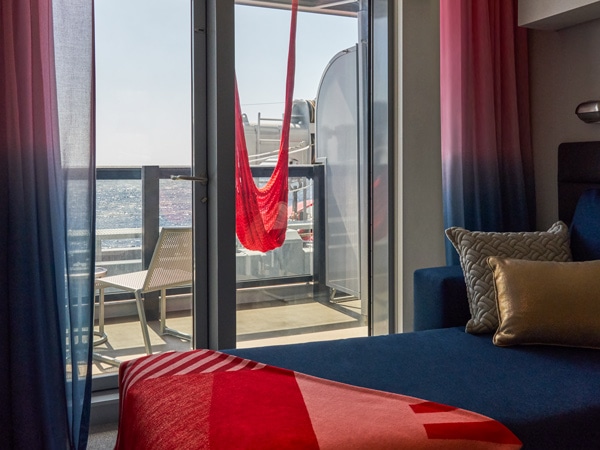
a balcony with a hammock in sea view cabin, Virgin Voyages’ Resilient Lady
Lounge in a hammock outside your cabin.

There are six different levels of cabins on Resilient Lady. I stayed in the Sea Terrace and have expanded on this below.

Sea Terrace: 17.2–20.9 square metres

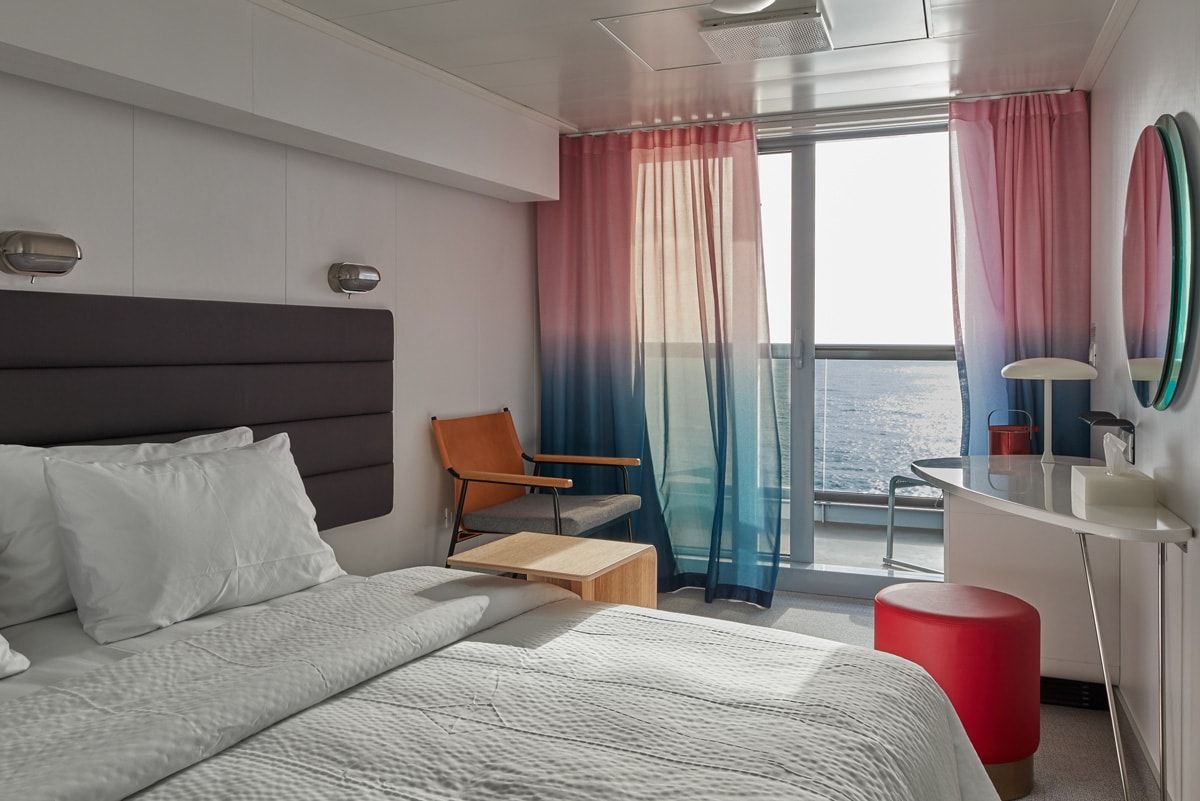
The Sea Terrace comes in regular and XL sizes. The minimalist furniture creates a greater sense of space, and the palate is predominantly blonde and black with splashes of red.

For clothing storage, there’s a hanging rail hidden behind a curtain and a small narrow cupboard with drawers and shelves. It’s not the usual floor-to-ceiling wardrobe, which aids in creating a sense of space.

The small, curved desk is ample, and only a small round stool that doubles as a poof is able to sit at the desk. An armchair, too low for the desk, sits in the corner.
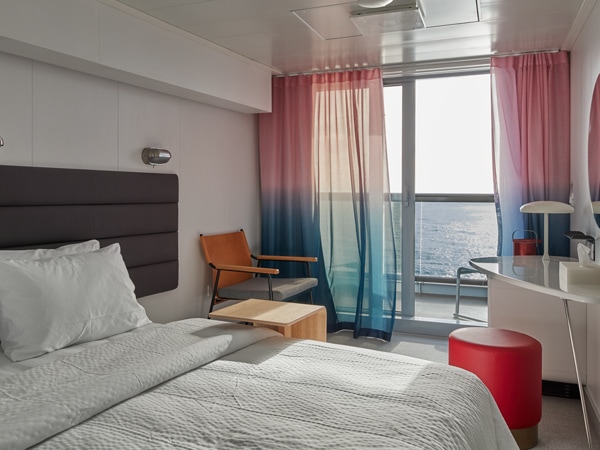
the interior of sea terrace inside the cabin, Virgin Voyages’ Resilient Lady
The curtains open up to incredible sea views.

The permanent bed is comfy and firm. Although Virgin’s fact sheets state that it’s “the Seabed, the first-ever transformational cabin bed at sea, specially engineered and handcrafted by Walter Knoll in Germany", I didn’t personally see the bed ‘transformed’.
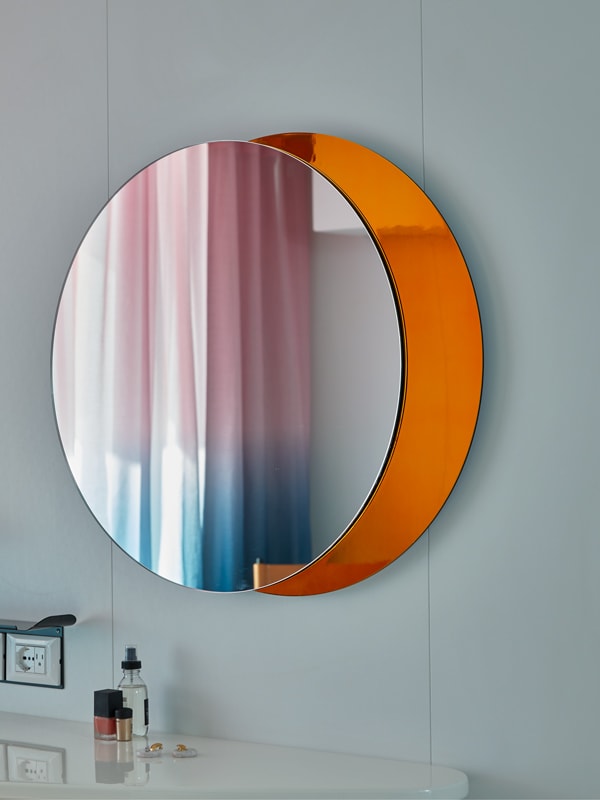
a mirror desk at sea terrace cabin, Virgin Voyages’ Resilient Lady
A mirror desk adds to the aesthetic feel of the cabin.

There are two unusual cabin additions. A convertible c-table can be used as an ottoman, coffee table, nightstand or tray for breakfast in bed, while the small, raised platform on the non-window side of the bed is handy for unpacking collections from the day on shore or objects like cameras that don’t fit in the hanging cupboard or on the desk.

There’s a small bar fridge but no mini bar.
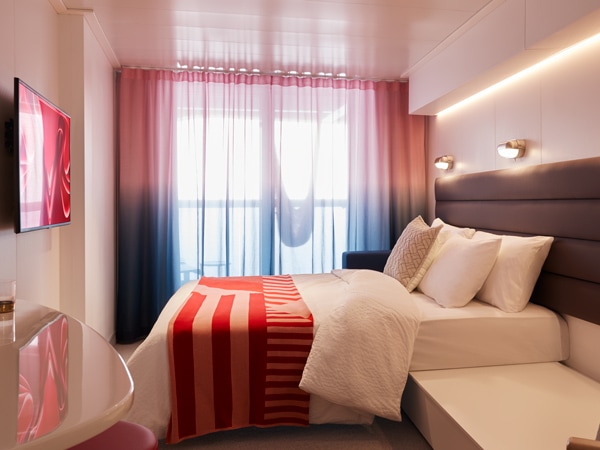
the bedroom inside the sea terrace cabin, Virgin Voyages’ Resilient Lady
Settle in the Sea Terrace cabin.

The bathroom is compact and has no cupboards for toiletries; instead, they can either sit next to the sink or on the shelf underneath. There’s a darker dedicated make-up remover towel which is a smart idea, for those who wear make-up. In the shower, the rain showerhead is appreciated and there’s enough room to swing a kitten.

The balcony is small, with a slimline set of table and chairs. The hammock innovation is smart, and while many other Sailors enjoyed hours reading in these slings, I unfortunately never had the time. The hammock is also a partnership with Yellow Leaf, a social enterprise empowering women in rural Thailand.
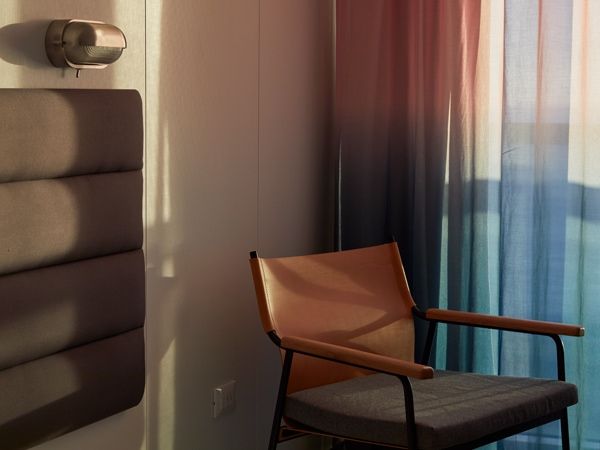
a chair beside the curtains at sea terrace cabin, Virgin Voyages’ Resilient Lady
The cabin’s amenities will keep you comfy.

Sea View: 12–17.7 square metres

Without a balcony, but with a window seat or porthole, the Sea View cabins are Sea Terraces without the terrace.
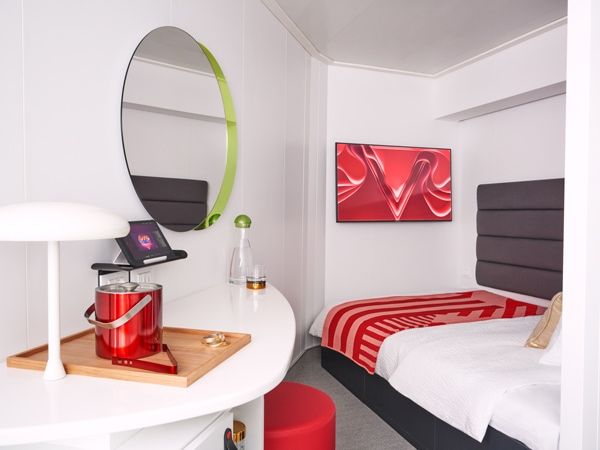
the interior at Sea View cabin, Virgin Voyages’ Resilient Lady
The Sea View is perfect for solo travellers.

The Sea View also comes in a one-person format, which is a nice inclusion for the solo traveller. The space is much smaller, with just a round stool to sit on.
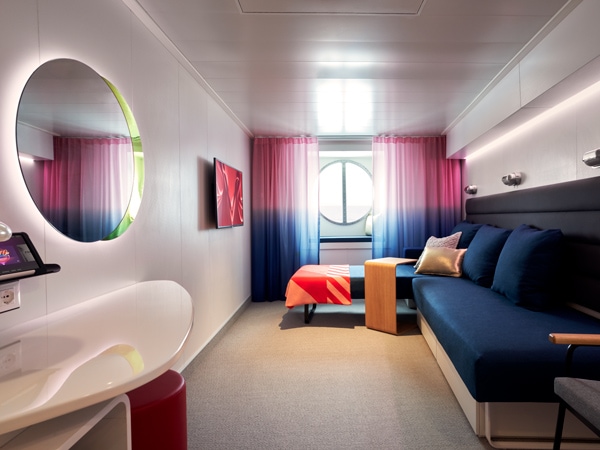
a look inside Sea View cabin, Virgin Voyages’ Resilient Lady
It comes with a cosy bed and couch to sit on.

Insider: 9.75–16.4 square metres

The internal cabins come in three different configurations.

Weekly travel news, experiences
insider tips, offers,
and more.

Insider

The internal couples cabin. This is much like the Sea Terrace (except with no sea views).

Social Insider

This is the classic four-bunk configuration. As this is an adults-only cruise, you’ll want to be very good friends with your bunkmates.
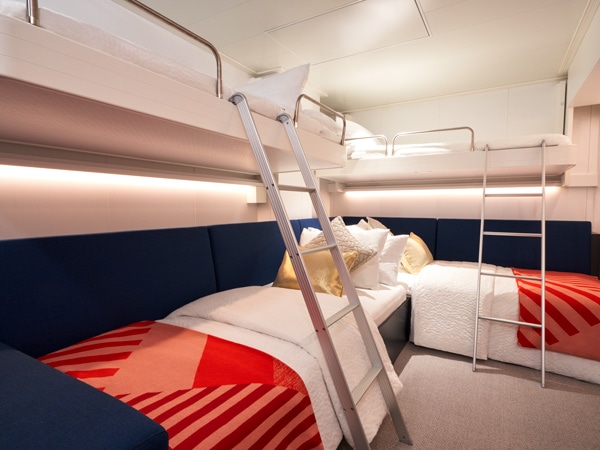
bunk beds at the Social Insider cabin, Virgin Voyages’ Resilient Lady
The Social Insider has bunk beds that can fit four persons.

Solo Insider

Take the solo Sea View and remove the porthole and you have your Solo Insider. You’ll either be an agoraphobe or hyperactive and literally use the room just for the three Ss (shower, shave and sleep… not sure what you were thinking the third ‘S’ was).

Want to see more stories from International Traveller in your Google search results?

  1. Click here to set International Traveller as a preferred source.
  2. Tick the box next to "International Traveller". That's it.
hero media

What the European heatwave means for your summer travel plans

Temperatures are soaring this summer, breaking records across Europe and the UK. 

Euro summer is a feeling like no other. But when a heatwave hits? The dream trip quickly turns into a sweaty mess. Extreme heat is sweeping Europe and the UK this week, with record-high temperatures impacting travel plans across the continent.

And while Australian summers are typically hotter in absolute temperature, many European cities aren’t equipped for high temperatures, resulting in unbearable weather.

Why is it so hot in Europe?

Signs of a hot summer loomed in May, when the mercury hit unprecedented spring highs. Now, extreme high temperature warning alerts have been issued in countries such as Spain, Italy, France, England, the Netherlands and Germany.

France saw its hottest day on record on Wednesday, with an average temperature of 30°C across the day and night. This surpasses the average temperature for June, which is 15°C to 25°C. Dozens of people have died, including 40 from drowning.

In Spain, 212 deaths have been linked to the heatwave.

The UK recorded its hottest June day ever on Wednesday with temperatures soaring to 36.1°C. In an article published by the Met Office – the UK’s national meteorological service – Professor Stephen Belcher CBE, Met Office Chief Scientist, shared his concerns about June’s heat. “To see temperatures like this in the UK in June is sobering. Events like this bring home the implications of climate change, with very high temperatures and humidity bringing significant health implications from heat stress, as well as impacts to a range of sectors such as transport, energy and water supply,” he said.

Heatwaves are becoming increasingly common in Europe and the UK, neither of which is prepared for such extremes. The World Meteorological Organization reported that in 2025, at least 95% of Europe experienced above-average annual temperatures and that the continent was heating up twice as fast as the global average.

How travel is impacted

A pharmacy sign displaying 40 degrees Celcius
A pharmacy broadcasting local weather data. (Credit: Getty/Dragoncello)

During a heatwave, power grids, water systems and transport networks can be affected, resulting in disrupted itineraries for travellers. In France, power outages have left thousands without electricity and early closures have been implemented for two of Paris’s biggest attractions, the Eiffel Tower (early afternoon rather than late at night) and the Louvre (two hours early). Eurostar cancelled its London to Paris and Paris to London services from the 22nd to the 25th, and major UK rail companies have been advising travellers to avoid using trains where possible, or to travel during early hours.

If a heatwave is predicted, being flexible with your itinerary and having fully refundable/changeable tickets is key, as extreme heat can force the cancellation of outdoor activities, impact rail and flight services and change the opening hours of sites and eateries.

Why does summer in Europe often feel hotter than summer in Australia?

people swimming in the Canal Saint-Martin in Paris
People swimming in the Canal Saint-Martin in Paris to cool off. (Credit: Rachael Thompson)

With some of the highest UV levels in the world, Australians are no strangers to the heat, adapting well to intense weather. But our infrastructure is largely equipped to withstand soaring temperatures with climate-responsive passive design, refrigerated air conditioning or evaporative coolers, as well as swimming spots aplenty.

Buildings in Northern and Western Europe and the UK, however, are constructed to retain heat and handle frosty winters. The lack of universal air conditioning means it generally feels hotter even though the temperature on your app might not look it. During a heatwave, it can feel like you’re in a sauna as cities act like heat traps.

How to stay cool and prepare for another heatwave

Relief is expected across Europe and the UK later this week, but more heatwaves are still possible in the coming months. Summer heat typically peaks in July and August.

Public transport often doesn’t have air conditioning, and buses in particular can be swelteringly hot. If you’re heading outside or your accommodation has no air conditioning, it’s worth buying a spray bottle and a handheld fan from a pharmacy or tourist stand. Check ahead of time if restaurants and cafes have air conditioning and make a booking in advance. The highest temperatures typically hit between 3pm and 6pm, so aim to head outdoors outside of these hours.

Rising temperatures invite travellers to enter a more intentional era of seeing the world. Now more than ever is the time to embrace lower-impact “coolcations” and off-season getaways.