hero media

Review: Real Berlin Experience Tour

We lace up our walking shoes and go undercover to review the Real Berlin Experience Tour, to get a local’s insight into the city’s creative heart. By Sue Gough Henly

It’s my first time in Berlin.

Sure I’m ticking off the iconic sights like Check Point Charlie and the Brandenburg Gate. But in this world capital of street art and alternative culture, I’ve also gotta get down and dirty.


And so it begins…

A few taps into Google directs me to the Real Berlin Experience which promises to ‘explore the cultural landscape from the local perspective seeing some of the world’s best street art’.

I decide to give it a shot and plan to meet our guide at the Berlin TV Tower, outside Starbucks. I’m not hopeful, given the starting point.

Turns out our guide Ben Spalding, a young American from Maine, is a German-speaking part-Puerto Rican street artist. “I do large animals and explore anxiety." In fact, all the guides are practising street artists.

Now we’re talking.


Street art, explained

In the space of a block, Ben points out and explains tagging (a form of city ownership or gangs marking their territory), stencils, screen printing, taping, ceramics and knitting. And he puts it into context as we walk through the layers of history in this most paradoxical of cities.

Berliners have been scarred by a long history of state intrusion into their private lives, from the Nazis through to the Stasi. As a collective backlash, it is pretty much open slather on the street today.


Literally anything goes

You can drink alcohol, carry up to 15 grams of marijuana, smoke anywhere, cavort with a prostitute. You can even barbecue naked in the famous Tiergarten, if you so want. And you can create art.

Though if you are caught in the act, the penalty is much lower for paperwork, which is why screen-printed street art is big here.


Interesting sights all around

Walking through Berlin’s now gentrifying old Jewish neighbourhood, we pass a Banksy rat. “Fake," says Ben. Proof of street art’s increasing commercialisation.

We stop at Otto Weidt’s brush and broom workshop, where he protected his blind Jewish workers during the Holocaust – now a poignant museum. Some incredible street art is cloistered in this area also, including an aerosol pointillist-style portrait by Aussie artist Jimmy C.


The public face of Berlin’s street art scene

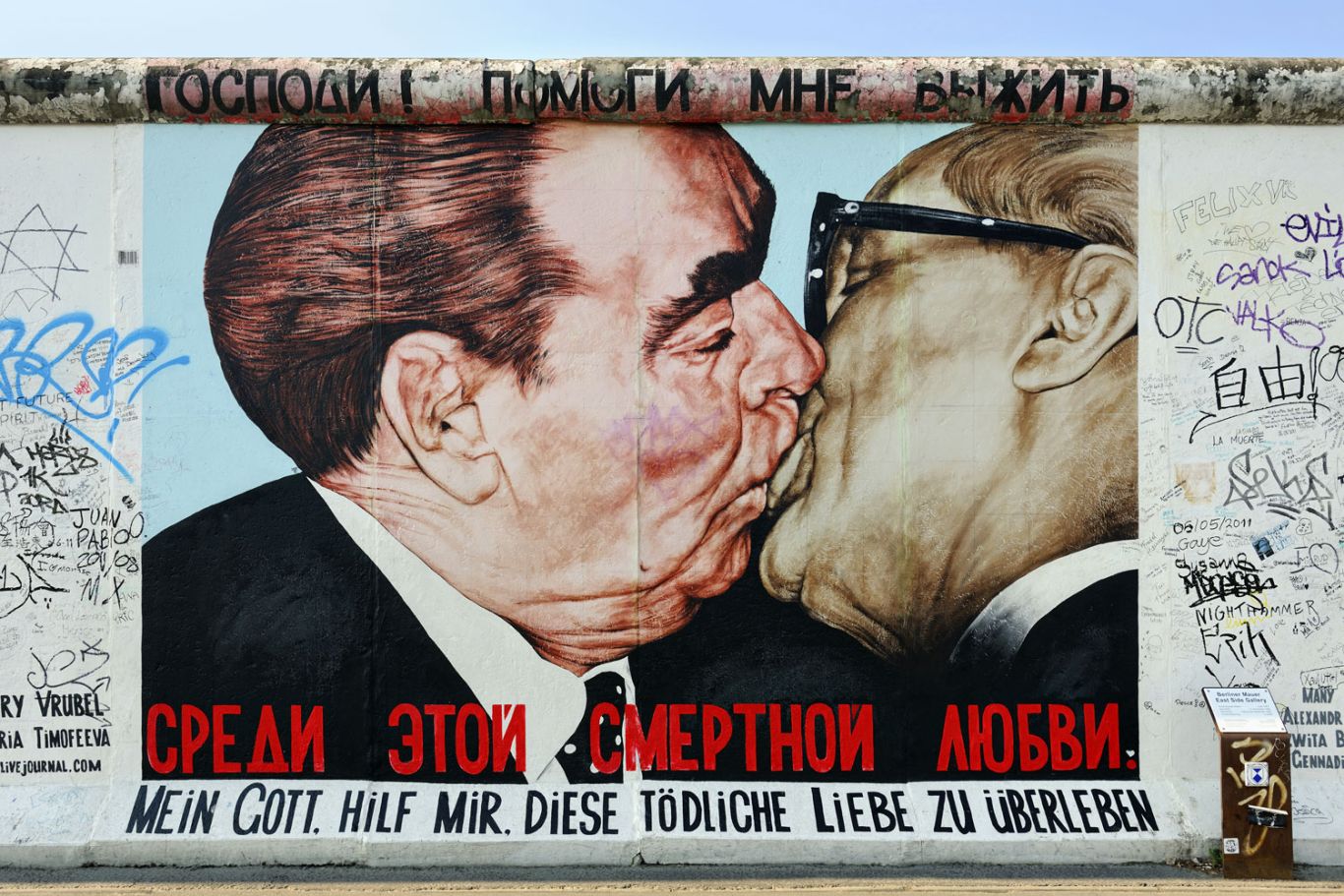
A quick subway ride brings us to the East Side Gallery: the public face of Berlin’s street-art scene along a restored section of the Berlin Wall. It’s touristy but worth a visit – it’s the longest open air gallery in the world at 1.3 kilometres.

Ben is ready to turn up the heat, though, in nearby Kreutzberg, home to Turkish and Vietnamese immigrants. We are dumbstruck by the scale, technique and searing social commentary of what we discover here.

On one corner of Oranienstraße, we see huge black and white scrawny animals dangling along the side of a five-story building, painted by Belgian artist ROA, who trained as a vet.

Across the intersection is a gripping work of photo realism by French artist MTO. Jack Nicholson, in all his manic leering madness from The Shining, peering through the wall with a larger-than-life-size orang-utan.

At the former Berlin Wall, Italian artist Blu has filled the side of a building with two white figures, each trying to grab the mask off the other as they make the sign for East and West.

We finish at street art hub Urban Spree – a not for profit organisation that holds exhibitions, performances and workshops. Under a post-modern decaying archway, Ben explains how Portuguese artist Vhils used chemicals and explosives to carve a sculptural portrait using the building’s very bricks and mortar.

Stunning. And, a commission for Levi’s. The famous jean company wanted to extend their reach into the street art scene so used Vhils’ artwork in their ‘Go Forth’ campaign. In fact, ironically a number of street artists are now getting paid commercially for their work.

And so the interchangeable world of anti-art and art as commodity takes a tumultuous turn. But thanks to Ben’s passion and knowledge of this controversial art I understand the streetscape now and can join the conversation.


The Details – Real Berlin Experience Tour 

Alternative Berlin Tours
+49 016 281 982 64
alternativeberlin.com

THE IT VERDICT:
Susan Gough Henly who paid her own way says:
“This would have to be one of the most effective ways to get an insider view of the zany, creative spirit permeating Berlin."

NOTES
Susan paid $16 for the four-hour tour.

Weekly travel news, experiences
insider tips, offers,
and more.

Want to see more stories from International Traveller in your Google search results?

  1. Click here to set International Traveller as a preferred source.
  2. Tick the box next to "International Traveller". That's it.
hero media

What the European heatwave means for your summer travel plans

Temperatures are soaring this summer, breaking records across Europe and the UK. 

Euro summer is a feeling like no other. But when a heatwave hits? The dream trip quickly turns into a sweaty mess. Extreme heat is sweeping Europe and the UK this week, with record-high temperatures impacting travel plans across the continent.

And while Australian summers are typically hotter in absolute temperature, many European cities aren’t equipped for high temperatures, resulting in unbearable weather.

Why is it so hot in Europe?

Signs of a hot summer loomed in May, when the mercury hit unprecedented spring highs. Now, extreme high temperature warning alerts have been issued in countries such as Spain, Italy, France, England, the Netherlands and Germany.

France saw its hottest day on record on Wednesday, with an average temperature of 30°C across the day and night. This surpasses the average temperature for June, which is 15°C to 25°C. Dozens of people have died, including 40 from drowning.

In Spain, 212 deaths have been linked to the heatwave.

The UK recorded its hottest June day ever on Wednesday with temperatures soaring to 36.1°C. In an article published by the Met Office – the UK’s national meteorological service – Professor Stephen Belcher CBE, Met Office Chief Scientist, shared his concerns about June’s heat. “To see temperatures like this in the UK in June is sobering. Events like this bring home the implications of climate change, with very high temperatures and humidity bringing significant health implications from heat stress, as well as impacts to a range of sectors such as transport, energy and water supply,” he said.

Heatwaves are becoming increasingly common in Europe and the UK, neither of which is prepared for such extremes. The World Meteorological Organization reported that in 2025, at least 95% of Europe experienced above-average annual temperatures and that the continent was heating up twice as fast as the global average.

How travel is impacted

A pharmacy sign displaying 40 degrees Celcius
A pharmacy broadcasting local weather data. (Credit: Getty/Dragoncello)

During a heatwave, power grids, water systems and transport networks can be affected, resulting in disrupted itineraries for travellers. In France, power outages have left thousands without electricity and early closures have been implemented for two of Paris’s biggest attractions, the Eiffel Tower (early afternoon rather than late at night) and the Louvre (two hours early). Eurostar cancelled its London to Paris and Paris to London services from the 22nd to the 25th, and major UK rail companies have been advising travellers to avoid using trains where possible, or to travel during early hours.

If a heatwave is predicted, being flexible with your itinerary and having fully refundable/changeable tickets is key, as extreme heat can force the cancellation of outdoor activities, impact rail and flight services and change the opening hours of sites and eateries.

Why does summer in Europe often feel hotter than summer in Australia?

people swimming in the Canal Saint-Martin in Paris
People swimming in the Canal Saint-Martin in Paris to cool off. (Credit: Rachael Thompson)

With some of the highest UV levels in the world, Australians are no strangers to the heat, adapting well to intense weather. But our infrastructure is largely equipped to withstand soaring temperatures with climate-responsive passive design, refrigerated air conditioning or evaporative coolers, as well as swimming spots aplenty.

Buildings in Northern and Western Europe and the UK, however, are constructed to retain heat and handle frosty winters. The lack of universal air conditioning means it generally feels hotter even though the temperature on your app might not look it. During a heatwave, it can feel like you’re in a sauna as cities act like heat traps.

How to stay cool and prepare for another heatwave

Relief is expected across Europe and the UK later this week, but more heatwaves are still possible in the coming months. Summer heat typically peaks in July and August.

Public transport often doesn’t have air conditioning, and buses in particular can be swelteringly hot. If you’re heading outside or your accommodation has no air conditioning, it’s worth buying a spray bottle and a handheld fan from a pharmacy or tourist stand. Check ahead of time if restaurants and cafes have air conditioning and make a booking in advance. The highest temperatures typically hit between 3pm and 6pm, so aim to head outdoors outside of these hours.

Rising temperatures invite travellers to enter a more intentional era of seeing the world. Now more than ever is the time to embrace lower-impact “coolcations” and off-season getaways.