hero media

Pedalling through the Palace of Versailles

Dimity Noble saddles up to review an all-day cycling tour through the Palace of Versailles, France.

When I was seven I visited the Palace of Versailles and vowed never to return.

Our guide fired off facts about its construction with the poetic finesse of an AK-47 as we shuffled between chambers trying to dodge the crowds.

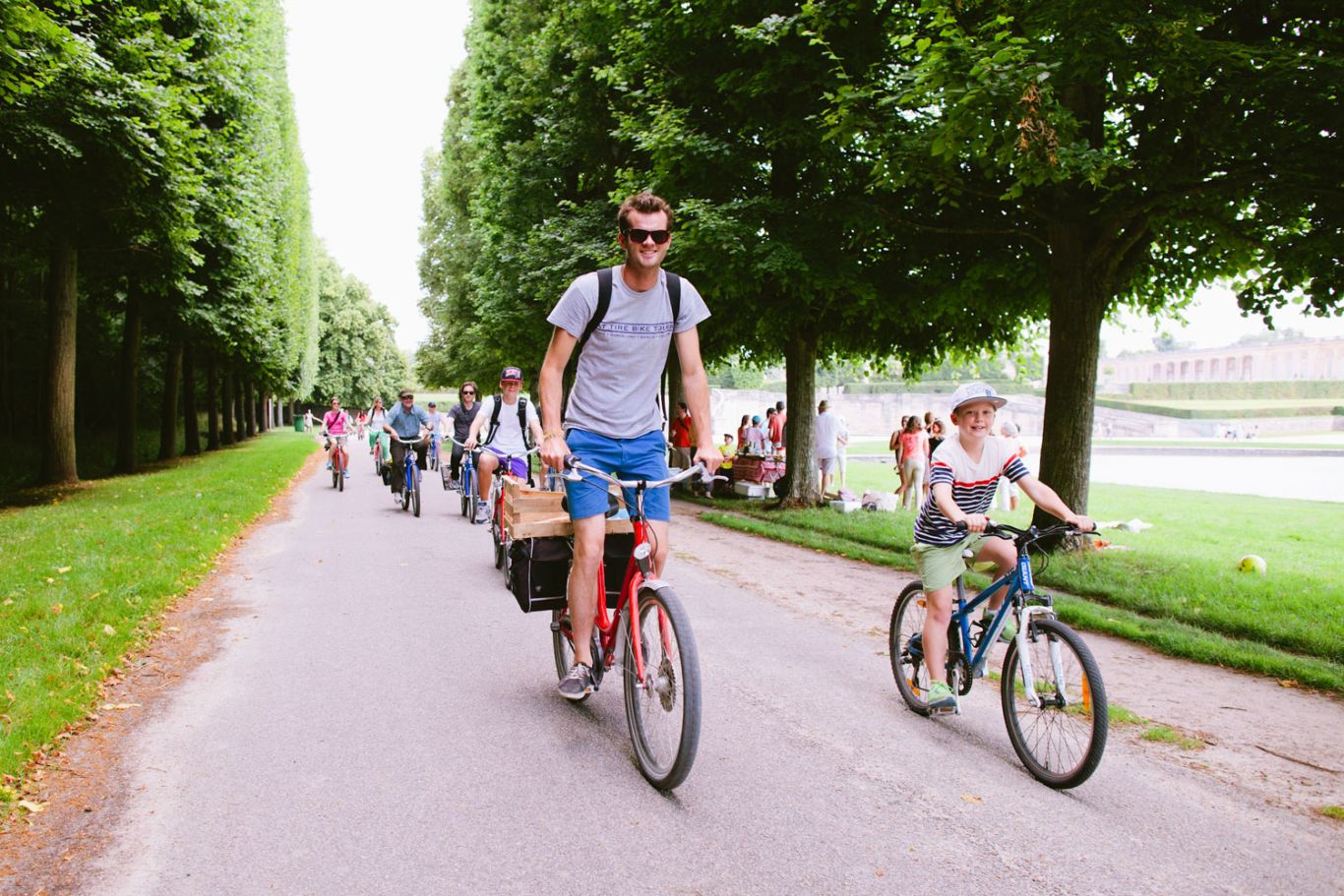
Thirty-odd years later I return – thanks to Sofia Coppola’s cranking Marie-Antoinette, which portrayed court life as a perpetual house party – to explore the 2000-acre kingdom on a 12-kilometre bike tour.

As an introduction, our young English guide, Eva, rips into a crash course on the scandalous history of French royalty.
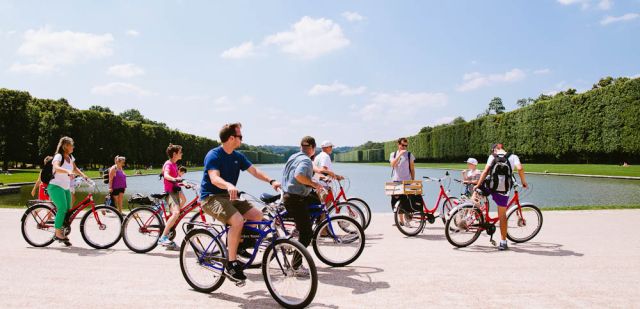
Break by the lake during the 12km tour.

She sums up the four King Louis’ and their relationship to Versailles: “Louis XIII started it (creating a hunting lodge), Louis XIV built it (the palace and extensive gardens) Louis XV enjoyed it (mistresses galore), and Louis XVI paid for it (with his head!)."

As a snail trail of eager tourists queue outside the palace’s gold-leafed gates, we avoid the crowds and cycle to the local markets to forage the endless stalls of ripe berries and sweet pâtisseries for our picnic lunch supplies.

To begin our tour, we cycle amongst forests, canals and an idyllic village with thatched houses, we are plied with tales of the frivolous sexual escapades, with Marie-Antoinette the star.

Her husband Louis XVI gave her one of the trianons (mini palaces) as a wedding gift, yet she forbade him to set foot inside. Instead, she entertained her soldier lover and inner circle (including a duchess she was also rumoured to be sleeping with).

Sumptuous banquets arrived through trapdoors on an elaborate pulley system from staff quarters below so the help never witnessed the days of feasting, gambling and opening and closing of bedroom doors. (Apparently Louis XVI suffered from phimosis and it’s believed their children weren’t even his.)

At lunch-time, our picnic is set up at the end of the Grand Canal, which extends some 1.6 kilometres from the base of the palace’s gardens.
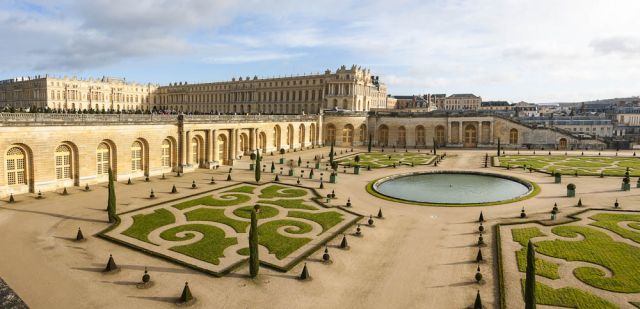
Walk or ride... hmmm... Palace of Versailles, France.
Walk or ride… hmmm… Palace of Versailles, France.

Looking across the water, I grasp the enormity of the palace’s engineering that required some 30,000 labourers and almost exhausted the coffers of France.

Stuffed from chunks of baguette spread with creamy brie and pâté washed down with some red, I stretch out on the grass and imagine a palatial 16th-century life: guns ablaze on ships during mock battle scenes (staged at great cost for the king’s amusement); Italian gondolas carrying mistresses in their ruffled finery gliding towards the Grand Trianon; the elephant that escaped the royal menagerie running about wildly; and the nerve of Louis XIV who allowed 150 people to take part in his daily rising and dressing ritual.

It was inevitable that revolutionaries would sever the lineage of French royalty for good. The people were, after all, paying for this ridiculous circus.

By mid-afternoon, Eva leaves us to wander through the palace’s interior.

A human mass forms as I enter, and slowly pushes me through every room. I doubt anyone can hear their audio-guides, let alone learn anything. As impressive as the jewel box-like Hall of Mirrors is, I crave space.

My royal mojo is restored as I wander the parterre gardens in peace, but without Eva’s spin on court life, it’s not quite as compelling. In fact, out of the five million or so people who visit the palace each year, only a fraction get to learn the stories that really lie beneath its glittering surface.

This time, courtesy of Eva, I’m one of the lucky ones.

The details

Who: Fat Tire Bike Tours, 24 rue Edgar Faure, Paris +33 015 658 1054.

The IT Verdict: Eva’s vivid account of the extravagances of the French court felt like we were delving into a juicy gossip rag whilst burning calories at the same time. Top that NW! Thoroughly recommended.

Notes: Prices from $121 for adults; $103 for children (includes return train from Paris to Versailles, a guided tour of the gardens, palace entry and audio guide). Pack hand-wipes, cutlery and plastic glasses for the picnic.

Hot tip: Also try Fat Tire’s bike tour of Monet’s Garden at Giverny – it’s like stepping (or cycling) into one of his sublime canvases. Explore the gardens, house and picnic by the Seine. From $106 per person for 8.5 hours (bike and helmet hire, return rail from Paris to Vernon and entry fee).

Want to see more stories from International Traveller in your Google search results?

  1. Click here to set International Traveller as a preferred source.
  2. Tick the box next to "International Traveller". That's it.
hero media

What the European heatwave means for your summer travel plans

Temperatures are soaring this summer, breaking records across Europe and the UK. 

Euro summer is a feeling like no other. But when a heatwave hits? The dream trip quickly turns into a sweaty mess. Extreme heat is sweeping Europe and the UK this week, with record-high temperatures impacting travel plans across the continent.

And while Australian summers are typically hotter in absolute temperature, many European cities aren’t equipped for high temperatures, resulting in unbearable weather.

Why is it so hot in Europe?

Signs of a hot summer loomed in May, when the mercury hit unprecedented spring highs. Now, extreme high temperature warning alerts have been issued in countries such as Spain, Italy, France, England, the Netherlands and Germany.

France saw its hottest day on record on Wednesday, with an average temperature of 30°C across the day and night. This surpasses the average temperature for June, which is 15°C to 25°C. Dozens of people have died, including 40 from drowning.

In Spain, 212 deaths have been linked to the heatwave.

The UK recorded its hottest June day ever on Wednesday with temperatures soaring to 36.1°C. In an article published by the Met Office – the UK’s national meteorological service – Professor Stephen Belcher CBE, Met Office Chief Scientist, shared his concerns about June’s heat. “To see temperatures like this in the UK in June is sobering. Events like this bring home the implications of climate change, with very high temperatures and humidity bringing significant health implications from heat stress, as well as impacts to a range of sectors such as transport, energy and water supply,” he said.

Heatwaves are becoming increasingly common in Europe and the UK, neither of which is prepared for such extremes. The World Meteorological Organization reported that in 2025, at least 95% of Europe experienced above-average annual temperatures and that the continent was heating up twice as fast as the global average.

How travel is impacted

A pharmacy sign displaying 40 degrees Celcius
A pharmacy broadcasting local weather data. (Credit: Getty/Dragoncello)

During a heatwave, power grids, water systems and transport networks can be affected, resulting in disrupted itineraries for travellers. In France, power outages have left thousands without electricity and early closures have been implemented for two of Paris’s biggest attractions, the Eiffel Tower (early afternoon rather than late at night) and the Louvre (two hours early). Eurostar cancelled its London to Paris and Paris to London services from the 22nd to the 25th, and major UK rail companies have been advising travellers to avoid using trains where possible, or to travel during early hours.

If a heatwave is predicted, being flexible with your itinerary and having fully refundable/changeable tickets is key, as extreme heat can force the cancellation of outdoor activities, impact rail and flight services and change the opening hours of sites and eateries.

Why does summer in Europe often feel hotter than summer in Australia?

people swimming in the Canal Saint-Martin in Paris
People swimming in the Canal Saint-Martin in Paris to cool off. (Credit: Rachael Thompson)

With some of the highest UV levels in the world, Australians are no strangers to the heat, adapting well to intense weather. But our infrastructure is largely equipped to withstand soaring temperatures with climate-responsive passive design, refrigerated air conditioning or evaporative coolers, as well as swimming spots aplenty.

Buildings in Northern and Western Europe and the UK, however, are constructed to retain heat and handle frosty winters. The lack of universal air conditioning means it generally feels hotter even though the temperature on your app might not look it. During a heatwave, it can feel like you’re in a sauna as cities act like heat traps.

How to stay cool and prepare for another heatwave

Relief is expected across Europe and the UK later this week, but more heatwaves are still possible in the coming months. Summer heat typically peaks in July and August.

Public transport often doesn’t have air conditioning, and buses in particular can be swelteringly hot. If you’re heading outside or your accommodation has no air conditioning, it’s worth buying a spray bottle and a handheld fan from a pharmacy or tourist stand. Check ahead of time if restaurants and cafes have air conditioning and make a booking in advance. The highest temperatures typically hit between 3pm and 6pm, so aim to head outdoors outside of these hours.

Rising temperatures invite travellers to enter a more intentional era of seeing the world. Now more than ever is the time to embrace lower-impact “coolcations” and off-season getaways.

Pedalling through the Palace of Versailles - International Traveller Magazine