hero media

Forget Bangkok, visit undiscovered Northern Thailand

The mystique of Northern Thailand, from Chiang Mai to the Golden Triangle, can be found in its lush green landscape, its time-honoured traditions and the gentle giants that inhabit it.

A silent procession of orange-robed figures emerge from the morning mist that hangs over the tropical tree-lined pathway. With shaved heads bowed, they solemnly step into view through shafts of light. I rub my bleary eyes to check that I’m not imagining their appearance.


It’s 6.45am; I’ve dragged myself away from the soft, silk pillows of my bed, where I slept peacefully to the steady thrum of cicadas, to participle in a daily Thai religious ritual. The Buddhist tradition of giving alms or almsgiving is a way of accruing good karma for this life and the next.


I’ve been kneeling for 10 minutes, earnestly anticipating the arrival of Buddhist monks, with fresh fruit and sticky rice at the ready. Each monk pauses in front of me and wordlessly reveals a brass bowl under a swathe of saffron-coloured material. I gently place the edible goods inside, then start a low, sonorous chant as their bare feet pad the leafy pathway to disappear from view as suddenly as they had appeared.
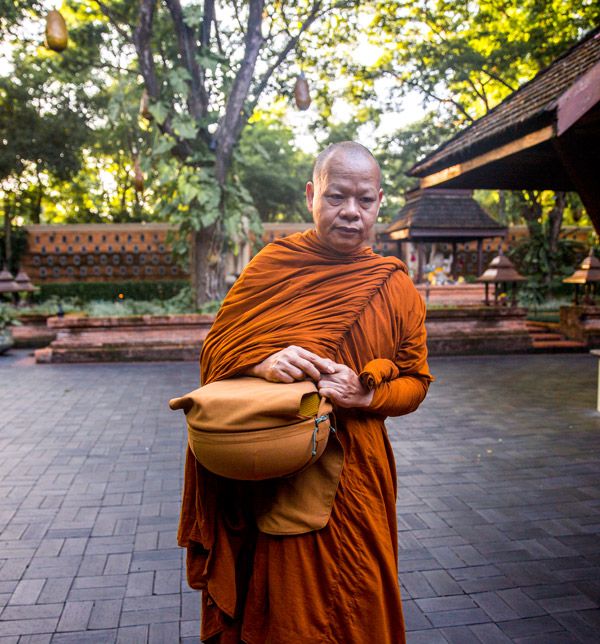
Thailand Monk
Almsgiving is a way of accruing karma in the Buddhist tradition.

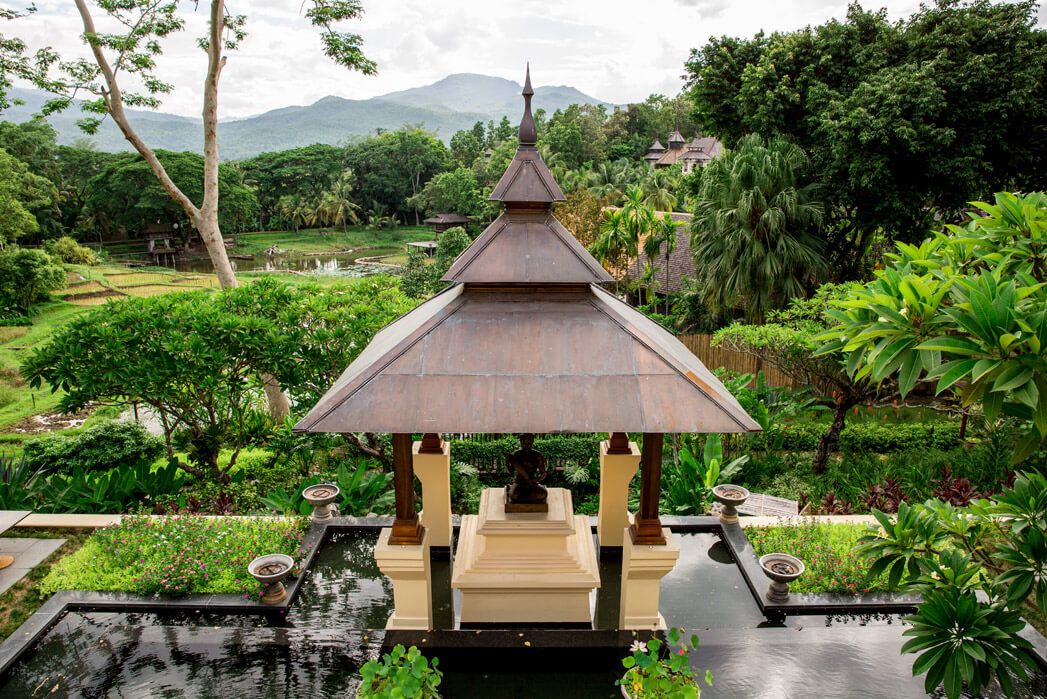
So tranquil are my surrounds, it’s hard to believe I’m at the entrance pavilion of the Four Seasons Resort Chiang Mai. The 12-hectare property is set amid the forested mountains that surround Mae Rim Valley, about 30 minutes north of Chiang Mai. It’s a haven of tropical foliage, waterfalls, lily ponds and Lanna-style pavilions dotted around terraced rice paddies.


The beautifully appointed Thai-style suites feature Siamese artwork and teak flooring, as well as private verandahs overlooking frangipani-scented gardens fringed by banyan trees.


A statue of Mae Phosop – the goddess of rice – sits overlooking the resort’s glistening rice fields. ‘The mother of rice prosperity’ is an important figure in ancient folklore, as the grain is a staple of the region. The glutinous rice prepared for the monks this morning was sourced from the resort’s own working rice paddies.
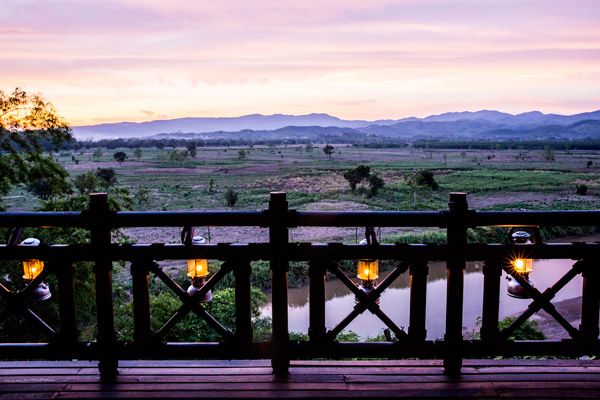
Thailand Rice Fields
Rice fields are a signature panorama in this part of Thailand.

I squelch across the marsh to meet the farmers who tend to the crops with the help of water buffalo, or ‘living tractors’. I watch as the resident buffalo are bathed to cool down in the sultry heat, before delving into a quick lesson in rice planting, which turns out to be back-breaking and a sure way to increase your appreciation of every single grain consumed during a stay here.

The North Star

While Southern Thailand has long attracted travellers with its idyllic islands and coconut palm-strewn beaches, the north is wildly different. It beckons with the promise of lush landscapes, cultural riches and deeply spiritual encounters. More than sand and sunshine, there’s something here for your very soul.


Chiang Mai was once the capital of the 13th-century Lanna Kingdom (meaning ‘one million rice fields’), which also covered neighbouring parts of Myanmar, China and Laos.


The province officially became part of Siam in 1933. It’s the country’s second largest city, yet only a fraction of the size of buzzing Bangkok. Buddhism is Thailand’s official religion and Chiang Mai is the spiritual heartland, with more than 300 temples (wats) and giant gilded Buddhas scattered across the province. The 700-year-old city is steeped in spiritual heritage and ancient traditions, and is therefore regarded with reverence by many Thais.
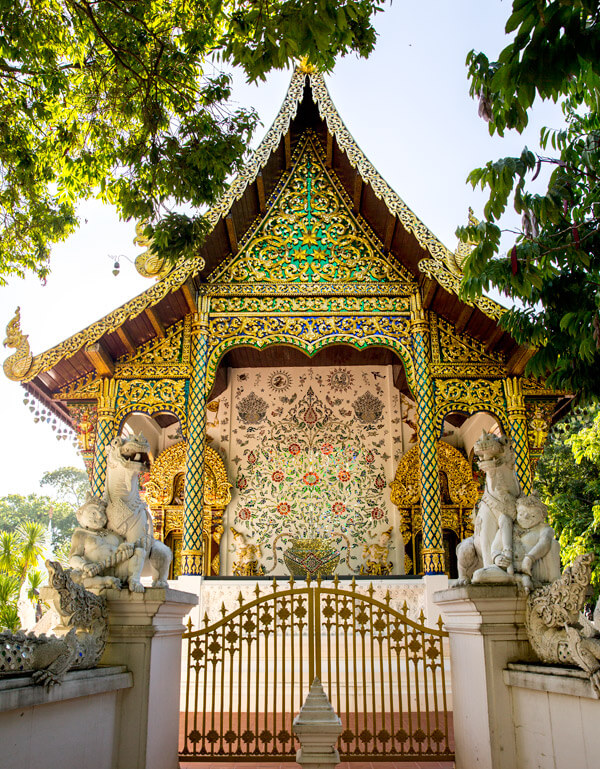
Thailand Temple
This part of Thailand is truly dense with temples.

Chiang Mai is an obvious starting point for those wanting to venture four hours further north to Chiang Rai. The confluence of Thailand, Burma and Laos, known as the Golden Triangle, or Sop Ruak to locals, is a mysterious land of teak tree forests and mist-shrouded mountains carved by the mighty Mekong River. In the age of mass tourism, it’s not often one feels like you’re getting off the beaten path.


However, the Four Seasons Tented Camp Golden Triangle, situated in a sleepy backwater on the northernmost edge of Thailand, is far-flung and exotic enough to entice intrepid travellers with the promise of adventure.

Searching for gold

The Four Seasons Tented Camp, dreamt up by the legendary American-born, Bangkok-based designer Bill Bensley, evokes the atmosphere of a 19th-century explorer’s outpost. The sense of arrival is inimitable, as a long-tailed boat navigates through the tea-coloured waterway of the Ruak River, a serpentine tributary that divides Thailand and Myanmar.


We glide past fishermen setting rattan fish traps and buffalo wading through the water. An enormous male elephant with a piercing pair of ivory tusks appears in the tall grass on the riverbank and signals our arrival with thunderous trumpeting. It’s an experience that is so perfect, it feels as though it’s been staged for my benefit; it’s rustic, remote and utterly romantic.


After clambering onto a small dock, I’m whisked away to my air-conditioned tent, chauffeured in a 1975 vintage jeep. By the afternoon I’m settled in one of the 15 canvas tents elevated among the treetops, with hardwood floors, handcrafted leather furnishings, a bed cloaked in mosquito netting and a freestanding copper bathtub.
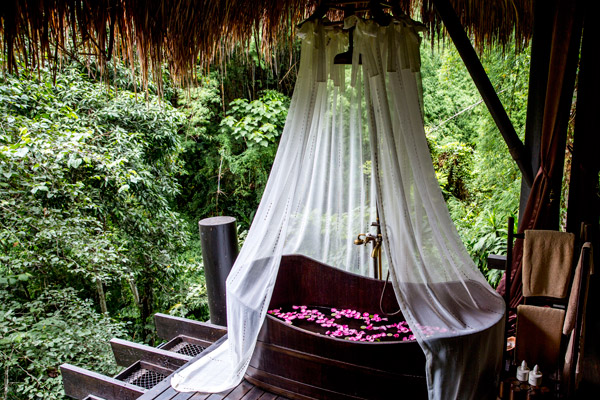
Chiang Rai Lodge
Substantial comfort amongst the Chiang Rai wilderness.

To get a grasp of the infamous past of this region, I visit the Hall of Opium. It’s a surprisingly vast museum – close to the fields where a sweeping carpet of poppies once bloomed and the sleep-inducing, sticky-brown sap was scored from unripe pods.


The province was notorious for opium trade, a dark chapter in Chiang Rai’s history that began to change when the government intervened in the 1970s. Opium cultivation was once a major cash crop for highland tribal communities and, in recent years, swathes of hillside have been reforested with other profitable produce, such as Arabica coffee, macadamia, fruit trees and tea plantations.

The great escape

I return from my excursion just in time for the quintessential camp experience – sundowners at the Burma Bar overlooking the pink, orange and red painted sky illuminating the Rauk River. Languid evenings are spent sipping cocktails at the breezy bar with the thatched roof that is bedecked with tribal antiques, Siamese textiles and overstuffed leather lounges.


This is prime position for panoramic views over Myanmar and the faraway hills of Laos. The open-air design allows one to feel part of the elements, amid the chorus of jungle sounds.


It’s the ideal setting for swapping traveller’s tales with other guests. I’ve met up with the exuberant Tobias Emmer, the German-born general manager of the camp.


“You can’t leave the tented camp without having a lemongrass martini," Tobias chuckles as we clink glasses. He’s joined me for a drink so I can learn more about the elephants cared for by the Four Seasons camp, which works hand-in-hand with the Golden Triangle Asian Elephant Foundation, a sanctuary that rescues poorly treated elephants and gives them a loving home in their natural habitat.
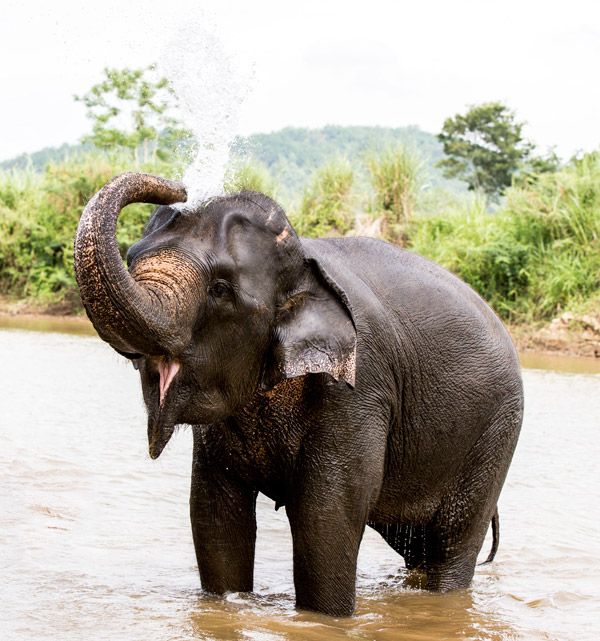
Each elephant has its own distinct personality.

Tobias explains that each elephant has a distinct personality. Linda, who was forced to work on the tourist strip of Bangkok’s red-light district as a calf, has found her forever home at the camp. She often joins guests for breakfast in the morning, polishing off baskets of bananas and crunching on coconuts as ‘glampers’ sip their morning coffee.


“Linda is a very food-excited personality; sometimes she doesn’t want to go until she has more bananas," says Tobias. Linda’s insatiable appetite (elephants can eat more than 200 kilograms of food per day) almost led to a major border control incident. She picked up the scent of food in the air from yonder, eventually crossing international waters and stealing into Myanmar.


It wasn’t long before she was found munching away on a Burmese farmer’s crops, having left a trail of ruined fences along the way. They had to enlist the help of Linda’s best ‘ele-friend’ Pumpoi to coax her back across the stream, dangling some sugar cane as additional bribery.


It rains heavily overnight. The sound of rain on the tent (one of the Earth’s most blissful sounds when you’re safe under the sheets) mingled with a peal of jungle noises – swishing leaves, an ensemble of calls from geckoes, frogs and birds – is both musical and mournful.


I wake up to the earthy, sweet perfume of petrichor. The sun’s rays hit the water as I soak up my surrounds from the outdoor shower, catching a glimpse of the gentle giants wandering through the greenery below.

Walking with locals

I meet up with the lead mahout (keeper), Khun Seng, by the old barn for the ‘Elephant and I’ experience. Khun and I will be exploring the wilderness with a herd of elephants: a real bucket-list activity. I’m dressed in a denim mahout outfit tied together with a sash crafted by a nearby hill tribe community.


I’m in awe of the peaceful creatures that stand before me. I tenderly run my palms flat along an elephant named Yuki’s trunk, her grey, crêpey skin is speckled pink and softer than I expected. She bats her long eyelashes and I get lost in her kind, amber eyes.


Our gaze is only broken as Khun Seng starts loudly listing a few rules: “You must not walk too close behind an elephant, as even the flick of a tail will hurt you." Check. “Don’t hug their trunks as the underside is very sensitive." Check. “Don’t feed the elephant and then tease them by taking the food away." Or, in my case, don’t resist when four trunks swoop in from all angles to deftly prize away the bananas that have been discovered in my bag.


Khun and I amble through the forest and deep into the tall grasslands alongside the majestic mammoths who move in a relaxed and unhurried manner. They pause to strip sugarcane or rub their backsides against trees that bend and strain against their weight.


We’d never reach the river for their bath without some encouragement from the mahouts, who keep uttering the words “pai, pai", which means ‘go’. As we near the swimming spot ahead, the mood changes and it’s like watching a group of playful toddlers.


Their steps pick up pace as they gleefully frolic into the water and their trunks spurt out cascades of murky water into the air. I’m so enthralled I hardly notice I’ve been covered in mud.


The heat has hit hard by midday. While the herd of elephants flap their enormous ears to cool down after their bath, I’m left sweltering in my denim outfit. It’s time to bid my four-legged friends farewell. Swapping the heavy denim fabric for a pair of swimmers, I take a quick dip in the lagoon-like rock pool back at the camp.


It’s a magical final evening. Tobias has organised a small party of fellow glampers and we dine in a lamp-lit al fresco setting. The barn is flanked with palm fronds and draped in fairy lights. Musicians play traditional Thai music, and the relaxing sound of the khim (a stringed musical instrument) carries in the still air. We feast on freshly caught ruby fish, marinated with fragrant hillside herbs and steamed in a tube of green bamboo over the fire pit.
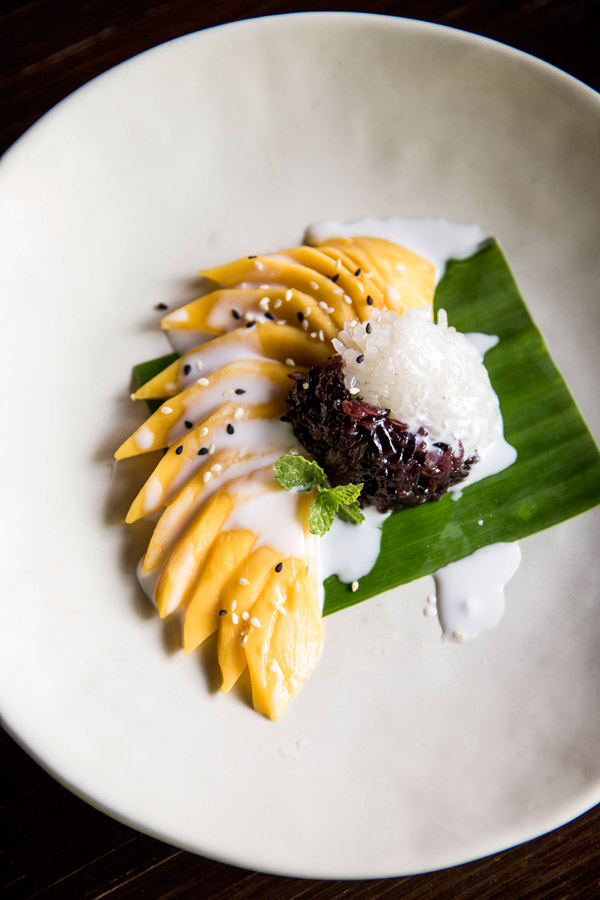
Chiang Rai Dessert
Mango drizzled with coconut sauce is a nice way to end any day.

A typical Thai dessert of mango sticky rice drizzled in coconut sauce is a fitting finale. After the banquet, we relocate to the riverbank to release khom loy fire lanterns into the night sky for good luck.


There’s a rustling of the rice paper as the lanterns catch flight and then they float, in slow motion, up to the heavens like giant, shimmering jellyfish. I make a wish to return to this endlessly enchanting place one day. Later that evening, I step out onto my deck for a nightcap.


Looking up, I see a dancing, incandescent object. My lantern is still toiling with its earnest task of carefully carrying my dreams to the ether. I stand there, transfixed, as I follow its movement with my eyes, until the lantern becomes a faraway firefly and then vanishes amid the twinkling stars.

Weekly travel news, experiences
insider tips, offers,
and more.

For more Thailand travel inspiration, visit our Thailand guide for more information.

Want to see more stories from International Traveller in your Google search results?

  1. Click here to set International Traveller as a preferred source.
  2. Tick the box next to "International Traveller". That's it.
hero media

These community homestays are changing how travellers experience Nepal

    After youth-led protests in 2025, this year Nepal elected a 35-year-old former rapper as Prime Minister. In a country where tourism is its biggest industry, what’s next for travellers? 

    In 1986, Nepal changed its clock. It had used India Standard Time since 1920 so, to differentiate, it wound its clock 15 minutes ahead of, not behind, its big-brother neighbour. Boss move. “Nepal is strongly opposed to the idea that our identity is connected to India,” says Community Homestay Network (CHN) guide Bikal Khanal.  

    Tharu dance
    Tharu dance is traditionally set to hand drums. (Credit: Kate Lewis)

    Today, Nepal is the only independent country with a 45-minute deviation to universal time; an oddity that’s become a symbol of national pride. The quirk is nearly as endearing as Kathmandu’s Tribhuvan airport where carved varnished wood and shiny red bricks rule. One sign points to a ‘Travelator’ and another to a ‘Grievance Handling Desk’ while visas are noisily stamped at customs for US dollars, cash only. When am I?  

    Nepal gray langur
    Spot the endemic Nepal gray langur. (Credit: Simon Urwin)

    The 15 or 45 minute anomaly sees me tap out completely on timezone calculations. Why bend my brain calculating if it’s quarter to or quarter past elsewhere when I’m in the honking here and now of Kathmandu where the air is high-altitude crisp, the prayer flags flutter and the street dogs howl?  

    How tourism is changing in Nepal

    Bardiya National Park
    Bardiya National Park is rich with wildlife. (Credit: Simon Urwin)

    India is not the only association many Nepalis would like to shake. With eight of the world’s 10 tallest mountains, including Mount Everest and Annapurna, Nepal has long attracted mountaineers and trekkers, and expedition numbers are continuing to rise.  

    Tourism is one of the country’s biggest sources of foreign currency, so this growth is not negative, per se. But according to Ang Tshering Lama, who co-founded Phaplu Mountain Bike Club, being reduced to a mere trekking destination is limiting.  

    “Trekking is just one layer of our identity,” says Ang. “When it becomes the dominant narrative, it limits how we’re seen and how we see ourselves.” Nepal’s recent success, however, in diverting trekkers to less-trafficked areas such as Manaslu mofuntain, where visitor numbers rose by 117 per cent last year, offers hope that tourism can diversify even more radically.   

    Local men in Bhada village
    Local men in Bhada village. (Credit: Simon Urwin)

    The founder of CHN, Shiva Dhakal, wants that change. “The whole idea of the Community Homestay Network is to promote experiences outside of trekking,” he says. “Community tourism changes lives and helps kids stay home instead of coming to the city or migrating to the Middle East.”  

    Ang grew up seeing people leave, “not because they wanted to but because there weren’t enough opportunities to stay”, he states. Yet from remote villages to living traditions; food, art, music and emerging subcultures, “there’s so much that’s not being seen.” 

    CHN is opening some of those doors. It doesn’t own, or fund, any homes. Rather, it promotes homestays to travellers on a single, slick platform, while fostering entrepreneurship in places where women, marginalised castes, Indigenous people and the youth stand to benefit the most.  

    A new generation demanding more

    Dalla Town Hall
    Dalla Town Hall, where volunteers discuss anti-poaching tactics. (Credit: Bheem Thapa)

    The future prospects of next-gen Nepalis can no longer be ignored. On a Kathmandu tour with 33-year-old guide Monica K.C, we pass buildings torched in the September 2025 ‘Gen Z protests’, including the Supreme Court and Parliament House. Seventy-two people died. “They were anti-corruption protests,” says Monica. “Politicians’ children are living a lavish life but the airports are crowded with youngsters leaving to find work.”  

    We stop in ‘little Tibet’ at the wondrous sixth-century Boudha Stupa. “The wheel of life is Buddhism in a nutshell,” says Monica. “Things such as hate, ignorance and anger keep you rotating around the wheel, so you must follow the principles of Buddhism to detach. If you can’t, there’s no nirvana for you.”  

    Boudha Stupa's prayer wheels
    Boudha Stupa’s prayer wheels are used to recite Buddhist prayers. (Credit: Kate Lewis)

    In a sun-drenched twist to the usual temple visit, we ascend the stupa’s sloping plinth and roam its whitewashed dome. Tendrils of diaphanous prayer flags stream from a steeple-like structure where the Buddha’s unblinking eyes stare out. No nirvana for you… 

    bouda stupa prayer flags
    Tibetan-style prayer flags embellish the whitewashed dome of Bouda Stupa, a Buddhist temple. (Credit: Kate Hennessy)

    The dome is delightfully free of guard rails or chiding from security. There is, however, a stern ‘No TikTok’ sign, perhaps in response to the youth’s newly flexed power. The booted-out Prime Minister, K.P. Sharma Oli, was replaced in a resounding election victory in March by 35-year-old Balendra Shah of the Rastriya Swatantra Party (RSP) – a former rapper and mayor of Kathmandu. The RSP’s manifesto indicates tourism is a priority, and that Nepal’s cultural identity in areas such as gastronomy will be strengthened.  

    Boudha Stupa vendors
    Vibrant souvenir shops and cafes around Boudha Stupa. (Credit: Kate Hennessy)

    A more confronting stop awaits at Pashupatinath Temple. Today is Bala Chaturdashi, a Hindu festival where thousands of devotees gather to honour their dead ancestors. Vendors hauling foam mattresses do a lucrative trade as people set up for a night of vigil. This includes burning the bodies of recently deceased relatives on bamboo pyres in the Bagmati River, which flows into the sacred Ganges.  

    A woman at annual Hindu festival Bala Chaturdashi
    A woman at annual Hindu festival Bala Chaturdashi, in Kathmandu. (Credit: Kate Hennessy)

    Wrapped in a shroud, the bodies are positioned with their heads facing north to the Himalayas where Lord Shiva resides. They’re covered with flowers and straw and set alight by male family members.  

    Hours later, the ashes are swept into the river where devotees will take a holy dip the next day. As much as Monica assures us it’s not voyeuristic to watch, I struggle to do so. “Here you see the reality of life because everyone ends up there,” she says, gesturing to the river.  

    Life unfiltered in the Terai region

    tharu woman
    Tharu woman and master weaver Parbati Chaudhary in Bhada Village. (Credit: Bheem Thapa)

    The reality of life needs processing time, which the western Terai region delivers in spades. The Terai is largely separated from India by the Karnali River and Bardiya National Park, where elephants, rhinos and the elusive Bengal tiger roam.  

    Once a nomadic tribe, the Indigenous Tharu people are now the largest ethnic group here. “They didn’t know their daily life was interesting for international travellers but they’re starting to understand now,” says CHN founder Shiva.  

    safari through Bardiya National Park
    Take a Jeep safari through Bardiya National Park. (Credit: Bheem Thapa)

    We fly Buddha Air to Dhangadhi airport and drive five hours to stay in Tharu homes. The journey to Bhada village is a blur of roadside fruit stalls, traffic-stopping sacred cows and fields sown with wheat, rice, mustard, spinach, cauliflower and potatoes. Nepal’s agriculture feeds only Nepal.  

    Marigolds
    Marigolds are an important part of Hindu rituals. (Credit: Simon Urwin)

    “The only thing we export is young people,” says our guide Bikal. As the light dims and we plunge evermore rural, mysterious mounds of compacted hay – some house-sized – loom like the creatures from Where The Wild Things Are. Even our trusty driver gets flummoxed by a dirt road that abruptly ends and we find ourselves hurtling across a paddock.  

    On arrival, some are ferried to mud-walled cottages greened by gourd creepers, with thatched roofs and rustic-chic mosquito nets. Myself and two others are ushered to the home of corner store owner, mechanic and mushroom farmer Man Kumar Chilaruwa and his wife Rajkumari.  

    community homestay entrance
    A warm welcome at a community homestay. (Credit: Simon Urwin)

    They escort us to a bunker-esque back building with steel doors and a folding security gate, behind which is gleaming linoleum, dolphin-printed tiles and a shower cavity that must be gingerly stepped through to reach the toilet.  

    The ceiling lights emit a rainbow of colours (the bathroom light gets stuck in, frankly, a quite frightening red). We’re nevertheless touched that our hosts invested in all this bling when the average salary is around $275 a month.  

    In the coming days, we participate in Tharu traditions such as making moonshine, dancing, weaving straw handicrafts and gold-panning. We’re fed well with staples of rice, mustard greens, lentil pancakes, daal, curried chicken and tomato chutney served on antibacterial saal leaves.  

    food at community homestay
    Dig in. (Credit: Kate Hennessy)

    Sonara community homestay president Indradevi Tharu tells us river snails are often served, and the boiled and pickled flesh of rats hunted in the rice fields. “Perhaps next time?” we say and all have a laugh.  

    The power of community homestays 

    community homestay owners in Nepal
    Barda community homestay owners Parbati Chaudhary and Ram Krishni Devi Chaudhary. (Credit: Simon Urwin)

    Immersing Western visitors in foreign cultural practices is not new. But with the Tharu, I never get that uneasy sensation that I’m being performed for. Despite being the only tourists, there’s no ‘othering’; just warm, composed and ultra-dignified welcomes. Like we’ve always been here.  

    “I love to have travellers in my village so I can see the world,” says local woman Parbati Chaudhary. “Why would I travel the world when the world comes to me?” 

    The graceful acceptance the Tharu offer, as well as the slow pace, works miracles on my frazzled nervous system. One day I even take a nap on a vacant homestay bed. 

    Sonara community room
    An authentic stay in the Sonara community. (Credit: Kate Hennessy)

    Roosters strut and goats bray as we sit on the ground in al fresco kitchens, rolling rice flour into cylinders steamed to make dhikri (dumplings). When water is needed, we fetch it using a hand-operated pump as a family of ducks strolls by, side-eying us like curious neighbours.  

    Animal lovers will delight in Tharu villages. Kind and resourceful inventions are everywhere, such as snacking stations where two posts lean together, with leafy boughs dangling on rope for baby goats to forage from.  

    CHN’s CEO, Aayusha Prasain, nods knowingly when one in our group says she cried when she left her host, Shayam Chaudhary, in Bhada. Shayam’s 17-year-old son, Prashant, had translated, which deepened the connection.  

    “Community tourism turns travel into a relationship, not a transaction,” says Aayusha. “It places decision-making power in the hands of local communities, especially women and youth.” Since 2018, CHN has hosted more than 4000 travellers from 52 countries in 408 households, and estimates women’s participation has increased by 381 per cent.  

    Elephant watch
    Elephant watch. (Credit: Simon Urwin)

    In the Bardiya community, where vexing human-animal conflict has been a balancing act for decades due to elephants raiding crops, long-time homestay operator Salik Ram Chaudhary says young people keep the older ones on their toes.  

    Gathering greens
    Gathering greens. (Credit: Bheem Thapa)

    “We can’t keep homestays stagnant,” he says. “We have to upgrade our service and redefine our product or young people won’t see it as an attractive business. If we can keep evolving with this travelling trend we’re confident the youths will stay and continue it.” 

    Back in Kathmandu, Monica explains that after the deaths of young protestors in September, a determination had spread to not let their sacrifice be in vain. “We want to keep holding the government accountable,” she says. “We don’t know what situation we’re facing, but we’re ready to face it.”  

    Interested in Nepal but prefer to experience it in total comfort? Read our guide to luxury travel in Nepal