hero media

Chiang Khan: Authentic Thailand without the invading hordes

An authentic Thai town that hasn’t completely been overrun by tourism? One does exist. John Borthwick travels – almost to Laos – to find it.

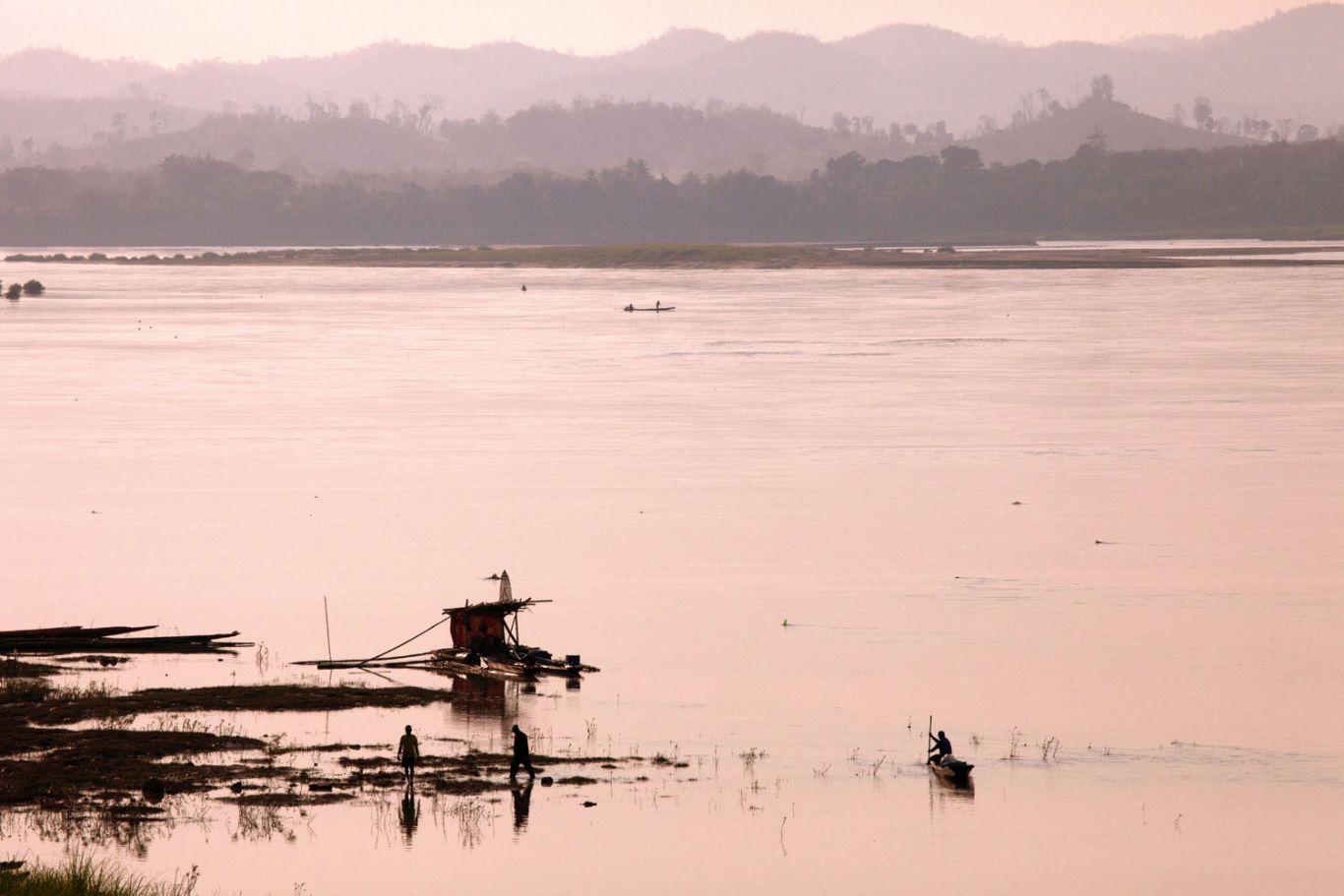
Across the Mekong River the hunched blue hills of Laos fade and a firestorm dusk dials itself down to pitch-blackness.

The beer is cold and my fish, fried with ginger and garlic, is crisp, tangy and cheap. A few hours later I fall asleep in a classic, unrestored Indochine mansion.

Come morning in Chiang Khan, I awake to a hullabaloo of gossip and chanting monks in the street outside.

It could all be 100 years ago but it’s not.

This old river trading port in northeast Thailand has become the town that time remembered. Perched on the banks of the Mae Nam Khong (Mekong River), 580 kilometres north of Bangkok, Chiang Khan was until recently an unremarked settlement whose glory days — if any — of the rubber trade, opium smuggling, banditry and cross-river spats with colonial French or communist Laos, were well behind it.

Its original main road, Chai Khong, running parallel with the river, had been superseded by a newer, highway-facing town built just inland. Like a Mekong-moated Brigadoon, Chai Khong Road’s kilometre of century-old, two-storey teak shophouses was slipping into a picturesque decrepitude of subsiding stumps, rust and irrelevance.

And then the Janus-faced joker of tourism stumbled into town. Starting with a trickle of savvy Bangkokians in search of something more authentically Thai than mega-malls and traffic jams, the word spread that here was a piece of Thai heritage that still looked like itself — that hadn’t yet been slam-dunked with T-shirt stalls, night markets and kitsch.

“Yes, the town has much history," a local woman tells me, “but it is written in Thai. I can read, but have not."

It’s hard to get many hard facts about Chiang Khan, other than it has a handful of fine, old Buddhist temples; there is, perhaps, a population of around 10,000 people; and the town celebrated its centenary in 2009. Searching, I find a Thai language website that, having run itself through a translator app, describes the town with the sort of fantastic cut-up poetics that William S. Burroughs would applaud, and I can’t beat: “Chiang Khan, the beauty of diamonds coconut long glass, she was as silk to the island and curry source of culture."

By sheer luck I have booked online a riverfront room in a building that itself is history, a cache of period Siamese-Lao memory.

The manager of Loogmai Guesthouse, Khun Neng, tells me it was the first concrete building in town. She guesses it is “about 60 years old" (although I might add another 20 to that) and was built by Vietnamese craftsmen for a local Thai-Chinese-Lao family in the style of French Indochinese villas — two storeys, 20-centimetre teak plank flooring, archways, louvered shutters, high ceiling fans and a steep stairway leading from the ground floor trading area to family quarters above.

My upstairs room is an airy, whitewashed cube with a bed and no wardrobe, but perfect wi-fi. Very Thai. My view of the Mekong is interrupted only by the two Japanese backpackers on the porch who seem to wash their clothes for hours each day. I love this building.

Neng tells me, “Townspeople took shelter here when there were cannon attacks from Laos across the river because it was the only concrete house in town." I assume this is probably during the Pathet Lao rule of the late 1960s to early 1970s.

We scroll down fast on the timeline to when those savvy Bangkokians, seeking their version of sea-change/tree-change/me-change, started buying up the street’s old, Siam-era teak houses and then refurbished them into guesthouses, home stays, gift stores and cafés.

I arrived (by plane, taxi, bus and tuk-tuk) to find a town that stretches itself languorously along the Mekong’s south shore like a cat on a couch.

Sensibly, Chiang Khan’s citizens constructed a promenade long ago that runs the length of the old town along the riverbank – a great spot to stroll during lavish sunsets, the burning noon or occasional morning mists. On the river below, fishermen in pirogues net the eternal tides that slip past heading from Tibet to the South China Sea.

From the far bank I can hear Lao music – the zither-like khim or bouncy Isaan jigs — and see kids splashing on sandy river beaches.

Chiang Khan has boomed in the past four years, and even more so in the last two. It has well and truly been ‘discovered’ by urban Thais (although not by farang — I see fewer than a dozen foreigners a day), many of them drawn to a nostalgic past that they never had: Buddhist monks at dawn receiving alms and sticky rice, those rambling family homes made of ancient teak on streets of almost no vehicles, and local specialities like hand-sewn quilts and maphrao kaew (sugar-coated dried coconut) snacks.

What visitors don’t come here for is banana boats, go-go bars, day spas, botox clinics, ladyboys, muay thai boxing, bucket booze and elephant rides – just yet.

In lieu of all that, I have a simple choice to hire a bicycle (around $2 per day) or motorcycle (around $5 per day), view the Buddhist wats (temples), have a foot massage, or to simply stroll, read, eat and drink by the river… and visit a few more wats.

Or have a caffeine fix. Now, for all the cafés in town it’s hard to find a decent cup, but I don’t mind. Some of the most illuminating conversations I have here are with café owners.

On the trendy Soi Nine side-street off Chai Khong, two well-off escapees from Bangkok’s Big Mango Bar, husband-and-wife-team Em and Arm, tell me how they visited Chiang Khan 18 months ago, “fell in love" with the place, bought a run-down shophouse and transformed it into the See I 249 coffee and music shop, complete with macarons.

Farther east along Chai Khong Road — now designated paradoxically as both a cultural street and walking street — I drink at the Ganga Guesthouse, a beautifully restored teak structure that bristles with antiques and curios (plus the family SUV parked in the front room).

The middle-aged proprietors, also ex-Bangkokians, tell a story that is, as Thais like to joke, “same-same but different". Having settled here just four years ago in their quest for a quiet, creative retirement, they are already considering moving on due to, ironically, the changes that they were harbingers of.

Those changes now see the old, meandering, wooden, Mekong-side of Chai Khong Road transformed each evening into an open-air mall of trinket stalls, pirate DVDs and CDs, hawker snack carts and logo T-shirts (I love Chiang Khan, etc.). Quite literally, at times, I can’t see its teakwood for the T’s.

“I am afraid Chiang Khan is going to be the next Pai," a senior Buddhist monk told an earlier reporter, referring to the once-lovely northern Thailand town that has been overrun by night marketeers, tourists and investors, eviscerating its former essence.

And these shades of Pai, Pattaya and Patong are already appearing along Chai Khong Road too. The irony is that much of the tourist booty for sale here is no longer locally-made but mass-produced wares that visitors can buy in any Thai market from Chiang Mai to Bangkok to Koh Chang — just tweak the last word in the “I love (wherever)" tagline.

Some 619 out of 2317 vintage shophouses on Chai Khong Road and its adjacent alleys have been registered with the municipality’s architectural campaign. What degree of actual ‘protection’ this affords them is unclear. My own lodgings, Loogmai Guesthouse — worthy of national heritage list preservation — is about to be extensively redeveloped into something hip, chic, boutique and probably anodyne. Same-same not different, so to speak.

I hop on my bike and take a short ride on a cool morning, south along the river towards one of Chiang Khan’s main attractions, the Kaeng Khut Khu rapids. I’ve read that the shiny rocks here are supposed to be very beautiful.

Like me though, the writer didn’t actually see the reefs or their rapids because the water flow was too high. No worry.

Instead I get birdsong, an old wat, a bit of exercise, the endless river and not a souvenir stall in sight.


How to get there
Thai Airways, Emirates, QANTAS/Jetstar and British Airways have daily flights direct to Bangkok from various Australian ports.

Getting there from Bangkok
Chiang Khan, Loei Province, is 580 kilometres north of Bangkok and 50 kilometres north of Loei city.
Air: Nok Air (nokair.com) flies daily from Bangkok’s Don Muang Airport to Loei. Then take a bus from Loei bus station; Nakhonchai buses connect regularly to Chiang Khan, one hour away.
Bus: Take the bus from Mo Chit Northern Bus Terminal (nine-hour journey).
Train: Take the overnight train from Hua Lamphong station to Nong Khai, then a bus to Chiang Khan.

When to go
Chiang Khan is a year-round destination. The coldest (by Thai standards) months are December and January; the hottest are April through to June. Expect sporadic rain from May to November.

Where to Stay
Budget: Plearn Plearn Lodge on Chai Khong Road (with a river-view garden) is a small establishment above a gift shop, with budget rooms at around $20 per night. Contact Ms Nana at plearnplearn.chiangkhan@gmail.com
Comfortable: Dai Heng Boutique Hotel, also on Chai Khong Road, has river-view rooms from $50 per night and others for $33 per night; +66 42 822 228
Old Chiang Khan Boutique Hotel, similarly located, also has river-facing rooms from $50 per night; theoldchiangkhan.com
Upmarket: Chiang Khan Hill Resort (chiangkhanhill.com) and Chiangkhan River Mountain Resort (chiangkhanrivermountain.com) are both located on the banks of the Mekong River. Although they are situated a little out of town, they are much quieter and have superior facilities and grounds to any other accommodation in town.

Where to eat
Nang Len Len is a café-restaurant with seating right on the riverfront promenade. Try pla pad khun chai (fried fish with ginger and spring onions), and expect ice in your beer. Near Soi 16 Soi 9 Srichangkhan.
See I 249 Café, on trendy Soi 9 Srichangkhan, is great for Western or Thai breakfast, coffee and drinks – a friendly place with live music at night.

You can’t leave without
1. Hiring a bicycle and peddling out to Kaeng Khut Khu, four kilometres downstream of Chiang Khan. From February to May there may be rapids depending upon the Mekong’s flow. Locals picnic here on regional Isaan snacks like kung ten (dancing shrimp salad). On the opposite bank, the Laos PDR town of Xanakhan is an official crossing only for Lao and Thai citizens.
2. Rising at dawn to see monks from the local wats in procession down Chai Khong Road and receiving alms from kneeling Thais. (If you participate, place your offering in the monk’s bowl. A woman should never touch a monk.)
3. A driving excursion that takes in Ban Khok, 18 kilometres south of Chiang Khan, a cultural village of the distinctive Tai Dam minority; Phu Ruea National Park, 60 kilometres west of Loei with a 1365-metre summit; Chateau de Loei Winery (chateaudeloei.com); and Highway 211 that hugs the Mekong east to Nong Khai is among the most scenic drives in Thailand.

Best thing about Chiang Khan
The town’s authentic teak structures, a sense of the Isaan rural past (that’s disappearing rapidly elsewhere) and just hanging out beside the great river.

Worst thing about Chiang Khan
You have to handle the sad evidence of market-driven changes corroding the town’s previous authenticity. Thais acknowledge this but seem reluctant or powerless to actually confront and resist the tide.

You should know
English is not as widely spoken here as it is in tourist towns elsewhere, so speak slowly and clearly – and point to the menu.

There are numerous ATMs and several banks.

If you land at Loei airport, the taxi fare to Loei bus station is around $7; you might wait there until 3:00pm for the scheduled 2:00pm bus to Chiang Khan, but it does come, eventually. As all travellers soon learn to say, “TIT" – That Is Thailand.

Want to see more stories from International Traveller in your Google search results?

  1. Click here to set International Traveller as a preferred source.
  2. Tick the box next to "International Traveller". That's it.
hero media

These community homestays are changing how travellers experience Nepal

    After youth-led protests in 2025, this year Nepal elected a 35-year-old former rapper as Prime Minister. In a country where tourism is its biggest industry, what’s next for travellers? 

    In 1986, Nepal changed its clock. It had used India Standard Time since 1920 so, to differentiate, it wound its clock 15 minutes ahead of, not behind, its big-brother neighbour. Boss move. “Nepal is strongly opposed to the idea that our identity is connected to India,” says Community Homestay Network (CHN) guide Bikal Khanal.  

    Tharu dance
    Tharu dance is traditionally set to hand drums. (Credit: Kate Lewis)

    Today, Nepal is the only independent country with a 45-minute deviation to universal time; an oddity that’s become a symbol of national pride. The quirk is nearly as endearing as Kathmandu’s Tribhuvan airport where carved varnished wood and shiny red bricks rule. One sign points to a ‘Travelator’ and another to a ‘Grievance Handling Desk’ while visas are noisily stamped at customs for US dollars, cash only. When am I?  

    Nepal gray langur
    Spot the endemic Nepal gray langur. (Credit: Simon Urwin)

    The 15 or 45 minute anomaly sees me tap out completely on timezone calculations. Why bend my brain calculating if it’s quarter to or quarter past elsewhere when I’m in the honking here and now of Kathmandu where the air is high-altitude crisp, the prayer flags flutter and the street dogs howl?  

    How tourism is changing in Nepal

    Bardiya National Park
    Bardiya National Park is rich with wildlife. (Credit: Simon Urwin)

    India is not the only association many Nepalis would like to shake. With eight of the world’s 10 tallest mountains, including Mount Everest and Annapurna, Nepal has long attracted mountaineers and trekkers, and expedition numbers are continuing to rise.  

    Tourism is one of the country’s biggest sources of foreign currency, so this growth is not negative, per se. But according to Ang Tshering Lama, who co-founded Phaplu Mountain Bike Club, being reduced to a mere trekking destination is limiting.  

    “Trekking is just one layer of our identity,” says Ang. “When it becomes the dominant narrative, it limits how we’re seen and how we see ourselves.” Nepal’s recent success, however, in diverting trekkers to less-trafficked areas such as Manaslu mofuntain, where visitor numbers rose by 117 per cent last year, offers hope that tourism can diversify even more radically.   

    Local men in Bhada village
    Local men in Bhada village. (Credit: Simon Urwin)

    The founder of CHN, Shiva Dhakal, wants that change. “The whole idea of the Community Homestay Network is to promote experiences outside of trekking,” he says. “Community tourism changes lives and helps kids stay home instead of coming to the city or migrating to the Middle East.”  

    Ang grew up seeing people leave, “not because they wanted to but because there weren’t enough opportunities to stay”, he states. Yet from remote villages to living traditions; food, art, music and emerging subcultures, “there’s so much that’s not being seen.” 

    CHN is opening some of those doors. It doesn’t own, or fund, any homes. Rather, it promotes homestays to travellers on a single, slick platform, while fostering entrepreneurship in places where women, marginalised castes, Indigenous people and the youth stand to benefit the most.  

    A new generation demanding more

    Dalla Town Hall
    Dalla Town Hall, where volunteers discuss anti-poaching tactics. (Credit: Bheem Thapa)

    The future prospects of next-gen Nepalis can no longer be ignored. On a Kathmandu tour with 33-year-old guide Monica K.C, we pass buildings torched in the September 2025 ‘Gen Z protests’, including the Supreme Court and Parliament House. Seventy-two people died. “They were anti-corruption protests,” says Monica. “Politicians’ children are living a lavish life but the airports are crowded with youngsters leaving to find work.”  

    We stop in ‘little Tibet’ at the wondrous sixth-century Boudha Stupa. “The wheel of life is Buddhism in a nutshell,” says Monica. “Things such as hate, ignorance and anger keep you rotating around the wheel, so you must follow the principles of Buddhism to detach. If you can’t, there’s no nirvana for you.”  

    Boudha Stupa's prayer wheels
    Boudha Stupa’s prayer wheels are used to recite Buddhist prayers. (Credit: Kate Lewis)

    In a sun-drenched twist to the usual temple visit, we ascend the stupa’s sloping plinth and roam its whitewashed dome. Tendrils of diaphanous prayer flags stream from a steeple-like structure where the Buddha’s unblinking eyes stare out. No nirvana for you… 

    bouda stupa prayer flags
    Tibetan-style prayer flags embellish the whitewashed dome of Bouda Stupa, a Buddhist temple. (Credit: Kate Hennessy)

    The dome is delightfully free of guard rails or chiding from security. There is, however, a stern ‘No TikTok’ sign, perhaps in response to the youth’s newly flexed power. The booted-out Prime Minister, K.P. Sharma Oli, was replaced in a resounding election victory in March by 35-year-old Balendra Shah of the Rastriya Swatantra Party (RSP) – a former rapper and mayor of Kathmandu. The RSP’s manifesto indicates tourism is a priority, and that Nepal’s cultural identity in areas such as gastronomy will be strengthened.  

    Boudha Stupa vendors
    Vibrant souvenir shops and cafes around Boudha Stupa. (Credit: Kate Hennessy)

    A more confronting stop awaits at Pashupatinath Temple. Today is Bala Chaturdashi, a Hindu festival where thousands of devotees gather to honour their dead ancestors. Vendors hauling foam mattresses do a lucrative trade as people set up for a night of vigil. This includes burning the bodies of recently deceased relatives on bamboo pyres in the Bagmati River, which flows into the sacred Ganges.  

    A woman at annual Hindu festival Bala Chaturdashi
    A woman at annual Hindu festival Bala Chaturdashi, in Kathmandu. (Credit: Kate Hennessy)

    Wrapped in a shroud, the bodies are positioned with their heads facing north to the Himalayas where Lord Shiva resides. They’re covered with flowers and straw and set alight by male family members.  

    Hours later, the ashes are swept into the river where devotees will take a holy dip the next day. As much as Monica assures us it’s not voyeuristic to watch, I struggle to do so. “Here you see the reality of life because everyone ends up there,” she says, gesturing to the river.  

    Life unfiltered in the Terai region

    tharu woman
    Tharu woman and master weaver Parbati Chaudhary in Bhada Village. (Credit: Bheem Thapa)

    The reality of life needs processing time, which the western Terai region delivers in spades. The Terai is largely separated from India by the Karnali River and Bardiya National Park, where elephants, rhinos and the elusive Bengal tiger roam.  

    Once a nomadic tribe, the Indigenous Tharu people are now the largest ethnic group here. “They didn’t know their daily life was interesting for international travellers but they’re starting to understand now,” says CHN founder Shiva.  

    safari through Bardiya National Park
    Take a Jeep safari through Bardiya National Park. (Credit: Bheem Thapa)

    We fly Buddha Air to Dhangadhi airport and drive five hours to stay in Tharu homes. The journey to Bhada village is a blur of roadside fruit stalls, traffic-stopping sacred cows and fields sown with wheat, rice, mustard, spinach, cauliflower and potatoes. Nepal’s agriculture feeds only Nepal.  

    Marigolds
    Marigolds are an important part of Hindu rituals. (Credit: Simon Urwin)

    “The only thing we export is young people,” says our guide Bikal. As the light dims and we plunge evermore rural, mysterious mounds of compacted hay – some house-sized – loom like the creatures from Where The Wild Things Are. Even our trusty driver gets flummoxed by a dirt road that abruptly ends and we find ourselves hurtling across a paddock.  

    On arrival, some are ferried to mud-walled cottages greened by gourd creepers, with thatched roofs and rustic-chic mosquito nets. Myself and two others are ushered to the home of corner store owner, mechanic and mushroom farmer Man Kumar Chilaruwa and his wife Rajkumari.  

    community homestay entrance
    A warm welcome at a community homestay. (Credit: Simon Urwin)

    They escort us to a bunker-esque back building with steel doors and a folding security gate, behind which is gleaming linoleum, dolphin-printed tiles and a shower cavity that must be gingerly stepped through to reach the toilet.  

    The ceiling lights emit a rainbow of colours (the bathroom light gets stuck in, frankly, a quite frightening red). We’re nevertheless touched that our hosts invested in all this bling when the average salary is around $275 a month.  

    In the coming days, we participate in Tharu traditions such as making moonshine, dancing, weaving straw handicrafts and gold-panning. We’re fed well with staples of rice, mustard greens, lentil pancakes, daal, curried chicken and tomato chutney served on antibacterial saal leaves.  

    food at community homestay
    Dig in. (Credit: Kate Hennessy)

    Sonara community homestay president Indradevi Tharu tells us river snails are often served, and the boiled and pickled flesh of rats hunted in the rice fields. “Perhaps next time?” we say and all have a laugh.  

    The power of community homestays 

    community homestay owners in Nepal
    Barda community homestay owners Parbati Chaudhary and Ram Krishni Devi Chaudhary. (Credit: Simon Urwin)

    Immersing Western visitors in foreign cultural practices is not new. But with the Tharu, I never get that uneasy sensation that I’m being performed for. Despite being the only tourists, there’s no ‘othering’; just warm, composed and ultra-dignified welcomes. Like we’ve always been here.  

    “I love to have travellers in my village so I can see the world,” says local woman Parbati Chaudhary. “Why would I travel the world when the world comes to me?” 

    The graceful acceptance the Tharu offer, as well as the slow pace, works miracles on my frazzled nervous system. One day I even take a nap on a vacant homestay bed. 

    Sonara community room
    An authentic stay in the Sonara community. (Credit: Kate Hennessy)

    Roosters strut and goats bray as we sit on the ground in al fresco kitchens, rolling rice flour into cylinders steamed to make dhikri (dumplings). When water is needed, we fetch it using a hand-operated pump as a family of ducks strolls by, side-eying us like curious neighbours.  

    Animal lovers will delight in Tharu villages. Kind and resourceful inventions are everywhere, such as snacking stations where two posts lean together, with leafy boughs dangling on rope for baby goats to forage from.  

    CHN’s CEO, Aayusha Prasain, nods knowingly when one in our group says she cried when she left her host, Shayam Chaudhary, in Bhada. Shayam’s 17-year-old son, Prashant, had translated, which deepened the connection.  

    “Community tourism turns travel into a relationship, not a transaction,” says Aayusha. “It places decision-making power in the hands of local communities, especially women and youth.” Since 2018, CHN has hosted more than 4000 travellers from 52 countries in 408 households, and estimates women’s participation has increased by 381 per cent.  

    Elephant watch
    Elephant watch. (Credit: Simon Urwin)

    In the Bardiya community, where vexing human-animal conflict has been a balancing act for decades due to elephants raiding crops, long-time homestay operator Salik Ram Chaudhary says young people keep the older ones on their toes.  

    Gathering greens
    Gathering greens. (Credit: Bheem Thapa)

    “We can’t keep homestays stagnant,” he says. “We have to upgrade our service and redefine our product or young people won’t see it as an attractive business. If we can keep evolving with this travelling trend we’re confident the youths will stay and continue it.” 

    Back in Kathmandu, Monica explains that after the deaths of young protestors in September, a determination had spread to not let their sacrifice be in vain. “We want to keep holding the government accountable,” she says. “We don’t know what situation we’re facing, but we’re ready to face it.”  

    Interested in Nepal but prefer to experience it in total comfort? Read our guide to luxury travel in Nepal