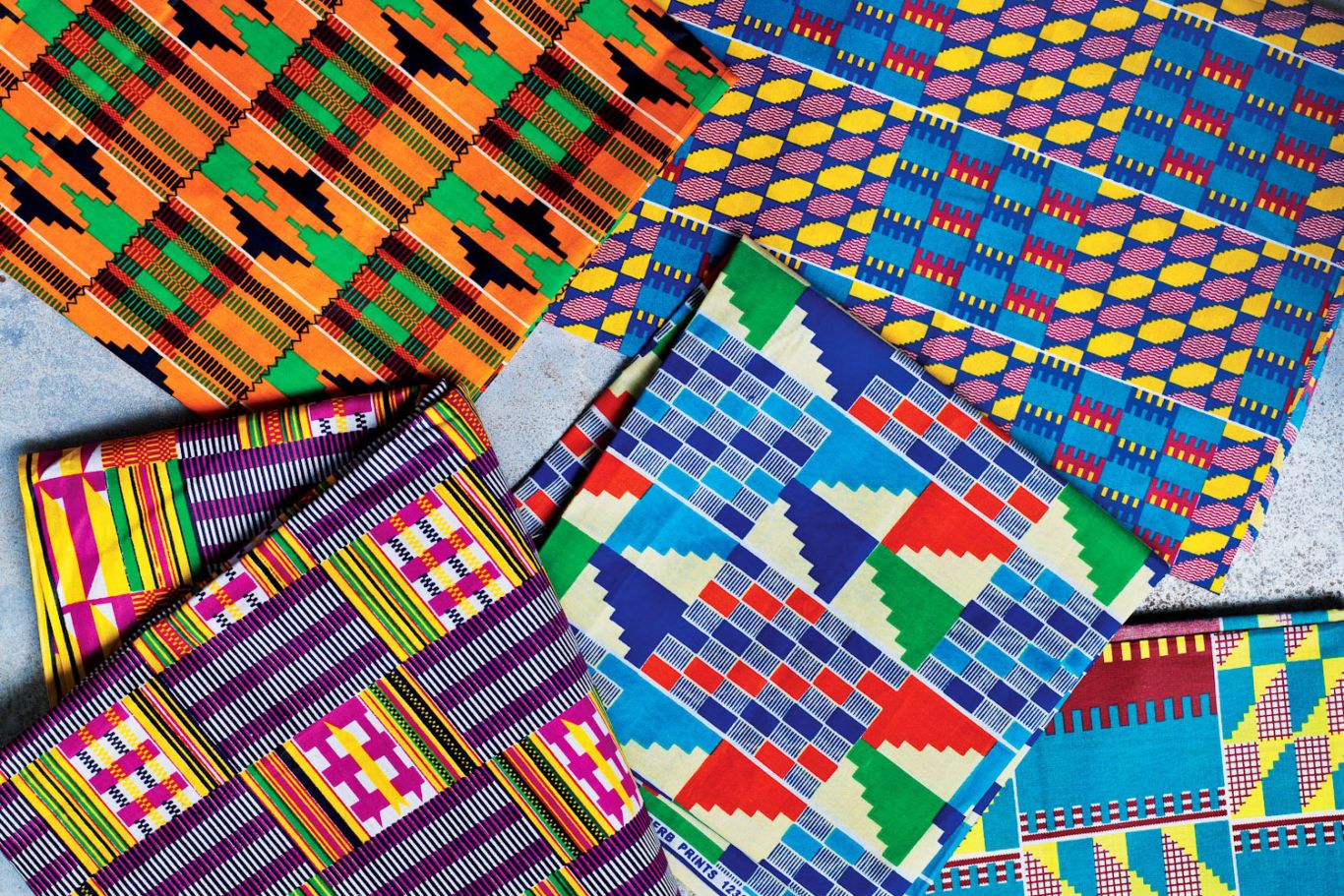
Ghana is a land of vibrant colours, and they all have an interesting story to tell in its wonderful Kente cloth. Words Eugene Yiga. Photography Chris Court. Styling Louise Marshall.
Red. Yellow. Green. If you look at maps of African countries, these three colours appear over and over again.
But what do they mean? “Each colour is there for a reason," our Ghana tour guide Elvis Wallace-Bruce explains of the colours, which are all represented in the Ghanaian flag, designed by Theodosia Salome Okoh and first adopted in 1957.
“The red represents the blood we shed in our struggle for independence, the gold represents the wealth from our industrial minerals, the green represents the rainforests and grasslands, and the five-pointed black star is the symbol of our people and African emancipation."
It’s much the same with the multicoloured Kente cloth, the most famous among various types of fabric produced by Ghana’s diverse ethnic groups.
The word itself comes from the Akan for ‘basket’ and the cloth originates from the Ashanti Kingdom, which dates back to the 17th century.
Popular folklore has it that the first cloth was made by two friends who, while on a hunting trip, were mesmerised by a spider spinning a web.
When they got home to their village of Bonwire, they decided to do something similar and the rest is history.
Fast-forward to the present and Bonwire is still the most famous place for weaving Kente cloth in Ghana, where it is now also woven by women as well as men, who were the traditional artisans.
The earliest Kente cloth was made from the black and white fibres of a raffia tree.
The Ashanti King was impressed but he believed that the fabric would be even more beautiful if it included different colours.
The raffia tree could only produce black and white threads so the weavers had to get creative when it came to adding different shades.
One of them decided to use the seeds and bark from local trees.
After shaving off the bark and grinding the seeds, weavers would mix this all together and create dyes of yellow, green, and red.
That’s how these three colours became the traditional ones used in Kente cloth. Over time more colours were added, but each still has a specific meaning (see over the page for a guide to each colours’ traditional interpretations).
Initially, the Kente cloth was only meant to be donned by chiefs and kings, who would wear it to grand festivals. But even as time passed and more people embraced the fabric, it was typically worn for sacred and ceremonial events, much like Western cultures use tuxedos and evening gowns.
And even as Kente cloth has spread across West Africa, and the rest of the world, its status remains high.
Increasingly made from rayon and cotton, it’s common to see people wearing Kente in Ghana on a day-to-day basis; not just as clothing but also as bags, sandals and hats.
But while the fabric has infused new trends, many of the original patterns are still a strong feature.
Where to get your fashion fix
With a heritage dating back more than 170 years, Vlisco is one of Africa’s oldest fashion companies. Since 1846, it’s produced thousands of different fabrics.
More recently, and in line with the belief that each fabric tells a different story, it’s documenting the tales online at vlisco.com.
One of Vlisco’s most popular brands in the mid- to high-end market is Woodin.
With more than 30 years of trading and retail stores spread over eight African countries, it’s making a mark across the continent and beyond.
As one of the first brands to offer a contemporary and wholly African fashion range for savvy individuals, Woodin sells limited edition fabrics, ready-to-wear outfits, and fashionable accessories.
It believes in constantly evolving, with unique designs arriving in store every few weeks.
It’s about embracing new patterns and styles in order to define a new African fashion identity.
Besides these two, there are several places where you can buy Kente in Ghana, including markets like AACD African Market, Makola, and Keneshie in the capital of Accra.
But when buying Kente cloth, it’s important to make sure you’re getting the real deal.
Authentic fabrics are 100 per cent hand-woven, which means the thread will be consistent on both sides; imitation cloth is printed so the opposite side may show a different colour or none at all.
It’s also important to realise that when shopping at markets, whatever price you’re quoted is just a guide.
Start by presenting a counter offer that is a third or even a half of what the vendor states.
Then you can negotiate back and forth until you reach a happy agreement somewhere in the middle.
The effort will be well worth it.
Kente colours and meanings
Gold – Royalty, wealth, high status, glory and spiritual purity.
Silver – Serenity, purity, joy; associated with the moon.
Grey – Healing and cleansing rituals.
Black – Maturation and intensified spiritual energy.
White – Purification, sanctification rites and festive occasions.
Yellow – Preciousness, royalty, wealth, fertility and beauty.
Red – Political and spiritual moods; bloodshed; sacrificial rites and death.
Pink – Associated with the female essence of life; a mild, gentle aspect of red.
Purple – Associated with feminine aspects of life; usually worn by women.
Maroon – The colour of Mother Earth; associated with healing.
Green – Vegetation, planting, harvesting, growth and spiritual renewal.
Blue – Peacefulness, harmony and love.
Weekly travel news, experiences
insider tips, offers, and more.
Going to Ghana
What you need
Visitors to Ghana must get a visa from a Ghanaian embassy or high commission. The application process takes around two weeks.
You also need to produce a yellow fever vaccination certificate and take the necessary precautions for malaria.
Where to stay
To book a room or suite at the Labadi Beach Hotel, call +233 30 277 3029 or go to legacyhotels.co.za/en/hotels/labadi
Where to go
There are many places in Accra that are full of stories, including a restaurant in an airplane, a theatre that looks like a ship, and a presidential home that looks like a hut.
Indeed, it seems like every street (especially the roundabouts) has a story behind its name. But if you’re looking for one of the best stories, go to the Kwame Nkrumah Memorial Park.
This site honours the man who was elected as the country’s first ever president in 1960, who promoted the idea of Pan-Africanism, and helped create the Non-Aligned Movement.
“We face neither East nor West," he once said.
“We face forward."
And, as is evident from his pointing statue, it’s a clear sign that Ghana’s definitely heading in the right direction!
Want to see more stories from International Traveller in your Google search results?
- Click here to set International Traveller as a preferred source.
- Tick the box next to "International Traveller". That's it.